Unit 4: Benefit Plan Programs
2.4 Baby Blueprints®
Baby Blueprints® is a maternity education and support program available to expectant Highmark members. This free program is designed to help expectant families better understand and enjoy every stage of pregnancy and make more informed care and lifestyle decisions.
Baby Blueprints offers expectant Highmark members educational information on all aspects of pregnancy through online resources during each trimester of pregnancy. Topics include prenatal care, proper use of medications, avoiding alcohol and tobacco, working, travel considerations, nutrition and weight gain, exercise, body changes, and many others.
Baby Blueprints will also provide program participants access to individualized support from a Maternity Wellness Coach. Providers are encouraged to promote patient enrollment to reinforce medical care and maternity information so that pregnant women may “have a greater hand in their health.”
Baby Blueprints is available to expectant Highmark members enrolled in a commercial group product, direct pay product, or social mission product.
Baby Blueprints is not available for members enrolled in a Medicare/Medicare Advantage product, Federal Employee Program (FEP), or any self-funded employer groups that have opted out. Enrollment in Baby Blueprints is simple and convenient. Expectant members can enroll at no cost over the phone by calling toll free 866-918-5267.
If members have further questions about Baby Blueprints, encourage them to call Member Services.
2.4 24/7 Nurse Advice Line (Blues On Call)
Blues On Call is a 24/7 Nurse Advice Line, which provides telephonic support for Highmark members, connecting members with registered nurses to get free, confidential advice on medical conditions, symptoms, treatments, medications, and health management. This resource is available to help members make informed decisions and navigate the health care system anytime, day or night.
Most Highmark members are automatically eligible to make use of Blues On Call services. No registration is required and the service is free.
Blues On Call does not:
- Address benefit issues
- Address claims issues
- Provide diagnosis or medical advice
Encourage your patient to call the Blues On Call phone line: 888-BLUE-428 (888-258-3428)
2.4 Diabetes Prevention Program
Certain Highmark members have access to a diabetes prevention program as part of their Highmark preventive benefits schedule. Self-funded employer groups may choose to opt out of the program.
The program is available to Highmark members who have coverage under their preventive benefits and meet the program’s eligibility criteria. Eligible members can choose between attending in-person classes in the community or an option with online classes and support.
Note: The program is effective for State of Delaware employees with coverage under a State of Delaware Group Health Insurance Program administered by Highmark Delaware.
What is the Diabetes Prevention Program?
The Diabetes Prevention Program (DPP) is a structured lifestyle and health behavior change program with the goal of preventing the onset of type 2 diabetes in individuals who are prediabetic. The program is certified by the Centers for Disease Control and Prevention (CDC). The 12-month program includes:
- Choice of an in-person classroom setting or an online/mobile app program
- 16 “core” sessions
- Monthly follow-up meetings
The program’s primary goal is to attain at least 5% average weight loss among participants. According to the CDC, losing 5% of your weight can help prevent diabetes.
Members can choose either an in-person classroom program or a virtual program.
Program Eligibility Criteria
Once members select a program, the vendor will confirm their eligibility prior to offering program enrollment. Eligible members must be at least 18 years of age and meet the following requirements:
- Body Mass Index (BMI) of 25 or greater
- No previous diagnosis of type 1 or type 2 diabetes
- Not be pregnant
To be eligible, members must also meet one of the following requirements:
- Receive a high-risk result (score of five or higher) on the CDC Prediabetes Risk Test found on the CDC’s National Diabetes Prevention Program website
- Had a blood test result in the prediabetes range within the past year:
- Hemoglobin A1C between 5.7% – 6.4%
- Fasting blood glucose of 100 – 125 mg/dL
- Two-hour blood glucose (after a 75g glucose load) of 140 – 149 mg/dL
- Be previously diagnosed with gestational diabetes (diabetes during pregnancy)
YMCA’S Classroom Program
The YMCA Diabetes Prevention Program provides a supportive environment where participants work together in a small group to learn about healthier eating and increasing their physical activity in order to reduce their risk for developing diabetes. The program is led by a trained Lifestyle Coach in a classroom setting over a 12-month period, beginning with 16 weekly sessions followed by monthly maintenance. The program is offered at select YMCA locations.
Under the YMCA in-person classroom program, the benefits/services include:
- Member attends structured sessions at an on-site location
- Led by a trained Lifestyle Coach
- Year-long program of 25 sessions
- Food, weight, and activity tracking
- Peer support and accountability
- CDC-approved curriculum
Noom: Weight Management
Noom is a leading digital health care company committed to chronic disease prevention and weight loss solutions through lifestyle change and behavior modification. Earning the highest CDC recognition (Full Plus recognition) for a diabetes prevention program, Noom offers an app-based, fully virtual 12-month diabetes prevention program consisting of personalized coaching, tracking tools, and peer support.
The benefits/services for eligible Highmark members include:
- Mobile apps include food, weight, and activity tracking
- CDC-approved Full Plus recognition curriculum
- Daily, “bite-sized” lessons designed to build lasting habits
- One-on-one lifestyle coaching support
- Peer support and online community platform
- Wireless scale earned through sustained engagement
- Note: Currently available for ASO clients only.
Verify Program Eligibility Via Availity®
Providers can verify a member’s coverage for the Diabetes Prevention Program in Availity’s Eligibility and Benefits Inquiry by selecting Additional Benefit Notes.
2.4 Health Promotion Programs
Health promotion and risk reduction are part of the overall health management program. Highmark’s Health Engagement Operations (HEO) department offers a variety of condition management, case management, and wellness programs. Services and programs are offered digitally, at the workplace, and telephonically.
Programs are designed to raise member awareness of healthy versus unhealthy habits, make healthy choices, reduce risk of injury, and help members with an acute or chronic condition. The health promotion activities focus on three key areas:
- Health Assessment
- Worksite Health Promotion Programs
- Lifestyle Improvement Programs

Highmark Blue Cross Blue Shield (WNY) and Highmark Blue Shield (NENY) are committed to helping our members take an active role in achieving and maintaining good health. That's why we offer health and wellness programs. These programs support your efforts to keep our members healthy by providing them with coverage benefits for health promotion and education services.
Members are more likely to attend health and wellness programs if they receive encouragement from their physicians or other providers, and we invite providers to encourage their patients to participate in the programs.
Highmark Blue Cross Blue Shield (WNY) and Highmark Blue Shield (NENY) have an extensive network of credentialed providers offering health education programs. Patients do not require a referral or written approval for most approved programs.
Programs are currently offered in the following categories:
- Diabetes education
- Maternal and infant health nutrition
- Physical activity
- Smoking cessation
- Stress management
- Weight management
We also offer programs on topics such as AIDS/HIV, children and adolescent health, arthritis, cancer information, holistic health, substance abuse, senior health, women's health, asthma, heart health, and a variety of support groups.
We encourage our members to take a variety of programs in order to enhance their overall wellness. Programs of similar topics (stress management, diabetes education, nutrition etc.) are limited to one class/program per year with the exception of fitness programs (Pilates, yoga, spinning), which are limited to two programs each year. Maternal and infant health programs are unlimited.
To register, members should contact the health and wellness program provider directly. Members are able to verify program eligibility by calling the customer service number on the back of their identification card.
Digital Resources – All Providers
Digital resources are available to Commercial, Affordable Care Act (ACA), and individual medically insured members, as well as Medicare Advantage and Medigap members. See the Reference Guide of Highmark Member Programs for more information.
Worksite Programs
Worksite programs are offered as an optional service to employers wishing to promote a healthy culture among their employees through awareness, education, and activities to encourage engagement.
Services that encourage awareness include on-site biometric screenings. Education services may include individual coaching in conjunction with the biometric screening experience and online resources. Engagement is encouraged through a variety of "Reward" and “Challenge” programs that track participation for incentive purposes.
Case and Disease Management Model
Highmark's Health Engagement Operations team serves as a catalyst to improve health outcomes for our members. Our multidisciplinary team orchestrates a comprehensive suite of programs and support, including case and disease management, behavioral health, social work, pharmacy, wellness, member engagement guides, and business operations strategy. These are not just isolated services, but a coordinated effort to address whole-person health.
Highmark's multidisciplinary clinical team focuses on the holistic care of the member to better manage their overall health using a disease-agnostic, whole-person care approach.
Key strengths include:
- Holistic, whole-person care: The program focuses on the member's overall health, not just specific diseases, addressing their physical, mental, and social well-being. This is a significant differentiator.
- Omnichannel approach: The use of multiple communication channels (phone calls, text messaging, 24/7 Nurse Advice Line) ensures members can be reached regardless of their communication preferences. This significantly improves accessibility and engagement.
- Targeted outreach: Outbound calls prioritize members with the greatest need, maximizing the impact of the program's resources.
- Integrated multidisciplinary team: Access to behavioral health specialists, pharmacists, dietitians, and wellness coaches provides comprehensive support addressing various aspects of a member's health.
- Access to virtual care and condition management programs: Members can choose from multiple virtual care and condition-specific management programs, offering a range of support options based on individual needs.
Comorbidities Addressed
The case managers address comorbidities that many seriously ill individuals face. The Case and Disease Management Model uses motivational interviewing and coaching techniques, and focuses on the whole person. These techniques allow the case managers to address the member's full spectrum of health care issues rather than focusing on a single issue or condition.
Enrollment Time Period
The time period a member is enrolled in a condition management program varies and is specific to the member's needs. The case managers assist the member in developing care goals whose focus is member self-management. Cases are considered "open" when the member agrees to work with a nurse case manager to identify health condition-related goals and review progress toward these mutually agreed-upon goals regularly.
Once identified for case management, the member’s case will remain in an open status as long as there are health improvement opportunities that have not been addressed and the member remains engaged and participating in the program.
Cases are "closed" when the member and their nurse case manager agree that identified goals have been achieved or the member declines continued participation.
Members are encouraged to re-engage with the case managers at any time that their clinical condition requires, or when they simply want the additional support of the case managers to work toward attainment of their goals.
2.4 Health Spending Accounts
Highmark offers the following health spending account options to respond to those needs:
- Health Savings Accounts (HSAs)
- Health Reimbursement Accounts (HRAs)
- Flexible Spending Accounts (FSAs) including Limited Purpose FSA and Dependent Care FSA
- Commuter Accounts including Parking and Transportation
Health spending accounts help Highmark members save money to cover their out-of-pocket medical costs, to better manage their health-related expenses, and offers significant tax savings. Members are able to track all of their health care spending online at their secure Highmark member website.
Direct Payment to Provider
If a member’s health spending account is set up for “Direct Payment to Provider” and money is available in the account, you will receive a separate payment (check or Electronic Funds Transfer, or EFT) and notice (known as an Explanation of Payment, or EOP) for claims paid under a member’s spending account.
If the member’s HSA, HRA, or FSA does not have sufficient funds for the entire amount due, you will receive whatever amount is available in the account. You can then bill the member directly for the remaining balance due. As subsequent deposits are made and additional funds become available in the account, the remaining portion of the payment will be distributed to the member.
Explanation of Payment (EOP)
Whenever a full or partial payment is made to you from a member’s health spending account, you and the member will receive an EOP to document the transaction. Availity-enabled providers will receive their EOPs via the Availity Remittance Viewer function. These are also available in PNC’s ECHO Health platform.
This Direct Payment to Provider option from a member’s health spending account does not eliminate your ability to collect patient liability, such as copayments or other outstanding balances, due at the time of service. Highmark provides “Real-Time” tools, accessed via Availity, that help providers determine member responsibility prior to or at the time of services.
- The Patient Cost Estimator function can assist you in estimating the member’s financial responsibility, including any deductible, coinsurance, and/or copayments included in the member’s plan benefits.
- The Claims and Encounters function gives providers the added ability to submit claims for specific health care services and may receive a fully adjudicated response within seconds. This allows providers to determine, at the time of service, the correct amount the member owes.
These real-time estimation and adjudication tools provide immediate responses and give providers the ability to discuss member financial liability with patients when services are scheduled or provided. They also enable providers to collect payment or make payment arrangements for the member’s share of the cost at the time of service. Please note, however, that if you collected payment upfront for member liability, and subsequently receive payment from the member’s health spending account, the refund must be issued directly to the member.
Note: Real-time transactions are accurate at the time of viewing or request. The member’s liability status could change by the time your claim is adjudicated based on claims received but not yet processed, additional services received prior to the adjudication of your claim, or if services rendered are different than those estimated.
For additional information about the Real-Time Tools available via Availity, see the Highmark Provider Manual's Chapter 1, Unit 3: Electronic Solutions – EDI and Availity.
Spending Account Inquiries
For spending account questions or issues in, contact the dedicated Provider Spending Account Information Line:
- Delaware: 800-346-6262
- New York: 844-945-5507
- Pennsylvania and West Virginia: 800-652-9478
Refund Checks for HSA, HRA, and FSA Overpayments
If you receive an overpayment from a member’s HSA, HRA, or FSA, it will be necessary for you to submit this overpayment back to Highmark at the applicable postal address below. Please do not send any overpayments directly to the member. Highmark will ensure that the proper monies are deposited back into the member’s account.
|
Delaware |
New York |
Pennsylvania and West Virginia |
|---|---|---|
|
Attention: Treasury |
Highmark New York |
Attention: Cashier |
2.4 Disclaimers
The following entities, which serve the noted regions, are independent licensees of the Blue Cross Blue Shield Association: Western and Northeastern PA: Highmark Inc. d/b/a Highmark Blue Cross Blue Shield, Highmark Choice Company, Highmark Health Insurance Company, Highmark Coverage Advantage Inc., Highmark Benefits Group Inc., First Priority Health, First Priority Life, Highmark Care Benefits Inc., or Highmark Senior Health Company. Central and Southeastern PA: Highmark Inc. d/b/a Highmark Blue Shield, Highmark Benefits Group Inc., Highmark Health Insurance Company, Highmark Choice Company or Highmark Senior Health Company. Delaware: Highmark BCBSD Inc. d/b/a Highmark Blue Cross Blue Shield. West Virginia: Highmark West Virginia Inc. d/b/a Highmark Blue Cross Blue Shield, Highmark Health Insurance Company or Highmark Senior Solutions Company. Western NY: Highmark Western and Northeastern New York Inc. d/b/a Highmark Blue Cross Blue Shield. Northeastern NY: Highmark Western and Northeastern New York Inc. d/b/a Highmark Blue Shield.
All references to “Highmark” in this document are references to the Highmark company that is providing the member’s health benefits or health benefit administration and/or to one or more of its affiliated Blue companies.
All revisions to this Highmark Provider Manual (the “manual” or “Highmark Provider Manual”) are controlled electronically. All paper copies and screen prints are considered uncontrolled and should not be relied upon for any purpose.
Unit 5: Telemedicine Services
2.5 Introduction to Telemedicine
2.5 Prescribing Protocol for Telemedicine Services
2.5 Services Provided by Well360 Virtual Health and Approved Telemedicine Vendors
2.5 Virtual Outpatient Office Visits
2.5 Outpatient Virtual Mental Health/Substance Abuse (Substance Use Disorder)
Many factors can make it difficult for patients to get appropriate medical care when they need it — geography, weather, availability of specialists, transportation, and others. With advancements in technology that allow for communications and information exchange at a distance, the telemedicine field is evolving rapidly to meet the needs of the patient community.
Telemedicine includes a growing variety of applications and services using two-way forms of telecommunications technology. The use of this technology is now becoming integrated into the ongoing operations of hospitals, specialty departments, and physician offices. For both providers and patients, telemedicine can play a significant role in facing the challenges of maintaining or improving health care outcomes while reducing costs.
Some of the most important benefits of telemedicine include accessibility and flexibility for the patient community. With the mounting shortage of physicians, especially for primary care, telemedicine offers patients the convenience of connecting with medical professionals more easily when traveling, pressed for time, unable to take time off from work or school, or not able to drive long distances to see their health care provider.
What is Telemedicine?
Telemedicine is defined as the exchange of medical information between sites via electronic communication for transmitting clinical information for diagnostic, monitoring, and therapeutic purposes. The term “telehealth” is often used in conjunction with telemedicine and is intended to include a broader range of services using telecommunication technologies, including videoconferencing. These terms are often used interchangeably.
Telemedicine is revolutionizing health care by bringing medical services directly to patients, regardless of their location. It utilizes technology like video conferencing, mobile apps, and remote monitoring devices to connect patients with health care providers. This allows for a wide range of services, from virtual consultations and diagnosis to remote monitoring and even surgery.
Highmark is committed to expanding access to quality care for our members and providing new options for more timely and convenient access to meet their needs. In our efforts to expand services and coverage to more members, we are providing telemedicine coverage options through:
- Well360 Virtual Health offers services provided by our approved telemedicine vendors via real-time interactive audio and video telecommunications technology. These vendors provide access to a national network of board-certified physicians.
- Benefit enhancements that provide coverage for “virtual visits” with our members’ trusted network providers using telecommunications technology.
- Highmark Commercial and Medicare Advantage plans follow the Centers for Medicaid and Medicare Services (CMS) guidelines for telemedicine visit coverage and reimbursement. Only the codes identified by CMS as appropriate for telemedicine services will be reimbursed by Highmark for Commercial Medicare Advantage members.
Highmark expects contracted providers to render telemedicine services in compliance with applicable laws and regulations. Providers who have questions about laws applicable to the practice of telehealth and telemedicine should consult with their attorney to ensure they are compliant with requirements appliable to their practice.
Reimbursement Policy 046
For information on billing and reimbursement for commercial and Medicare Advantage products, see:
Highmark Reimbursement Policy RP-046: Telemedicine and Telehealth Services.
This policy includes complete guidelines for both professional and facility billing requirements for reimbursement, including the use of Place of Service code 02 or code 10 on all professional telehealth claims and the modifiers needed for both professional and facility claims.
Reimbursement policies are available on the Provider Resource Center under Claims > Reimbursement Programs > Reimbursement Policies.
The standard of care applicable to an in-person patient encounter also applies to a virtual patient encounter. Telemedicine consultations and treatment, including the authorization and dispensing of prescription medication(s), must be held to the same professional standards of appropriate medical practice as traditional in- person patient encounters.
Prior to issuing prescriptions via telemedicine, providers must ensure that a provider-patient relationship is established and documented in the member's file. A proper “provider-patient relationship” may be established when the provider (physician/practitioner) obtains all relevant medical history and conducts an appropriate evaluation to establish a diagnosis(es) and identify underlying conditions or contraindications to recommended treatment.
A valid provider-patient relationship may be established using telemedicine technologies provided the appropriate standard of care is met and all applicable state and federal statutes and regulations are followed. The services to establish the provider-patient relationship during the initial encounter, as described above, must take place through an interactive audio telecommunications system consistent with applicable federal and state requirements, Audio-only encounters may be used when permitted under applicable CMS, federal, or state regulations.
Providers should give careful consideration in determining whether an in-person office visit for the initial visit would be beneficial in establishing a provider-patient relationship based on the member’s presenting condition(s). While some situations are appropriate for using telemedicine technologies for member care in lieu of the traditional in-person office visit, others are not.
Methods That Are Not Acceptable
A provider-patient relationship may not be established through, but not limited to, the following:
- Internet questionnaires;
- Social media;
- Email messages;
- Patient-generated medical history;
- Text messages;
- Facsimile (fax) machine; or
- Any combination of the above.
These do not constitute acceptable standard of care and prescriptions cannot be issued to Highmark members when a provider seeks to establish a provider-patient relationship with the member based solely on these methods.
The following guidelines apply when using telemedicine technology to issue prescriptions to Highmark members:
- Prior to issuing a prescription, all relevant information that shows that a provider-patient relationship has been established (e.g., patient demographic information, chief complaint, history of present illness, allergies, medications, past medical and surgical history, family and social history, etc.) must be documented and maintained in the member’s medical record as required with in-person diagnosis and treatment services.
- If state law requires an in-person examination prior to the delivery of telemedicine services, the in-person services must be concluded and documented in the member’s medical record prior to the initiation of any related telehealth visits and issuance of prescriptions.
- For situations in which the standard of care requires an in-person examination in order to establish a diagnosis and determine recommended treatment, the in-person examination must be performed and documented in the member’s medical record prior to issuing a prescription via telemedicine.
- If allowable per state regulations, a provider without an established provider-patient relationship may issue a prescription via telemedicine if the prescribing provider is:
- Consulting at the request of another practitioner who maintains an ongoing relationship with the member;
- The other practitioner has performed an in-person physical examination of the member; and
- The other practitioner agrees to supervise the member’s ongoing care and use of the prescribed medications.
All federal and state prescribing statutes and regulations, including any limitations on prescribing and dispensing controlled substances, must be adhered to in prescribing through telemedicine technology.
American Well™ (Amwell) is the Highmark-approved vendor for Well360 Virtual Health, Highmark’s virtual care solution.
Effective Jan. 1, 2022, Highmark introduced a long-term virtual health platform, Well360 Virtual Health. To support our Well360 Virtual Health platform, we chose Amwell as our vendor solution, with Highmark and Amwell both sharing a goal of offering the ultimate member experience for virtual urgent care, primary care, dermatology, and women’s health.
Well360 Virtual Health is easy to access and navigate when members need convenient, real-time virtual urgent care visits.
Important: Teladoc will still continue to be available to some ASO (Administrative Services Only) clients.
Services Provided by Well360 Virtual Health
Well360 Virtual Health provides national coverage by certified providers via real-time interactive video and audio telecommunications technology. If members use Well360 Virtual Health for any of the following treatments, member cost sharing applies and can vary in the form of a copay or subject to network deductible and/or coinsurance as per their benefits:
- 24/7/365 Urgent Care: Urgent-type care, such as, but not limited to the following: cough, sinus infection, sore throat, vomiting, diarrhea, fever, pinkeye, flu/cold, headache. These practitioners belong to nationwide networks of licensed, board-certified physicians, including family practitioners, internists, and pediatricians for acute care for minor illness.
- See member's On-Demand Telemedicine Service benefit.
- Virtual Primary Care: The Virtual Primary Care solution connects members to virtual primary care doctors, providing easy and fast access to care. Primary care visits are scheduled visits with the member’s virtual PCP. Pediatricians are available servicing children 12 and older. Primary Care appointments can typically be scheduled within seven days or less. Services include both medically necessary office visits and routine physical exams.
- See member’s PCP/Physician Office Visit benefit.
- Dermatology: The dermatology solution virtually connects a member to a dermatologist. This is done by secure asynchronous* capabilities which allow for more convenient skin examinations and faster turnaround times compared to in-person dermatology visits.
- See member’s Specialist Office Visit benefit.
- Women’s Health: Women’s Health provides services for women by providers who specialize in women’s care. Women’s Health service consists of three different services offered on the platform – Women’s Health Medical Care (16+ years), Women’s Health Therapy (10+ years) and Women’s Health Lactation Consulting (16+ years).
- See member’s On-Demand Telemedicine Service, Outpatient Mental Health, and Preventive Adult Care benefit.
- *Women’s Health Therapy is only available to ASO clients who opt into Virtual Health Enhanced Services.
All vendors operate in accordance with state laws and regulations, and their providers are licensed to practice in the state in which the member is located. Members must have the benefit associated with the service line to obtain these services from Well360 Virtual Health.
Important: Well360 Virtual Health consists of providers within the Amwell Medical Group (AMG).
Each Well360 Virtual Health service line is housed within a member’s benefits. Urgent care within the On-Demand Telemedicine Service Benefit, Primary Care under PCP/Physician Office Visit, Dermatology under Specialist Office visit, and Women’s Health (Medical Care under On-Demand Telemedicine Service, Therapy under Outpatient Mental Health, and Lactation under Preventive Adult Care).
For More Information
To learn more about Amwell, visit amwell.com.
Attention: Providers Using the Amwell Technology Platform for Their Private Practices
If you contract with American Well to provide an online virtual visit option for your patients using the Amwell technology platform, the agreement includes 24/7 support provided by Amwell’s nationwide provider network, the “Online Care Group,” whenever you/your staff are not available. Keep in mind that Highmark member benefits may vary depending on who is actually performing the services:
- If you provide Virtual Outpatient Office Visits to Highmark members, the services are eligible under the Highmark member’s Office Visit benefits.
- If primary care services are provided to a Highmark member by an Amwell Online Care Group provider, they are eligible under a Highmark member’s On-Demand Telemedicine Service benefit, if applicable.
As a result, the Highmark member’s cost-sharing may vary depending on which provider performs the service — you or the Online Care Group. In addition, if the member does not have the On-Demand Telemedicine Service benefit, as well as other benefits (see above), the services would not be covered when provided by an Online Care Group provider.
In your discussions with Amwell, confirm that it will be clear to your patients who is providing care when they sign on for an online visit — you or the Online Care Group. In addition, educate your patients about your online access and availability, and ensure that your Highmark patients understand that their benefits/cost-sharing could differ if care is provided by the Online Care Group when you are not available.
Attention: Behavioral Health Providers
Virtual Behavioral Health visits, whether provided by you or by an Online Care Group provider, are subject to cost-sharing under the member’s Outpatient Mental Health benefit; therefore, the member’s cost-sharing is the same for services provided by you or by the Online Care Group.
For More Information on Other Telemedicine Services
See the applicable sections of this unit for more information on Highmark’s benefit enhancements that provide coverage for Virtual Outpatient Office Visits and Virtual Behavioral Health/Substance Abuse (Substance Use Disorder).
Virtual Visits provide our network participating providers with the option of delivering services to our members via real-time interactive audio and video telecommunications, or “telemedicine,” when appropriate. Telemedicine enables providers to extend their reach and improve their efficiency and effectiveness while still maintaining high quality care and attention to patient safety.
Virtual Visits are the remote delivery of outpatient services through the use of secure real-time interactive audio and video telecommunications technology. A patient can participate in a virtual visit with a provider from the privacy of their own home, office, or other private setting.
Why Virtual Outpatient Visits?
Virtual Visits can provide expanded access to services, more efficient delivery of services, and also potential cost savings.
- Access to care can be increased for all members — especially for individuals with multiple chronic health conditions, those with severe illness and disability, and underserved populations in rural and remote areas.
- Virtual visits are a cost-effective way to engage with patients and deliver care anywhere, anytime, while reducing administrative costs for the provider and travel costs for the patient.
- Virtual Visits can be used to triage cases and help reduce emergency room visits and hospitalizations by diverting members to less costly forms of care.
Originating and Distant Sites
The “originating site” is the location of an eligible member at the time the evaluation or consultation service is being provided via a virtual visit. The originating site can be either a medical site (e.g., PCP’s office, outpatient facility) or a non-medical site (e.g., member’s home or office) and is connected to a performing provider at a “distant site" (i.e., the performing provider’s physical location).
The virtual visit benefit provides coverage for the services of the performing provider at the distant site and also for an access fee billed by the medical originating site where the patient is located, when applicable.
Eligible Providers
Highmark participating providers who have the required telecommunications technology to support Virtual Visits are eligible. The services performed must fall under the scope of the provider’s license, and the sessions must be conducted following Highmark’s service and security guidelines.
Providing Virtual Visits for Highmark members is optional and not a requirement of network providers.
Member Eligibility
Virtual Visits are available to most Highmark members with individual health plans and employer group coverage, both fully and self-insured, that include benefits for Outpatient Office Visits. This is also available for Federal Employee Program (FEP) members.
Any member cost-sharing or visit limits under the Outpatient Office Visit benefit would apply. For example, if a member’s benefit has a copay for an office visit, then the copay would be applied to Virtual Visits.
Consult coverage materials to determine eligibility for Medicare Advantage and Medicare Supplemental plans.
Reminder: Always Verify Benefits
Providers are reminded to always verify a member’s eligibility and benefits prior to rendering services. It is the provider’s responsibility to confirm that the member’s benefit plan provides the appropriate benefits for the anticipated date of service. You can verify benefits electronically quickly and easily via Availity’s Eligibility and Benefits Inquiry or by submitting a HIPAA 270 transaction.
In Availity, use Additional Benefit Notes in Eligibility and Benefits Response.
If the member has coverage for Virtual Outpatient Office Visits, the benefit category will indicate "Virtual Visits – Yes."
Important: On-Demand Telemedicine Service Benefit Category is for Well360 Virtual Health and Teladoc Services Only.
Virtual Visits are a service delivery option provided to our members under the Outpatient Office Visit benefits. They are separate from the services provided by our approved telemedicine vendors — Amwell and Teladoc, which are independent companies that provide online medical consultation services for patients through their network of practitioners.
In Availity's Eligibility and Benefits Inquiry, the “Telemedicine Service” benefit category under Professional Services is an indicator for Well360 Virtual Health and Teladoc services only. It does not indicate a member’s eligibility for Virtual Visits. For more information on the services these vendors provide for Highmark members, see the section in this unit titled Services Provided by Well360 Virtual Health and Approved Vendors.
Note: Highmark partners with Amwell to deliver Well360 Virtual Health, Highmark’s virtual care solution.
Technology Requirements
The Virtual Visits must take place via real-time audio and video telecommunications. Interactive telecommunications technology must be multi-media communication that, at a minimum, includes audio and video equipment permitting real-time consultation among the patient location and provider location.
The provider must ensure that the aesthetic quality of the consultation is comparable to that of an in-person consultation (i.e., proper lighting, camera positioning, network connection, etc.). The provider’s monitor resolution (matrix) must be a minimum of 512x512 at 8-bit pixel depth.
The technology needed by the member will be driven by the technology platform that the provider uses to conduct this service. Members can be at any location that they choose that is conducive for Virtual Visits, provided the member has access to both audio and video streaming technology. The member should be in a location that is private and away from distractions.
Security Guidelines
Virtual Visits must be conducted through real-time interactive audio and video telecommunications hardware and software that are HIPAA (Health Insurance Portability and Accountability Act) and HITECH (Health Information Technology for Economic and Clinical Health Act) compliant.
Highmark supports the highest standards to protect the confidentiality of our members’ information, but there may be risks in passing personal health information (PHI) virtually. Highmark is not responsible for the security of virtual visits and does not validate the safeguards of any equipment and software used on either side of the virtual transmission.
Guidelines for Providing Services
Virtual Visits are not intended to replace in-person visits and support; it is another care delivery option that can be used by primary care providers if they choose. The provider can make the determination whether Virtual Visits are the right course of treatment for their patients. If you offer Virtual Visits but feel that it will not be the most effective approach for a patient, then you may refuse to see the patient virtually.
Virtual Visits can be conducted for initial, follow-up, or maintenance care; however, providers should give careful consideration in determining whether an in-person office visit for the initial visit would be beneficial in establishing a doctor-patient relationship.
Requirements
The following guidelines must be followed when conducting Virtual Visits:
- Telemedicine can be delivered via a real-time 2-way audio-only conversation in Delaware (DE), New York (NY), Pennsylvania (PA), and West Virginia (WV) – but in DE and NY, the patient must be unable to access the appropriate broadband service or other technology necessary to establish an audio and visual connection.
- All services provided must be medically necessary.
- Services performed must fall under the scope of the provider’s licensure.
- Providers shall comply with local, state, and federal laws and other regulatory agency requirements.
- Mechanisms to ensure continuity of care, follow-up, and referrals for emergency services must be in place and transparent to patients. Telemedicine treatment and consultations, including the authorization and dispensing of prescription medication(s), shall be held to the same professional standards of appropriate medical practice as those in a traditional in-office face-to-face encounter.
- The provider must take the appropriate steps to establish a doctor-patient relationship and conduct all appropriate evaluations and history consistent with traditional standards.
- The provider must obtain all relevant medical information (e.g., patient demographic information, chief complaint, history of present illness, allergies, medications, past medical/surgical/family history, and social history) prior to delivery of a medical diagnosis and treatment.
- Documentation of any visits using secure interactive audio and/or video telecommunications technology must be maintained in the patient’s medical record as required with in-person diagnosis and treatment services.
- When applicable, at a medical originating site, the medical examination of the patient at the originating site must be under the control of the specialty practitioner at the distant site.
- A designated room with appropriate equipment, including camera, lighting, transmission, and other needed electronics and the appropriate medical office amenities is established in both the medical originating site, when applicable, and the distant site.
Billing and Reimbursement
Claims for Virtual Visits are submitted based on how you are contracted with Highmark.
Reimbursement will be based on the plan allowance in place at the time services were rendered.
Member cost sharing (copay, deductible, and/or coinsurance) and visit limits apply if applicable.
For more information on billing and reimbursement, see Highmark Reimbursement Policy 046: Telemedicine and Telehealth Services. Reimbursement policies are available on the Provider Resource Center by hovering over Claims in the main menu and choosing Reimbursement Policies under Reimbursement Resources.
Reminder: Directing Care to Network Providers
Providers are reminded that members will receive the highest level of benefits when a provider is a participating Highmark network provider and, when applicable, is in the highest benefit tier. Depending on their benefit plan, some members may not receive coverage for services provided by an out-of-network provider or may be responsible for higher cost-sharing amounts for services provided by an out-of-network provider.
As a participating provider, you should direct members to other providers who participate in the network associated with the member’s benefit plan. If a recommended provider is not participating in the network associated with the member’s benefit plan, the member must be notified in advance that a non-participating provider is not obligated to follow Highmark contractual guidelines and services could result in higher out-of-pocket expenses for the member.
The demand for behavioral health/substance abuse (substance use disorder) services continues to steadily increase. However, telemedicine is now allowing behavioral health/substance abuse (substance use disorder) specialists to provide their expertise remotely, offering more flexibility. Highmark will reimburse mental health/substance abuse (substance use disorder) providers for outpatient care delivery via Virtual Behavioral Health/Substance Abuse (Substance Use Disorder).
What is Virtual Behavioral Health/Substance Abuse (Substance Use Disorder)?
Virtual behavioral health/substance abuse (substance use disorder) is the remote delivery of outpatient mental health/substance abuse (substance use disorder) services through the use of secure real-time interactive audio and video telecommunications technology. A patient can participate in a virtual visit with a behavioral health/substance abuse (substance use disorder) specialist from the privacy of their own home, office, or other private setting.
Why Virtual Behavioral Health/Substance Abuse (Substance Use Disorder)?
Virtual behavioral health/substance abuse (substance use disorder) is about more than just convenience — it is about members receiving the care that they need when they need it, or the care they are afraid to seek in person due to social stigma. It helps address barriers to access, stigma, and time constraints typically associated with mental health/substance abuse (substance use disorder) services. Virtual behavioral health/substance abuse (substance use disorder) can provide expanded access to services, more efficient delivery of services, and also potential cost savings.
- Access to mental health/substance abuse (substance use disorder) care can be increased for all patients but especially for individuals with multiple chronic health conditions, those with severe illness and disability, and underserved populations in rural and remote areas.
- Virtual visits can provide added comfort to patients who otherwise might be fearful and resistant to meet face-to-face in a clinic.
- Counseling and intervention services can be delivered more quickly via teleconferencing sessions versus on-site appointments that may take longer to arrange.
- Virtual visits are a cost-effective way to engage with patients and deliver care anywhere, anytime while reducing administrative costs for the provider and travel costs for the patient.
- Virtual behavioral health visits can be used to conduct psychiatric consultations to triage cases and help reduce emergency room visits and hospitalizations by diverting clients to less costly forms of care.
Eligible Providers
Any Highmark participating mental health/substance abuse (substance use disorder) provider who has the necessary telecommunications technology to support a virtual outpatient mental health/substance abuse (substance use disorder) visit may participate. The services performed must fall under the scope of the provider’s license, and the sessions must be conducted following Highmark’s recommended service and security guidelines. Providing virtual behavioral health/substance abuse (substance use disorder) visits for Highmark members is optional and not a requirement.
Member Eligibility
Virtual behavioral health/substance abuse (substance use disorder) is available to most Highmark members with individual health plans and employer group coverage, both fully and self-insured, that include an Outpatient Mental Health/Substance Abuse (Substance Use Disorder) benefit. Note: If a member’s group plan does not include or carves out mental health/substance abuse (substance use disorder) benefits to a vendor, then Highmark’s virtual behavioral health/substance abuse (substance use disorder) coverage would not apply to the member.
Any member cost-sharing under the Outpatient Mental Health/Substance Abuse (Substance Use Disorder) benefit would apply. For example, if a member’s benefit plan has a copay for an outpatient mental health visit, the copayment will apply to virtual mental health services.
Virtual behavioral health services are not available for members with Medicare supplemental plans.
Note: This is also available for Federal Employee Program (FEP) members.
Important: On-Demand Telemedicine Service Benefit Category is for Well360 Virtual Health and Teladoc Services Only
Virtual behavioral health/substance abuse (substance use disorder) is a service delivery option provided to our members under the Outpatient Mental Health benefit. It is separate from the services provided by our approved vendors — Amwell and Teladoc — under the On-Demand Telemedicine Service benefit. Amwell and Teladoc are independent companies that provide online medical consultation services for patients through their network of practitioners.
In Availity's Eligibility and Benefits Inquiry, the "Telemedicine Service" benefit category under Professional Services is an indicator for Well360 Virtual Health and Teladoc services only. It does not indicate a member’s eligibility for virtual behavioral health services. For more information on the services these vendors provide for Highmark members, see the section in this unit titled Services Provided by Well360 Virtual Health and Approved Telemedicine Vendors.
Note: Highmark partners with Amwell to deliver Well360 Virtual Health, Highmark’s virtual care solution.
Reminder: Always Verify Benefits
Providers are reminded to always verify a member’s eligibility and benefits prior to rendering services. It is the provider’s responsibility to confirm that the member’s benefit plan provides the appropriate benefits for the anticipated date of service. You can verify benefits electronically quickly and easily via Availity’s Eligibility and Benefits Inquiry or by submitting a HIPAA 270 transaction.
Technology Requirements
The virtual behavioral health/substance abuse (substance use disorder) visit must take place via real-time interactive video and audio telecommunications. Interactive telecommunications technology must be multi-media communication that, at a minimum, includes audio and video equipment permitting real-time consultation among the patient location and provider location.
The provider must ensure that the aesthetic quality of the consultation is comparable to that of an in-person consultation (i.e., proper lighting, camera positioning, network connection, etc.). The provider’s monitor resolution (matrix) must be a minimum of 512x512 at 8-bit pixel depth.
The technology needed by the member will be driven by the technology platform that the provider uses to conduct this service. Members can choose at any location that is conducive for virtual behavioral health/substance abuse (substance use disorder) visits, provided the member has access to both audio and video streaming technology. The member should be in a location that is private and away from distractions.
Security Guidelines
Virtual behavioral health/substance abuse (substance use disorder) visits must be conducted through real-time interactive audio and video telecommunications hardware and software that are HIPAA (Health Insurance Portability and Accountability Act) and HITECH (Health Information Technology for Economic and Clinical Health Act) compliant.
Highmark supports the highest standards to protect the confidentiality of our members’ information, but there may be risks in passing personal health information (PHI) virtually. Highmark is not responsible for the security of virtual visits and does not validate the safeguards of any of the equipment and software used on either side of the virtual transmittal.
Guidelines for Providing Services
Virtual visits are not intended to replace in-person visits and support; it is another care delivery option that can be used by mental health/substance abuse (substance use disorder) providers if they choose. The provider can make the determination whether a virtual behavioral health/substance abuse (substance use disorder) visit is the right course of treatment for their patients. The mental health/substance abuse (substance use disorder) provider must determine what channel of care is the best for their patient. If you offer virtual behavioral health/substance abuse (substance use disorder) services but feel that it will not be the most effective approach for a patient, then you may refuse to see the patient virtually.
Virtual behavioral health/substance abuse (substance use disorder) visits can be conducted for initial, follow-up, or maintenance care; however, providers should give careful consideration in determining whether an in-person office visit for the initial visit would be beneficial in establishing a doctor patient relationship.
The following guidelines must be followed when conducting virtual behavioral health/substance abuse (substance use disorder) visits:
Any telecommunications technology used must provide both audio and video streams that meet Highmark’s technology and security requirements.
- All services provided must be medically appropriate and necessary.
- Services performed must fall under the scope of the provider’s licensure.
- Providers shall comply with local, state, and federal laws and other regulatory agency requirements.
- Telemedicine treatment and consultations, including the authorization and dispensing of prescription medication(s), shall be held to the same professional standards of appropriate medical practice as those in a traditional in-office face-to-face encounter.
- The provider must take the appropriate steps to establish a doctor-patient relationship and conduct all appropriate evaluations and history consistent with traditional standards.
- The provider must have all the relevant medical information (e.g., patient demographic information, chief complaint, history of present illness, allergies, medications, past medical/surgical/family history, and social history) to deliver a competent medical diagnosis, treatment, and counseling plan.
- Documentation of the real-time interactive audio and video telecommunication relevant to the ongoing medical care of the patient should be maintained as part of the patient’s medical record.
- New York practitioners must provide Highmark current details on availability of their participating behavioral health/substance abuse (substance use disorder) services, including provider locations (city, town, and ZIP Code), for purposes of ensuring that Highmark at all times has the most current provider behavioral health/substance abuse (substance use disorder) service information.
Billing and Reimbursement
Reimbursement for virtual behavioral health/substance abuse (substance use disorder) service is based on the fee schedule in place on the date of service and is subject to any applicable member cost-sharing (copay, deductible, and/or coinsurance).
For more information on billing and reimbursement, see Highmark Reimbursement Policy Bulletin RP-046: Telemedicine and Telehealth Services. Reimbursement policies are available on the Provider Resource Center by hovering over Claims in the main menu and choosing Reimbursement Policies under Reimbursement Resources.
The Highmark Provider Directory located on each of our public websites is a fast, easy way for our members to find providers near their homes or their workplace. And it is a valuable tool that offers your current and potential patients important details about your practice, including office location, hours of operation, parking availability, and nearby public transit information.
The online Provider Directory can also indicate if you are able to offer the “virtual” telemedicine services as described in this unit (Virtual Outpatient Office Visits; Virtual Behavioral Health/Substance Abuse (Substance Use Disorder) Visits; and for providers located in Delaware, telemedicine services as applicable under Delaware House Bill 69 and Delaware House Bill 160). This is self-reporting and up to you to supply us with this information.
Updating Your Practice Information via Availity Essentials®
If you are able to provide virtual visits/telemedicine services, you can notify Highmark by updating your practice information via Availity. Select Provider Data Maintenance or Provider File Management (Delaware, Pennsylvania, and West Virginia only) in Availity's Payer Spaces.
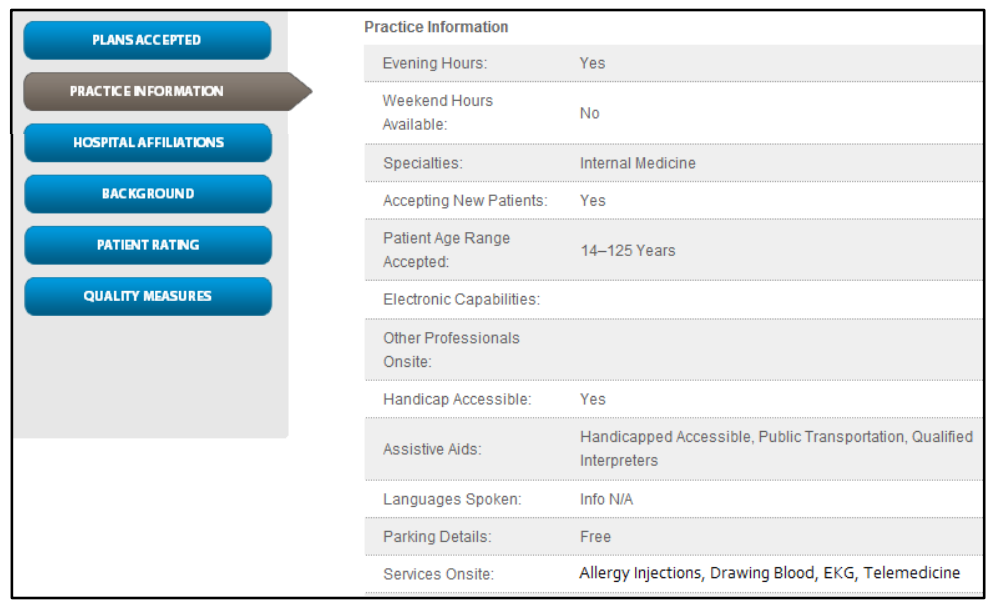
Once your files are updated, your listing in the online Provider Directory will be updated to indicate that you can provide telemedicine services. Here is an example of how this would display in Practice Information in your file of the Provider Directory:
What is Telestroke?
A telestroke service is a consultative modality that facilitates care for patients with acute stroke in a hospital emergency department by a vascular neurologist at stroke centers. These services are provided through telemedicine in the form of real-time video-conferencing for timely consultations with a vascular neurologist.
Telestroke services operate on a "hub and spoke" model allowing community hospitals that lack comparable staffing as larger urban hospitals and academic medical centers to access the expertise of the stroke centers and provide enhanced stroke care.
Applicable Products
The telestroke benefit enhancement applies to all eligible Highmark members with Commercial coverage.
Hub and Spoke
The "hub" is considered the specialist, the vascular neurologist at the stroke center. The specialist is able to visualize real-time video feeds and conduct examinations of patients experiencing stroke-like symptoms from various emergency departments that represent the "spoke" via a video-conference link.
Originating Site Billing and Reimbursement
When a "spoke" facility is providing a telestroke service via a telecommunications system, they are to use HCPCs code Q3014 (telehealth originating site facility code) to bill for the technical services, along with Revenue Code 0780 with a stroke diagnosis.
Always Check Medical Policy
Medical Policy includes medical guidelines that are appropriate for the majority of individuals with a particular disease, illness, or condition.
Highmark's medical policies are accessible on the Provider Resource Center in the main menu under Policies and Programs and then Medical Policies.
Verify Eligibility
Providers are reminded to always verify a member's eligibility and benefits prior to rendering services. It is the provider's responsibility to confirm that the member's benefit plan provides the appropriate benefits for the anticipated date of service.
You can verify benefits electronically quickly and easily via Availity's Eligibility and Benefits Inquiry or by submitting a HIPAA 270/271 transaction.
The following entities, which serve the noted regions, are independent licensees of the Blue Cross Blue Shield Association: Western and Northeastern PA: Highmark Inc. d/b/a Highmark Blue Cross Blue Shield, Highmark Choice Company, Highmark Health Insurance Company, Highmark Coverage Advantage Inc., Highmark Benefits Group Inc., First Priority Health, First Priority Life, Highmark Care Benefits Inc., or Highmark Senior Health Company. Central and Southeastern PA: Highmark Inc. d/b/a Highmark Blue Shield, Highmark Benefits Group Inc., Highmark Health Insurance Company, Highmark Choice Company or Highmark Senior Health Company. Delaware: Highmark BCBSD Inc. d/b/a Highmark Blue Cross Blue Shield. West Virginia: Highmark West Virginia Inc. d/b/a Highmark Blue Cross Blue Shield, Highmark Health Insurance Company or Highmark Senior Solutions Company. Western NY: Highmark Western and Northeastern New York Inc. d/b/a Highmark Blue Cross Blue Shield. Northeastern NY: Highmark Western and Northeastern New York Inc. d/b/a Highmark Blue Shield.
All references to “Highmark” in this document are references to the Highmark company that is providing the member’s health benefits or health benefit administration and/or to one or more of its affiliated Blue companies.
All revisions to this Highmark Provider Manual (the “manual” or “Highmark Provider Manual”) are controlled electronically. All paper copies and screen prints are considered uncontrolled and should not be relied upon for any purpose.
Unit 6: The BlueCard® Program
2.6 What is the BlueCard Program?
2.6 How the Program Works: An Example
2.6 How to Identify BlueCard Members
2.6 Medicaid Programs Administered by BluePlans
2.6 Blue Cross Blue Shield Global SolutionsSM Travel Medical Insurance
2.6 Consumer Directed Healthcare and Health Care Debit Cards
2.6 Health Insurance Marketplaces
2.6 Blue Exchange for Inquiries and Authorizations
2.6 BlueCard Eligibility and Benefits Verification
2.6 Electronic Provider Access (EPA)
2.6 Claim Submission and Claim Status Inquiry
2.6 Itemized Bills Required for High-Dollar Host Claims
2.6 New Audit Requirements for Million-Dollar Claims
2.6 Contiguous County and Eligible Affiliate Contracting
2.6 Ancillary Claim Filing Rules
2.6 Medicare Advantage Products
2.6 Medicare Advantage PPO Network Sharing
2.6 Medicare Advantage Eligibility, Claims, and Payment
The 34 independent, community-based, and locally operated Blue Cross and Blue Shield companies and the Blue Cross and Blue Shield Association (BCBSA) comprise the Blue Cross and Blue Shield System, the nation's oldest and largest family of health benefits companies. The Blues cover 100 million Americans in all 50 states, the District of Columbia, and Puerto Rico. Nationwide, more than 96% of hospitals and 95% of professional providers contract with the Blue System — more than any other health insurer.
Offering a variety of products, programs, and services to all segments of the population, the Blues cover large employer groups, small businesses, and individuals. Moreover, the Blues have enrolled more than half of all U.S. federal workers, retirees, and their families, making the Federal Employee Program (FEP) the largest single health plan group in the world.
As a participating provider of Highmark, you may render services to patients who are members of other Blue Plans traveling to or living in Delaware, New York, Pennsylvania, and West Virginia.
This unit describes the BlueCard Program and its advantages and provides information to make filing claims easy. You will find helpful information about:
- Identifying members
- Verifying eligibility
- Obtaining precertifications/preauthorizations
- Filing claims
- Who to contact with questions
BlueCard® is a national program that enables members of one Blue Plan to obtain health care service benefits while traveling or living in another Blue Plan’s service area. The program links participating health care providers with the independent Blue Cross Blue Shield (BCBS) Plans across the country and in more than 200 countries and territories worldwide through a single electronic network for claims processing and reimbursement.
The program lets you submit claims for patients from other Blue Plans, domestic and international, to your local Blue Plan. Highmark is your sole contact for claim submission, payment, adjustments, and issue resolution.
The BlueCard Program lets you conveniently submit claims for members from other Blue Plans, including international Blue Plans, directly to Highmark. Highmark will be your one point of contact for all your claims-related questions.
Always look to Highmark first when you need help with information about out-of- area members. We are committed to meeting your needs and expectations. In doing so, your out-of-area Blue Plan patients will have a positive experience with each visit.
Highmark Networks Supporting BlueCard
The BlueCard Program is supported by Highmark’s networks as follows:
Delaware
The Delaware Provider Network supports the BlueCard Program.
New York
- Northeastern New York Provider Networks support the BlueCard Program.
- Western New York Provider Networks support the BlueCard Program.
Pennsylvania
- Participating Provider Network: Supports all BlueCard programs for members with traditional, POS, or HMO coverage who are traveling or living outside of their Blue Plan’s service area.
- Keystone Health Plan West (KHPW)*: The KHPW network supports the BlueCard PPO programs in the 29-county Western Region of Pennsylvania for members in a PPO plan who are traveling or living outside of their Blue Plan’s service area.
- Premier Blue Shield Network: The Premier Blue Shield Network supports the BlueCard PPO programs in all other Highmark service areas in Pennsylvania for members in a PPO plan who are traveling or living outside of their Blue Plan’s service area.
*Keystone Health Plan West is Highmark’s managed care provider network in the 29-county Western Region of Pennsylvania.
West Virginia
- Indemnity Network: Supports the BlueCard programs for members with traditional or HMO coverage who are traveling or living outside of their Blue Plan’s area.
- Preferred Provider Organization (PPO) Network: Supports the BlueCard PPO programs for members in a PPO plan who are traveling or living outside of their Blue Plan’s service area.
- Point of Service (POS) Network: Supports the BlueCard POS programs for members in a POS plan who are traveling or living outside of their Blue Plan’s service area.
BlueCard Program Exclusions
Claims for the following products are excluded from the BlueCard Program:
- Stand-alone dental
- Self-administered prescription drugs delivered through an intermediary model (using a vendor)
- Vision delivered through an intermediary model (using a vendor)
- The Federal Employee Program (FEP)*
- Medicare Advantage**
- Medicaid and State Children’s Health Insurance Program (SCHIP) products that are part of state’s Medicaid program
*For more information on FEP, see the Highmark Provider Manual’s Chapter 2, Unit 3: Other Government Programs, and for billing tips, see Chapter 6, Unit 4: Professional (1500/837P) Reporting Tips.
**Medicare Advantage (MA) is a separate program from BlueCard and delivered through its own centrally administered platform; however, since you may see members of other Blue Plans who have MA coverage, MA information is available in this unit.
The following diagram illustrates how the BlueCard® program works. In this example, a member with coverage through BlueCross BlueShield of Tennessee is seeking services in Illinois.
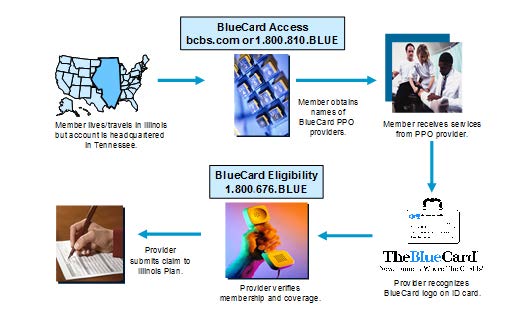
There are two scenarios where a Tennessee member might need to see a provider in the Illinois Blue Plan’s service area:
- If the Tennessee member was traveling in Illinois; or
- If the member resides in Illinois and has employer-provided coverage through BlueCross BlueShield of Tennessee.
How the Member Can Find Participating Providers
In either scenario above, the member can obtain the names and contact information for BlueCard PPO providers in Illinois by calling the BlueCard Access Line at 800-810-BLUE (2583).
The member can also obtain information online by using the BlueCard National Doctor and Hospital Finder available at bcbs.com.
Note: Although members are not obligated to identify participating providers through either of these methods, it is their responsibility to go to a PPO provider if they want to access PPO in-network benefits.
How a Provider Verifies the Member's Eligibility and Benefits
When the member makes an appointment and/or sees an Illinois BlueCard PPO provider, the provider may verify the member’s eligibility and coverage information via the BlueCard Eligibility Line at 800-676-BLUE (2583).
The provider may also obtain this information via a HIPAA electronic eligibility transaction if the provider has established electronic connections for such transactions with the local Plan, Blue Cross and Blue Shield of Illinois
Claim Submission and Payment
After rendering services, the provider in Illinois files a claim locally with Blue Cross and Blue Shield of Illinois. The Illinois Blue Plan forwards the claim internally to BlueCross BlueShield of Tennessee.
The Tennessee Blue Plan adjudicates the claim according to the member’s benefits and the provider’s arrangement with the Illinois Plan. This information is sent back to Blue Cross and Blue Shield of Illinois.
When the claim is finalized, the Tennessee Plan issues an explanation of benefit (EOB) to its member. The Illinois Plan issues the explanation of payment or remittance advice to its provider and pays the provider.
When members of out-of-area Blue Plans arrive at your office, be sure to ask them for their current Blue Plan membership identification card. The card will display the member’s identification number.
Important facts concerning Member IDs:
- The main identifier for out-of-area members is the prefix.
- A correct Member ID number includes the prefix (first three positions) and all subsequent characters, up to 17 positions total. This means that you may see cards with ID numbers between 6 and 14 numerals/letters following the prefix.
- Do not add/delete characters or numerals within the Member ID.
- Do not make up prefixes.
- Do not change the sequence of the characters following the prefix.
- The prefix is critical for the electronic routing of specific HIPAA transactions to the appropriate Blue Plan.
Do not assume that the member’s ID number is the Social Security number. All Blue Plans have replaced Social Security numbers on Member ID cards with an alternate, unique identifier.
Note: Members who are part of the Blue Cross Blue Shield Federal Employee Program (FEP), which is excluded from BlueCard, will have the letter "R" in front of their Member ID number instead of a 3-character prefix.
Prefix (Formerly "Alpha Prefix")
The 3-character prefix at the beginning of the member’s identification number is the key element used to identify and correctly route claims. The prefix identifies the Blue Plan or national account to which the member belongs. It is critical for confirming a patient’s membership and coverage.
The 3-character prefix has historically been an “alpha prefix” with all alpha characters. Beginning in 2018, the Blue Cross Blue Shield Association (BCBSA) issued alphanumeric “prefixes” to Blue Plans since the options for 3-character all alpha combinations were running low. The examples below illustrate the alpha and alphanumeric prefixes on the Member ID card (A = alpha; N = numeric):
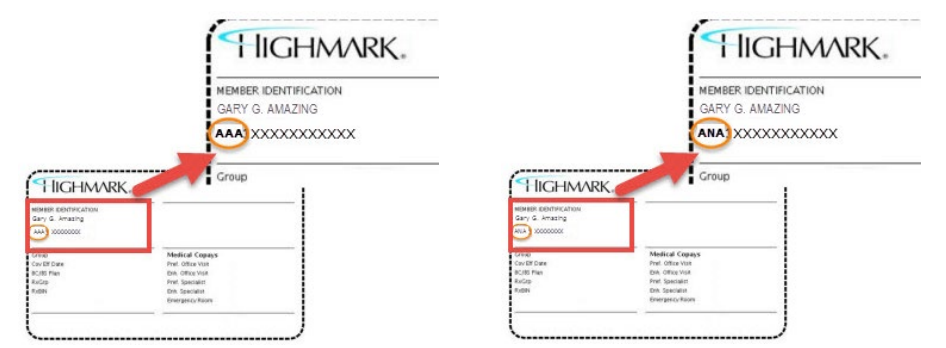
There will be no change to existing 3-character alpha prefixes for products/accounts already in existence. Alphanumeric prefixes will be created and assigned to Blue Plans for new products or new large national group accounts.
Examples of Member ID Numbers
The following examples represent various numeral/letter combinations that may be seen as Member IDs for Blue Plan members (A = alpha; N = numeric):
Remember: Member ID numbers must be reported exactly as shown on the ID card and must not be changed or altered. Do not add or omit any characters from the Member ID.
As a provider servicing out-of-area members, you may find the following tips helpful:
- Ask the member for the most current ID card at every visit. Since new ID cards may be issued to members throughout the year, this will ensure that you have the most up-to-date information in your patient’s file.
- Verify with the member that the ID number on the card is not his/her Social Security Number. If it is, call the BlueCard Eligibility Line at 800-676-BLUE to verify the ID number.
- Make copies of the front and back of the member’s ID card and pass this key information on to your billing staff.
- Capture all ID card data to ensure accurate claim processing. If the information is not captured correctly, you may experience a delay with the claim processing.
Suitcase Logos
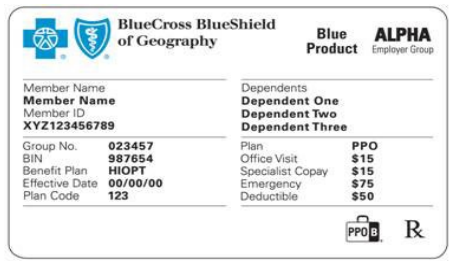
Older BlueCard Member ID cards may have a suitcase logo, either as an empty suitcase or as a PPO in a suitcase.
The PPO in a suitcase logo indicates that the member is enrolled in either a PPO product or an Exclusive Provider Organization (EPO) product. In either case, you will be reimbursed according to Highmark’s PPO provider contract.
Note: EPO products may have limited benefits out-of-area. The potential for such benefit limitations is indicated on the reverse side of an EPO ID card.
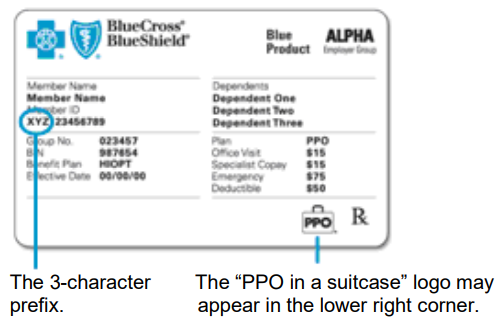
Beginning Jan. 1, 2025, members may present Blue Cross Blue Shield (BCBS) ID cards that no longer include the various suitcase logos.
- The suitcase logo will be replaced with the applicable product indicator. For example, rather than presenting the PPO logo in a suitcase logo, PPO member ID cards will now simply feature the PPO acronym.
- This does not impact member benefits or a member’s network access.
- You should continue to follow the normal process for verifying member benefits and eligibility.
- Transition from the use of the suitcase logo is expected to be a multi-year approach. In the interim, you may continue to see cards with the applicable suitcase logo.
One of the key elements of health care reform under the Affordable Care Act (ACA) is the public "exchange" — officially known as the Health Insurance Marketplace. On newer member ID cards, instead of the PPO B in the suitcase icon, providers now may see PPO B, which is the Product Indicator. On older member ID cards, the PPO B in a suitcase logo on an ID card indicates that the member has a Blue Plan PPO or EPO product from the exchange. These members have access to a Blue System PPO network referred to as “BlueCard PPO Basic.”
Many Blue Plans have created a new BlueCard PPO Basic network; however, Highmark will utilize the same networks as we do for BlueCard PPO. You will be reimbursed for covered services in accordance with your PPO contract with Highmark.
For older BlueCard member ID cards, the empty suitcase logo indicates that the member is enrolled in one of the following products: traditional, Health Maintenance Organization (HMO), or Point of Service (POS). For members with these products, you will be reimbursed according to Highmark’s traditional participating provider contract.
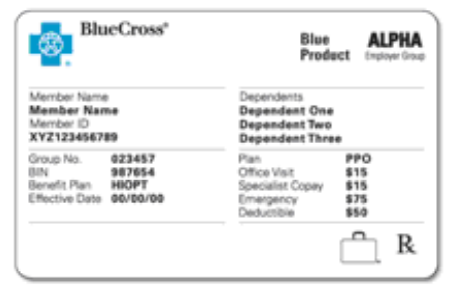
For newer BlueCard member ID cards — instead of an empty suitcase icon — providers now may see HMO or POS, which is the Product Indicator.
Blue Plan ID Cards Without Suitcase Logos
Newer Blue Plan ID cards will not have the suitcase logo, as noted above. Some older Blue Plan ID cards also may not have a suitcase logo. Those are the ID cards for Medicaid; State Children’s Health Insurance Programs (SCHIP), if administered as part of a state’s Medicaid program; and Medicare complementary and supplemental products, also known as Medigap.
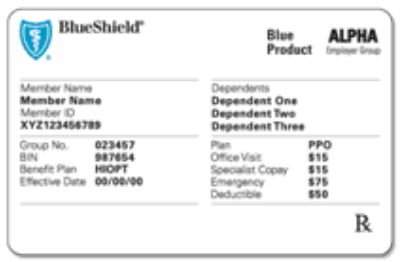
Government determined reimbursement levels apply to these products. While Highmark routes all of these claims for out-of-area members to the member’s Blue Plan, most of the Medicare complementary or Medigap claims are sent directly from the Medicare intermediary to the member’s Blue Plan via the established electronic Medicare crossover process.
BlueCard Managed Care/POS Program Members
The BlueCard Managed Care/POS Program is for members who reside outside their Blue Plan’s service area. Unlike in the BlueCard PPO Program, the BlueCard Managed Care/POS members are enrolled in a Highmark network and have a primary care physician (PCP).
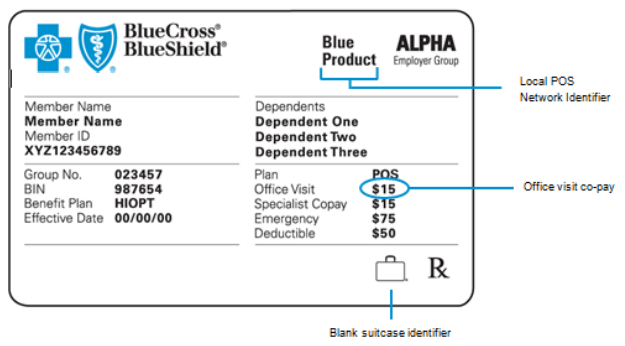
You can recognize BlueCard Managed Care/POS members who are enrolled in a Highmark network through the Member ID card as you do for all other BlueCard members. The ID cards will include:
- The 3-character prefix at the beginning of the member’s ID number
- A local network identifier
Note: Older member cards may still include the blank suitcase logo; newer member cards do not feature the suitcase logo.
Medicaid is a government program that provides free or low-cost health care to an eligible population. States design their own Medicaid programs within federal guidelines – eligible populations, cost-sharing, benefits, and other rules vary by state. State Medicaid agencies contract with health insurers, including Blue Cross and Blue Shield (BCBS) Plans, as Managed Care Organizations (MCOs) to administer comprehensive Medicaid benefits.
Medicaid members have limited out-of-state benefits, generally covering only emergent situations. In some cases, such as continuity of care, children attending college out of state, or a lack of specialists in the member’s home state, a Medicaid member may receive care in another state, and generally the care requires authorization. Reimbursement for covered services is limited to the Medicaid allowed amount established in the member’s home state.
Blue Plan Medicaid ID Cards
Members enrolled in BCBS Medicaid plans are issued ID cards from the home plan where they reside and are usually provided with state-issued Medicaid ID cards. It is important to note that:
- Blue Plan Medicaid ID cards do not always indicate that a member has a Medicaid product.
- Blue Plan Medicaid ID cards do not have the suitcase logo.
- The back of the Blue Plan Medicaid ID card must contain a disclaimer indicating limited out-of-area benefits.
Providers should submit an eligibility inquiry if the ID card has no suitcase logo and has a disclaimer with benefit limitations.
Obtaining Eligibility and Benefits, and Prior Authorization
You can obtain eligibility and benefit information for out-of-area BCBS Medicaid members using the same tools as you would for other out-of-area Blue Plan members:
- Submit an eligibility inquiry using Availity;
- Submit a HIPAA 270/271 electronic eligibility inquiry; or
- Call the BlueCard Eligibility line at 800-676-BLUE (2583).
Providers can also request prior authorization for out-of-area Blue Plan Medicaid members using the same tools available for BlueCard:
- BlueExchange;
- BlueCard Eligibility Line at 800-676-BLUE (2583); and
Electronic Provider Access (EPA) tool for pre-service review, including prior authorization.
Claim Submission and Reimbursement
Although BCBS Medicaid claims are processed through the BCBS Inter-Plan system, Medicaid is not officially part of the BlueCard Program since there is no network reciprocity, and the locally negotiated rates do not apply to Medicaid claims. However, you still submit out-of-area Blue Plan Medicaid claims to Highmark as you would submit BlueCard claims, and you will receive reimbursement from Highmark. You will be reimbursed according to the member’s home state Medicaid fee schedule, which may or may not be equal to what you are accustomed to receiving for the same service in your state.
When you see a Blue Plan Medicaid member from another state, you must accept the Medicaid allowed amount applied in the member’s home state even if you do not participate in Medicaid in your own state. Federal regulations limit providers to the Medicaid allowed amount applicable in the member’s home state as payment in full. Billing Medicaid members for the amount between the Medicaid allowed amount and charges for Medicaid-covered services is specifically prohibited by Federal regulations (42 CFR 447.15).
In some circumstances, a state Medicaid program will have an applicable copay, deductible, or coinsurance applied to the member’s plan. You may collect this amount from the member as applicable. Note that the coinsurance amount is based on the Medicaid fee schedule in the member’s home state for that service.
If you provide Medicaid services to a member who is not covered by Medicaid, you will not be reimbursed. In some states, you may bill a Medicaid member for services not covered by Medicaid if you have obtained written approval from the member in advance of services being rendered.
Medicaid Provider Enrollment Requirements
Some states require that out-of-state providers enroll in their state’s Medicaid program in order to be reimbursed. Some of these states may accept a provider’s Medicaid enrollment in the state where they practice to fulfill this requirement. To view provider enrollment requirements for BCBS Medicaid states, see the Medicaid Provider Enrollment Requirements by State. This document is also available in the BlueCard Information Center on the Provider Resource Center.
If you are required to enroll in another state’s Medicaid program, you should receive notification upon submitting an eligibility or benefit inquiry. You should enroll in the state’s Medicaid program before submitting the claim. If you submit a claim without enrolling, your Medicaid claims will be denied, and you will receive information from Highmark regarding the Medicaid provider enrollment requirements. You will be required to enroll before the Medicaid claim can be processed and before you may receive reimbursement.
Required Data Elements for Medicaid Claims
Medicaid MCOs are required to report specific Medicaid encounter information to their states and may incur a financial penalty if the data is not submitted or incomplete. State Medicaid encounter data reporting requirements vary from state to state. When billing for a Medicaid member, remember to check the Medicaid website of the state where the member resides to understand the state’s Medicaid requirements for reporting encounter data elements.
The data elements identified below are required on all out-of-area Blue Plan Medicaid claims so that BCBS Medicaid MCOs are able to comply with encounter data reporting applicable to their respective state.
Applicable Medicaid claims submitted without these data elements will be denied:
- National Drug Code (NDC)
- Rendering Provider Identifier (NPI)
- Billing Provider Identifier (NPI)
Applicable Medicaid claims submitted without these data elements may be pended or denied until the required information is received:
|
Billing Provider (Second) Address Line |
Ordering Provider Identifier and Identification Code Qualifier |
|
Billing Provider Middle Name or Initial |
Ordering Provider Identifier and Identification Code Qualifier |
|
(Billing) Provider Taxonomy Code |
Attending Provider NPI |
|
(Rendering) Provider Taxonomy Code |
Operating Physician NPI |
|
(Service) Laboratory or Facility Postal Zone or ZIP Code |
Claim or Line Note Text |
|
(Ambulance) Transport Distance |
Certification Condition Applies Indicator and Condition Indicator (Early and Periodic Screening, Diagnosis and Treatment [EPSDT]) |
|
(Service) Laboratory Facility Name |
Certification Condition Applies Indicator and Condition Indicator (Early and Periodic Screening, Diagnosis and Treatment [EPSDT]) |
|
(Service) Laboratory or Facility State or Province Code |
Service Facility Name and Location |
|
Value Code Amount |
Ambulance Transport Information |
|
Value Code |
Patient Weight |
|
Condition Code |
Ambulance Transport Reason Code |
|
Occurrence Codes and Date |
Round Trip Purpose Description |
|
Occurrence Span Codes and Dates |
Stretcher Purpose Description |
|
Referring Provider Identifier and Identification Code Qualifier |
Important: National Drug Codes (NDCs) are required on all applicable out-of-area Blue Plan Medicaid claims, including inpatient, outpatient, and professional; claims submitted without applicable NDCs reported will be denied.

Converting NDCs from 10 Digits to 11 Digits
Many NDCs are displayed on drug packaging in a 10-digit format. Proper billing of an NDC requires an 11-digit number in a 5-4-2 format. Converting NDCs from a 10- digit to an 11-digit format requires a strategically placed zero, dependent upon the 10-digit format.
The following table shows common 10-digit NDC formats indicated on packaging and the associated conversion to an 11-digit format, using the proper placement of a zero. The correctly formatted additional “0” is in a bold font and underlined in the following example. Note that hyphens indicated below are used solely to illustrate the various formatting examples for NDCs. Do not use hyphens when entering the actual data in your paper claim form.
Converting NDCs from 10 Digits to 11 Digits
|
10-Digit Format on Package |
10-Digit Format Example |
11-Digit Format |
11-Digit Format Example |
Actual 10-Digit NDC Example |
11-Digit Conversion of Example |
|
4-4-2 |
9999-9999-99 |
5-4-2 |
09999-9999-99 |
09999-9999-99 0002-7597-01 Zyprexa® 10mg Vial |
00002759701 |
|
5-3-2 |
99999-999-99 |
5-4-2 |
99999-0999-99 |
50242-040-62 Xolair® 150mg Vial |
50242004062 |
|
5-4-1 |
99999-9999-9 |
5-4-2 |
99999-9999-09 |
60575-4112-1 Synagis® 50mg Vial |
60575411201 |
The Blue Cross and Blue Shield Association licenses Blue Plans outside of the United States. International Licensees currently include the following:
- Blue Cross Blue Shield (BCBS) of U.S. Virgin Islands
- BlueCross and BlueShield of Uruguay
- Blue Cross and Blue Shield of Panama
- Blue Cross Blue Shield of Costa Rica
If in doubt, always check with Highmark as the list of International Licensees may change.
International Blue Plan ID Cards
Occasionally, you may see member ID cards that are from members of International Licensees or that are for international-based products. Currently, those Licensees include BlueCross and BlueShield of Uruguay and Blue Cross and Blue Shield of Panama. Additionally, Blue Cross Blue Shield international products include those provided through Blue Cross Blue Shield Global Solutions and the Blue Cross Blue Shield Global® portfolio; however, if in doubt, always check with Highmark as the list of International Licensees and products may change. ID cards from these Licensees and for these products will also contain the prefix (three alpha/alphanumeric characters, at the beginning of the member’s ID number) and may or may not have one of the benefit product logos referenced in the following sections. Please treat these members the same as you would domestic BCBS Plan members (e.g., do not collect any payment from the member beyond cost-sharing amounts such as deductible, coinsurance, and co-payment) and file their claims to [insert local Plan name]. See below for sample ID cards for international members and products.
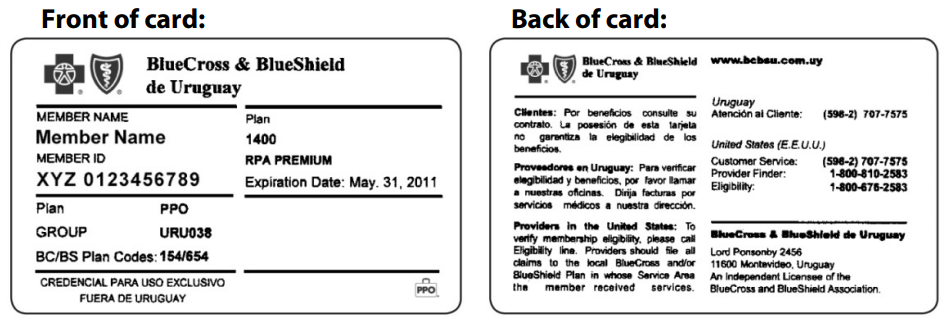
Canadian Association of Blue Cross Plans are Separate and Distinct
The Canadian Association of Blue Cross Plans and its member Plans are separate and distinct from the Blue Cross and Blue Shield Association (BCBSA) and its member Plans in the United States.
Claims for members of the Canadian Blue Cross Plans are not processed through the BlueCard Program. Please follow the instructions of these Canadian plans for servicing their members. Instructions may be provided on their ID cards.
The Blue Cross Plans in Canada are:
- Alberta Blue Cross
- Manitoba Blue Cross
- Medavie Blue Cross
- Ontario Blue Cross
- Pacific Blue Cross
- Quebec Blue Cross
- Saskatchewan Blue Cross
BCBS Global Solutions health plans help travelers and expatriates get high-quality, safe, and convenient care around the world and are offered in cooperation with many Blue Cross and Blue Shield companies, including Highmark. Through innovative product offerings, including concierge-level service and unsurpassed mobile technology, members who are living or traveling abroad can find carefully selected doctors and hospitals in more than 180 countries. When members receive care in the United States, they can obtain in-network benefits via the local Blue Cross Blue Shield network.
Blue Cross Blue Shield Global Solutions is the trade name of Worldwide Insurance Services, LLC (Blue Cross Blue Shield Global Solutions Insurance Services in California and BCBS Global Solutions Insurance Services in New York), an independent licensee of the Blue Cross and Blue Shield Association and is made available in cooperation with Highmark). Blue Cross Blue Shield Global Solutions is a brand owned by the Blue Cross and Blue Shield Association.
Fully insured plans are underwritten by 4 Ever Life Insurance Company, Oakbrook Terrace, IL, NAIC #80985 or 4 Ever Life International Limited, Bermuda, independent licensees of the Blue Cross Blue Shield Association. Refer to the certificate of coverage to confirm the insurance carrier.
Verifying a Blue Plan patient's benefits and eligibility is now more important than ever since new products and benefit types have entered the market. In addition to patients who have traditional Blue PPO, HMO, POS, or other coverage with typically high lifetime coverage limits (i.e., $1 million or more), you may now see patients whose annual benefits are limited to $50,000 or less.
Currently, Highmark does not offer the limited benefit plans described here to our members; however, you may see patients with these limited benefit plans who are covered by another Blue Plan.
How to recognize members with limited benefits products Patients with Blue limited benefits coverage carry ID cards that may have one or more of the following indicators:
- Product name will be listed such as InReach or MyBasic;
- A green strip at the bottom of the card;
- A statement either on the front or back of the ID card stating that this is a limited benefit product;
- A black cross and/or shield to help differentiate it from other identification cards.
These Blue limited benefits ID cards may look like this:
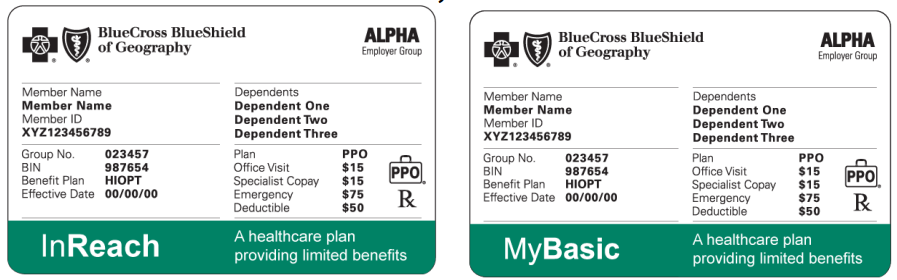
Verify Eligibility and Benefits
In addition to obtaining a copy of the patient’s ID card, and regardless of the benefit product type, we recommend that you verify the patient’s eligibility and benefits. You may do so electronically or you may call the 800-676-BLUE Eligibility Line for out-of-area members.
Both electronically and via telephone, you will receive the patient’s accumulated benefits to help you understand the remaining benefits left for the member. If the cost of services extends beyond the patient’s benefit coverage limit, inform the patient of any additional liability they might have.
Annual benefit limits should be handled in the same manner as any other limits on medical coverage. Any services beyond the covered amounts or the number of treatments are member liability.
We recommend you inform patients of any potential liability they might have as soon as possible.
Some Blue Plans offer Reference Based Benefits to self-funded group accounts that limit certain (or specific) benefits to a dollar amount that incents members to actively shop for health care for those services.
The goal of Reference Based Benefits is to engage members in their health choices by giving them an incentive to shop for cost-effective providers and facilities. Reference Based Benefit designs hold the member responsible for any expenses above a calculated “Reference Cost” ceiling for a single episode of service.
Due to the possibility of increased member cost-sharing, Reference Based Benefits will incent members to use Plan transparency tools, like the National Consumer Cost Tool (NCCT), to search for and identify services that can be performed at cost-effective providers and/or facilities that charge at or below the reference cost ceiling.
Reference Cost
The Blue Plan will pay up to a predetermined amount, called a “Reference Cost,” for specific procedures. If the allowed amount exceeds the reference cost, the excess amount becomes the member’s responsibility.
The Blue Cross Blue Shield Association (BCBSA) calculates reference costs on a state-by-state basis with each state representing a “cost region” with its own reference costs. The reference costs are established in a cost region based on claims data provided by the Blue Plan(s) in that region. Reference costs are updated on an annual basis.
Applicable Services
The Blue Plan and the employer group collaborate to define the services for which Reference Based Benefits will apply. Services could include inpatient services, outpatient procedures, and diagnostic services; and services may vary by employer group with coverage under the same Blue Plan. Reference Based Benefits are not applicable to any service that is urgent or emergent.
Verifying Coverage
When you submit an electronic eligibility and benefits inquiry prior to performing services, you will be notified if a member is covered under Reference Based Benefits.
In addition, you may call the BlueCard Eligibility phone number to verify if a member is covered under Reference Based Benefits: 800-676-BLUE (800-676-2583).
Claims, Payment, and Member Responsibility
Reference Based Benefits do not alter the Highmark fee schedule. Providers are paid the applicable fee schedule allowance on all services where Reference Based Benefits apply.
When Reference Based Benefits are applied and the cost of the services rendered is less than the cost ceiling, then Highmark will pay eligible benefits as it has in the past. The member continues to pay their standard cost-sharing amounts in the forms of coinsurance, copay, or deductible as normal.
If the cost of the services rendered exceeds the reference cost ceiling, then Highmark will pay benefits up to that reference cost ceiling. The member continues to pay their standard cost-sharing amounts in the forms of coinsurance, copay, or deductible, as well as any amount above the reference cost ceiling up to the contractual amount.
Example 1: If a member has a reference cost of $500 for an MRI and the allowable amount is $700, then Highmark will pay up to $500 for the procedure, and the member is responsible for the $200.
Example 2: If a member has a reference cost ceiling of $600 for a CT scan and the allowable amount is $400, then Highmark will pay up to $400 for the procedure.
Consumer Transparency Tools
Since members are subject to any charges above the Reference Cost up to the contractual amount for particular services, members may ask you to estimate how much a service will cost. Also, you can direct members to view their Blue Plan’s transparency tools to learn more about the cost established for an episode of care.
Blue Cross Blue Shield (BCBS) Axis is a national effort by Blue Cross and/or Blue Shield Plans across the country to assist members in navigating the health care delivery system. A national database houses pre-calculated cost estimates submitted by Blue Plans, which allows members to view the total cost of specific medical procedures and common office visits for providers across the country.
Note: Highmark members have access to this information through the Care Cost Estimator which is available to them by logging into their account on Highmark’s websites.
Questions?
If you have any questions regarding Reference Based Benefits, contact the Highmark Provider Service Center.
Consumer Directed Healthcare (CDHC) is a broad term that refers to a movement in the health care industry to empower members, reduce employer costs, and change consumer health care purchasing behavior.
Health plans that offer CDHC provide the member with additional information to make an informed and appropriate health care decision through the use of member support tools, provider and network information, and financial incentives.
Health Care Debit Cards
Members who have CDHC plans often have health care debit cards that allow them to pay for out-of-pocket costs using funds from their Health Reimbursement Account (HRA), Health Savings Account (HSA), or Flexible Spending Account (FSA). All three are types of tax-favored accounts offered by the member’s employer to pay for eligible expenses not covered by the health plan.
Some cards are “stand-alone” debit cards to cover out-of-pocket costs while others also serve as a Member ID card with the member’s ID number. These debit cards can help you simplify your administration process and can potentially help:
- Reduce bad debt
- Reduce paperwork for billing statements
- Minimize bookkeeping and patient account functions for handling cash and checks
- Avoid unnecessary claim payment delays
In some cases, the card will display the Blue Cross and Blue Shield trademarks along with the logo from a major debit card such as MasterCard® or Visa®.
Example: Stand-alone health care debit card
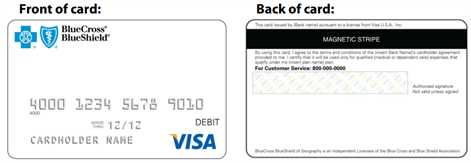
Example: Combined health care debit card and Member ID card
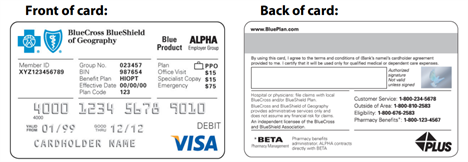
The health care debit card includes a magnetic strip allowing providers to swipe the card to collect the member’s cost-sharing amount (i.e., copayment). With health care debit cards, members can pay for copayments and other out-of-pocket expenses by swiping the card through any debit card swipe terminal. The funds will be automatically deducted from the member’s appropriate HRA, HSA, or FSA account.
Combining a health insurance ID card with a source of payment is an added convenience to members and providers. Members can use their cards to pay outstanding balances on billing statements. They can also use their cards via phone in order to process payments. In addition, members are more likely to carry their current ID cards because of the payment capabilities.
If your office currently accepts credit card payments, there is no additional cost or equipment necessary. The cost to you is the same as the current cost you pay to swipe any other signature debit card.
Helpful Tips
The following tips will be helpful when you are presented with a health care debit card:
- Carefully determine the member’s financial responsibility before processing payment. You can access the member’s benefits and accumulated deductible by using online electronic capabilities or by contacting the BlueCard Eligibility Line at 800-676-BLUE (2583).
- You may use the debit card for member responsibility (i.e., copay) for medical services provided in your office. Do not use the card to process full payment upfront.
- You may choose to forego using the debit card on the date of service and wait for the claims to be processed by Highmark to determine the member’s responsibility.
- All services, regardless of whether or not you have collected the member responsibility at the time of service, must be billed to Highmark for proper benefit determination and to update the member’s claim history.
Questions?
If you have any questions about the member’s benefits, check eligibility and benefits electronically or by calling 800-676-BLUE (2583).
For questions about the health care debit card processing instructions or payment issues, contact the toll-free debit card administrator’s number on the back of the card.
The Patient Protection and Affordable Care Act of 2010 provides for the establishment of Health Insurance Marketplaces (or “Exchanges”) in each state where individuals and small businesses can purchase qualified coverage. These exchanges are websites through which eligible consumers may purchase insurance.
The Marketplaces are intended to create a more organized and competitive marketplace for health insurance by offering members a choice of health insurance plans, establishing common rules regarding the offering and pricing of insurance, and providing information to help consumers better understand the options available to them. The Marketplaces will enhance competition in the health insurance market, improve choice of affordable health insurance, and give individuals and small businesses purchasing power comparable to that of large businesses.
The Marketplaces offer consumers a variety of health insurance plans. Product and Plan information, such as covered services and cost sharing (i.e., deductibles, coinsurance, copayments, and out-of-pocket limits) are organized in a manner that makes comparisons across health insurance plans easier for consumers.
In conjunction with offering a choice of health insurance plans, the Marketplace is intended to provide consumers with transparent information about health insurance plan provisions such as premium costs and covered benefits as well as a plan’s performance in encouraging wellness, managing chronic illnesses, and improving consumer satisfaction.
Marketplace Options
Each state was given the option to set up its own “state-based” Marketplace approved by the Department of Health and Human Services (HHS) for marketing products to individual consumers and small employers. If the state did not set up a state-run marketplace, HHS has established either a federally facilitated Marketplace or a Federal partnership Marketplace in the state.
Blue Plans that offer products on the Marketplaces collaborate with the state and federal governments for eligibility, enrollment, reconciliation, and other operations to ensure that consumers can seamlessly enroll in individual and employer-sponsored health insurance products.
Pennsylvania and New York operate state-based exchanges. Delaware and West Virginia are two of the seven states that formed state-federal partnerships with the states operating the plan management and consumer assistance functions of the Marketplace.
Exchange Individual Grace Period
The Patient Protection and Affordable Care Act (PPACA) mandates a three-month grace period for individual members who receive a premium subsidy from the government and are delinquent in paying their portion of premiums. The grace period applies as long as the individual has previously paid at least one month’s premium within the benefit year. The health insurance plan is only obligated to pay claims for services rendered during the first month of the grace period. PPACA clarifies that the health insurance plan may pend claims during the second and third months of the grace period.
Blue Plans are required to either pay or pend claims for services rendered during the second and third month of the grace period. Consequently, if a member is within the last two months of the federally mandated individual grace period, providers may receive a notification from Highmark indicating that the member is in the grace period.
Claims and Utilization Review
Providers should follow current practices with Highmark for claims processing and handling of Marketplace claims. You can make claim status inquiries through Highmark or by submitting an electronic inquiry to Highmark.
If authorization/precertification is needed, you should follow the same protocol as you do for any other BlueCard members.
Blue Exchange was developed by the Blue Cross Blue Shield Association as a gateway for routing inquiries about out-of-area members between providers and the member’s Blue Plan. Blue Exchange transactions submitted through Highmark are routed to the member’s Blue Plan based on the prefix.
Blue Exchange simplifies your exchanges for out-of-area members using HIPAA- compliant transactions. There are three primary types of transactions that can be routed via BlueExchange:
- Eligibility and Benefits Inquiry and Response;
- Claim Status Inquiry and Response; and
- Referral/Authorization Requests.
Accessing Blue Exchange Via Availity Essentials
Highmark provides you with convenient, easy-to-use access to Blue Exchange via Availity. Each of these transactions can be initiated through Availity’s authorization workflow.
Electronic Transactions Routed Via Blue Exchange
If your office has the capability, the following transactions can be submitted to Highmark for out-of-area members via your practice management software and routed via Blue Exchange:
- 270 for Eligibility and Benefits
- 276 for Claim Status
- 278 for Utilization Review
Highmark will route both the inquiry and response transactions between you and the member’s Blue Plan via Blue Exchange.
As a Highmark participating provider, you have three options for verifying eligibility for members of other Blue Plans:
- Submit an electronic HIPAA 270 transaction to Highmark
- Initiate a secure message via Availity
- Call the BlueCard Eligibility line at 800-676-BLUE (2583)
Electronic Transactions Preferred
Electronic transactions and online communications have become integral to health care, and they are the preferred method of interaction between providers and Highmark. Today’s technology can help you simplify business operations, cut costs, and increase efficiency in your office.
Electronic options for verifying eligibility and benefits for out-of-area Blue Plan members provide a quick turnaround. You can use the following electronic options for verifying eligibility and benefits for an out-of-area member:
- Submit a HIPAA 270 Eligibility Inquiry transaction to Highmark: Highmark will route both the inquiry and the 271 response transactions between you and the member’s Blue Plan via BlueExchange
- Initiate a secure message via Availity
BlueCard Eligibility Phone Line
For those offices that are not electronically enabled, the Blue Cross Blue Shield Association provides a toll-free phone line for eligibility and benefit inquiries for BlueCard members. Contact BlueCard Eligibility at 800-676-BLUE (2583).
- English and Spanish speaking phone operators are available to assist you.
- Blue Plans are located throughout the country and may operate on a different time schedule than Highmark; you may be transferred to a voice response system linked to customer enrollment and benefits outside that Plan’s regular business hours.
- The BlueCard Eligibility Line is for eligibility, benefit, and precertification and referral authorization inquiries only; it should not be used for claim status. Direct all claim inquiries to Highmark.
Electronic Health ID Cards
Some Blue Cross Blue Shield Plans have implemented electronic health ID cards to facilitate seamless coverage and eligibility verification process.
- Electronic health ID cards enable electronic transfer of core subscriber/member data from the ID card to the provider’s system.
- A Blue Plan electronic health ID card has a magnetic stripe on the back of the card, similar to what you can find on the back of a credit or debit card. The subscriber/member electronic data is embedded on the third track of the 3-track magnetic stripe.
- Core subscriber/member data elements embedded on the third track of the magnetic stripe include: subscriber/member name, subscriber/member ID, subscriber/member date of birth, and Plan ID.
- Providers will need a track 3 card reader in order for the data on track 3 of the magnetic stripe to be read (the majority of card readers in provider offices only read tracks 1 and 2 of the magnetic stripe; tracks 1 and 2 are proprietary to the financial industry).
- The Plan ID data element identifies the health plan that issued the ID card. Plan ID will help providers facilitate health transactions among various payers in the marketplace.
- An example of an electronic ID card:
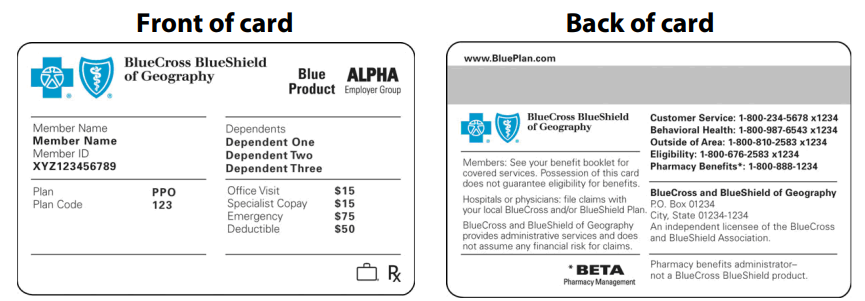
Traditionally, many Blue Plan members have been held responsible for obtaining pre-service review from their Home Plan when receiving inpatient and outpatient care in another Blue Plan’s service area. If authorization is not obtained, the member could be subject to financial penalties.
Pre-service review is defined as the process of obtaining authorization for medical treatment prior to select procedures and services. The process is commonly referred to as precertification, preauthorization, notification, and/or pre-admission.
Inpatient Services
All Blue Plans must require participating providers to obtain pre-service review for inpatient facility services for out-of-area members. In addition, members are held harmless when pre-service review is required and not obtained by the provider for inpatient facility services (unless an account receives an approved exception).
These requirements apply to all fully insured health benefit plans. However, if a self-funded employer group wishes to keep member precertification penalties in place, a formal exception can be filed with the BCBSA. If an account receives an approved exception, a member penalty could apply if pre-service review is not obtained for inpatient services.
Highmark provider contracts require participating providers to obtain pre-service review for inpatient facility services for our members and out-of-area BlueCard® members. Highmark participating providers are also required to hold members harmless if the member’s plan requires pre-service review, and the provider did not attempt to acquire an authorization.
This initiative also requires Blue Plan participating providers to keep the Home Plan informed of changes in a member’s condition. Providers must notify the member’s Home Plan within 48 hours when a change to the original pre-service review occurs, and within 72 hours for emergency and/or urgent admissions.
Note: This policy does not affect medical necessity. Services must still be medically necessary, appropriate, and a covered benefit. If, prior to service or care, the provider requests authorization and it is denied, a Highmark participating provider can bill the member if the member was informed of the denial and agreed in writing to be responsible for payment for the service or care.
Outpatient Services
Although providers are responsible for obtaining pre-service review for inpatient facility services, your out-of-area Blue Plan patients are responsible for obtaining precertification/preauthorization from their Blue Plan when required for outpatient services. However, you may contact the member’s Blue Plan for authorization on behalf of the member.
Highmark’s prior authorization requirements for outpatient services include those services provided by out-of-area providers participating with their local Blue Plan. This ensures that the care our members receive while living and traveling outside of the Highmark service areas is medically necessary and managed consistently as it is throughout our service areas.
Availity Essentials portal functionality is enabled to accept authorization requests for outpatient services from out-of-area Blue Plan providers when submitted via their local portals.
Claims for services on the prior authorization list received without authorization will be denied, and a request for medical records will be sent to the provider’s local Blue Plan.
Medical Policy and Precertification/Preauthorization Router for Out-of-Area Members
Highmark provides you with a tool to access Medical Policy and general precertification/preauthorization information for out-of-area members from other Blue Plans. All you need is the out-of-area member’s prefix to find the information for the home plan.
You'll find the Medical Policy and Pre-Certification/Pre-Authorization Router for Out-of-Area Members in the Inter-Plan Programs section of the Provider Resource Center (PRC). This link is also available in the PRC's BlueCard Information Center.
Note: This feature is not available for members in the Federal Employee Program (FEP) or in a Medicare Advantage Program.
How to Obtain Authorization
The following options are available to you for obtaining pre-service review/pre-authorization for out-of-area BlueCard members:
- Submit an electronic HIPAA 278 transaction (Referral/Authorization) to Highmark via your practice management software. Highmark will route both the inquiry and response transactions between you and the member’s Blue Plan via BlueExchange.
- Use Availity Essentials. Select Patient Registration from the menu bar, and then choose Authorization and Referrals.
- Call BlueCard Eligibility at 800-676-BLUE (2583) and ask to be transferred to the utilization review area. Your call will be routed directly to the area that handles precertification/preauthorization at the member’s Home Plan.
When obtaining precertification/preauthorization, provide as much information as possible to minimize potential claims issues. Providers are encouraged to follow up immediately with a member’s Blue Plan to communicate any changes in treatment or setting to ensure existing authorization is modified or a new one obtained, if needed. Failure to obtain approval for the additional days may result in claims processing delays and potential payment denials.
The member’s Blue Plan may contact you directly related to clinical information and medical records prior to treatment or for concurrent review or disease management for a specific member.
Electronic Provider Access (EPA) enables providers to use their local Blue Plan provider portal to gain access to an out-of-area member’s Home Plan provider portal through a secure routing mechanism. Once in the Home Plan provider portal, the out-of-area provider has the same access to electronic pre-service review capabilities as the Home Plan’s local providers.
The ability to access the Home Plan's portal for pre-service review will result in a more efficient pre-service review process, reduced administrative costs for both the provider and the Blue Plan, and improved provider and member satisfaction.
Determine if Precertification is Required
You can first check whether precertification is required by the member’s Home Plan by either:
- Going to Eligibility and Benefits Inquiry in Availity Essentials
- Accessing the Home Plan’s precertification requirements pages by using the Medical Policy Router available on the Provider Resource Center
The seven steps below illustrate how claims flow through BlueCard:
- Member of another Blue Plan receives services from the provider.
- Provider submits claim to the local Blue Plan where the services were rendered (excluding ancillary and air ambulance services).
- Local Blue Plan recognizes BlueCard member and transmits standard claim to the member’s Blue Plan.
- Member’s Blue Plan adjudicates claim according to the member’s benefit plan.
- Member’s Blue Plan issues an Explanation of Benefits (EOB) to the member.
- Member’s Blue Plan transmits claim payment disposition to the local Blue Plan.
- Local Blue Plan pays the provider.
You should always submit out-of-area Blue Plan claims to Highmark using the applicable NAIC code as the payer code in the 837 Health Care Claim transaction. Highmark will work with the member’s Blue Plan to process the claim. The member’s Blue Plan will send an Explanation of Benefits (EOB) to the member.
Highmark will send you an explanation of payment or remittance advice. We will also issue the payment to you under the terms of our contract with you and based on the member’s benefits and coverage.
For More Information
See the NAIC Codes section of this unit for complete information on all Highmark NAIC payer codes.
Helpful Tips
Electronic claims submission is a valuable method of streamlining claim submission and processing, and results in faster payment. Following these helpful tips will improve your claim experience:
- Ask members for their current Member ID card and regularly obtain new photocopies of it (front and back). Having the current card enables you to submit claims with the appropriate member information (including the prefix) and avoid unnecessary claims payment delays.
- Consider electronic inquiries if you wish to inquire about precertification requirements before the service is provided or call 800-676-BLUE (2583) and ask to be connected with the utilization review area.
- Check eligibility and benefits to verify the member’s cost-sharing amount before processing payment.
- Indicate on the claim any payment you collected from the patient.
- On the 837I and the 837P electronic claim submission, use the Patient Amount Paid Segment (AMT01=F5 patient paid amount).
- On the 1500 Claim Form, report the amount paid in locator Box 29. This is the total of patient and other payer(s) prior paid, not just patient prior paid.
- On the UB-04, report this information in locator Box 54.
- Submit all Blue Plan claims to your local Highmark plan where the services were rendered. Be sure to include the member’s complete identification number when you submit the claim. This includes the 3-character prefix. Submit claims with valid prefixes only. Claims with incorrect or missing prefixes and member identification numbers cannot be processed. Any corrections to that information must be submitted on a new claim.
- Service Facility should be reported when services are rendered in a location other than the physician’s office. Service Facility fields are listed below.
- If no Service Facility is documented, the address of the Billing Provider’s office will be used to process your claim. Please do not submit your check or mailing address. Report the address of the Billing Provider office in the fields outlined below.
- One exception: If you are contracted with both your local Blue Cross Blue Shield or Blue Shield plan where your practice is located and the out-of-area (OOA) patient’s Home plan, always submit the claims to the patient’s Home plan.
- Note: Bill the appropriate addresses according to the instructions above using the following fields:
|
Electronic Claim Forms |
|---|
837I 5010 Institutional |
2000-2010AA |
Billing Provider Loops |
2310E |
Service Facility Loop |
|
837P 5010 Professional |
2000A-2010AA |
Billing Provider Loops |
2310C |
Service Facility Loop |
|
Paper Claim Forms |
|---|
UB 04 Institutional Paper Form |
Field #1 |
Facility Name and Address |
1500 Professional Paper Form |
Box 33 |
Billing Provider Information |
Box 32 |
Service Facility Location Information |
- Check claim status through Availity Essentials’ Claim Status Inquiry or by submitting an electronic HIPAA 276 transaction (Claim Status Request) to Highmark. All claim inquiries should be directed to Highmark and not the member’s Plan.
- Do not send duplicate claims. Sending another claim, or having your billing agency resubmit claims automatically, actually slows down the claims payment process and causes confusion for the member receiving multiple EOBs for the same services.
International Claims
The claim submission process for international Blue Plan members is the same as for domestic Blue Plan members. You should submit the claims directly to Highmark.
Note: See the section on How to Identify International Members in this unit for information on servicing members of the Canadian Blue Cross Plans.
Coding
Code claims as you would for Highmark claims.
Claim Status Inquiry
Highmark is your single point of contact for all claim inquiries.
- Availity’s Claim Status, used to view local claims, can also be used to find the latest status on OOA claims. To view OOA claims electronically, you must include the prefix when entering the member identification number.
Adjustments
Contact Highmark if an adjustment is required. We will work with the member’s Blue Plan for adjustments; however, your workflow should not be different. To initiate adjustments:
- Search for the claim in question via Claim Status within Availity and then initiate an adjustment request via the Claims Investigation Inquiry.
- Providers who are not Availity-enabled should submit adjustments electronically via the HIPAA 837 transaction if your office system is capable.
Provider Appeals
Provider appeals are handled through Highmark. We will coordinate the appeal process with the member's Blue Plan, if needed.
However, if you are appealing on behalf of the member, direct your inquiry to the member's Blue Plan. To inquire about the Plan’s process to initiate an appeal on behalf of the member, call the Customer Service phone number on the member's identification card.
If Claim Payment Is Not Received
If you have not received payment for a claim, do not resubmit the claim because it will be denied as a duplicate. This also causes member confusion because of multiple Explanations of Benefits (EOBs).
Claim processing times can differ at the various Blue Plans. If you do not receive your payment or a response regarding your payment within 30 days, visit Availity Essentials, submit a HIPAA 276 (claim status request), or call Highmark’s Provider Service Center to check the status of your claim.
In some cases, a member’s Blue Plan may pend a claim because medical review or additional information is necessary. When resolution of a pended claim requires additional information from you, Highmark may either ask you for the information or give the member’s Blue Plan permission to contact you directly.
Coordination of Benefits
Coordination of benefits (COB) refers to how we ensure members receive full benefits and prevent double payment for services when a member has coverage from two or more sources. The member’s contract language explains the order for which entity has primary responsibility for payment and which entity has secondary responsibility for payment.
If you discover the member is covered by more than one health plan, and:
- Highmark or any other Blue Plan is the primary payer, submit the other carrier’s name and address with the claim to Highmark. If you do not include the COB information with the claim, the member’s Blue Plan will have to investigate the claim. This investigation could delay your payment or result in a post-payment adjustment which will increase your volume of bookkeeping.
- A non-Blue health plan is primary and Highmark or any other Blue Plan is secondary, submit the claim to Highmark only after receiving payment from the primary payer, including the explanation of payment from the primary carrier. If you do not include the COB information with the claim, the member’s Blue Plan will have to investigate the claim. This investigation could delay your payment or result in a post-payment adjustment which will increase your volume of bookkeeping.
Carefully review the payment information from all payers involved on the remittance advice before balance billing the patient for any potential liability. The information listed on the Highmark remittance advice as patient liability may be different from the actual amount the patient owes you due to a combination of two or more insurance payments.
Coordination of Benefits Questionnaire Available Online

Highmark depends on help from the member and/or provider to obtain accurate, up-to-date information about Coordination of Benefits (COB). The provider’s assistance with this process will eliminate the need to gather the information later, thereby reducing potential claim processing delays.
If you would like to assist, the Coordination of Benefits Questionnaire for BlueCard members is available to you on the Provider Resource Center's BlueCard Information Center.
If you wish to have the questionnaire completed by the policyholder at the time of service, you can fax the completed form with the policyholder’s signature to Highmark. Be sure to use a fax cover sheet that includes contact information for your practice or facility.
Or, you can ask the member to complete the form and then send it to their Home Plan — the Blue Plan through which they are covered — as soon as possible after leaving your office or facility. Members should mail the form to the Blue Plan address listed on the back of their member identification card where they will also find their Home Plan’s telephone number if they have questions.
Calls From BlueCard Members
If BlueCard members contact you with questions about claims, advise them to contact their Blue Plan and refer them to their ID card for a customer service number.
The member’s Blue Plan should not contact you directly regarding claims issues. If the member’s Plan contacts you and asks you to submit the claim to them, refer them to Highmark.
For More Information
- Visit the BlueCard Information Center on the Provider Resource Center.
- Call the Highmark Provider Service Center.
The Blue Cross Blue Shield Association (BCBSA) requires Blue Plans serving as the Host Plan for out-of-area Blue Plan members to perform high-dollar prepayment reviews for certain claims and communicate results of these reviews to the members’ Home Plans. The review process must be conducted prior to passing the host claim to the Home Plan.
The Home Plan is the Blue Cross and/or Blue Shield Plan where the insured is enrolled. The Host Plan is any other Blue Plan whose contracted providers are providing health care services to a Blue Plan member outside of his or her home plan's service area.
For example, Highmark serves as the Host Plan when an out-of-area Blue Plan member (e.g., has coverage through BlueCross BlueShield of Illinois) seeks services from a Highmark participating provider in our service areas.
Therefore, a host claim would be a claim that you submit to Highmark for services you provided to an out-of-area Blue Plan member. Highmark forwards the host claim to the member’s Home Plan internally through the BlueCard electronic system, and then the Home Plan adjudicates the claim, sending the information back to Highmark in order for Highmark to reimburse you.
Requirements For Providers
Highmark requires itemized bills for all high-dollar host claims that meet the criteria below. The requirements apply regardless of how claims were submitted.
Host claims that meet the following criteria require submission of itemized bills:
- Inpatient acute care;
- Allowance of $50,000 or greater;
- All lines of business, except Medicare Supplemental/Medigap and Medicaid; and
- Any pricing methodologies that are price based on charges (e.g., percentage-based).
Note: These requirements do not apply to the following claims pricing models that do not incorporate individual services or charges due to global pricing methodology:
- Per-diem
- Flat-fee case rate
- DRG (Diagnosis-Related Group) rate
Submitting Itemized Bills to Highmark
To send an itemized bill to Highmark, you can:
- Fax itemized bills to 855-329-8191/Attention: Kelly Rizor
- Email itemized bills to HighmarkHostHighDollarReview@highmark.com
If Itemized Bills Not Received
If we do not receive an itemized bill for these claims within three days after they are submitted, they will be rejected with code E1224 – “In order to process the claim, additional information is required.” As a result, payment will be delayed. If any discrepancies are found during the High Dollar Itemized Bill Audit, the claim will be amended during initial processing and only the lines that are not eligible will be denied E5027. Highmark will advise what the discrepancies are via our discrepancy sheet. The facility will not be responsible for refiling a corrected claim.
Effective July 1, 2026, the Blue Cross Blue Shield Association (BCBSA) is mandating that all Blue Plans, including Highmark, audit claims allowing $1 million or more to ensure billing accuracy.
Important: Highmark’s policy requiring itemized bills for high-dollar claims remains in effect (see the Highmark Provider Manual's 2.6 Itemized Bills Required for High-Dollar Host Claims for more information). The new BCBSA mandate is an additional requirement for $1 million claims.
How the Audit Mandate Works
Plans — both Host and Home — will be required to perform the following activities prepay:
- Host Plan Responsibilities
- Itemized bill review
- Diagnosis Related Group (DRG) review
- Claim data and financial accuracy, including:
- Pricing review
- Plan payment policy review
- Provider contract review
- Line by line review
- Never event review
- HAC (Hospital-Acquired Conditions) review
- Core clinical editing
- Advanced editing/secondary editing
- Home Plan Responsibilities
- Benefit accuracy
- Prior authorization
- Duplicate check
- Coordination of benefits
- Clinical review (including):
- Medical necessity review
- Medication review
- Level of care review
- High-Dollar payment approval/signoff process
Medical Records
When a claim is allowing $1 million or more, timely submission of all requested medical records is mandatory for a pre-payment review. Failure to provide these records in accordance with Highmark's policies and/or contractual terms will result in claim denial.
Once medical records have been received, the claim audit will resume.
Further Evaluation
The $1 million threshold will be evaluated by the BCBSA in 2028 to determine if further changes are needed.
The National Association of Insurance Commissioners (NAIC) is the U.S. standard- setting and regulatory support organization created and governed by the chief insurance regulators from the 50 states, the District of Columbia and five U.S. territories. Through the NAIC, state insurance regulators establish standards and best practices, conduct peer review, and coordinate their regulatory oversight. NAIC staff supports these efforts and represents the collective views of state regulators domestically and internationally. NAIC members, together with the central resources of the NAIC, form the national system of state-based insurance regulation in the U.S.
NAIC codes are unique identifiers assigned to individual insurance carriers. Accurate reporting of NAIC codes along with associated prefixes and suffixes to identify the appropriate payer and to control routing is critical for electronic claims submitted to Highmark EDI (Electronic Data Interchange).
Claims billed with the incorrect NAIC code will reject on your 277CA report as A3>116, “Claim submitted to the incorrect payer.” If this rejection is received, please file your claim electronically to the correct NAIC code. Refer to the tables below for applicable NAIC codes for your service area.
Delaware

|
NAIC Code |
Provider Type |
Products |
|---|---|---|
|
00070 |
Facility provider types |
|
|
00570 |
All other provider types |
|
New York

|
NAIC Code |
Provider Type |
Products |
|---|---|---|
|
55204 |
All provider types |
|
*Providers will continue to submit claims to Empire for Empire/Anthem members who are seen in — Albany, Clinton, Columbia, Essex, Fulton, Greene, Montgomery, Rensselaer, Saratoga, Schenectady, Schoharie, Warren, and Washington counties — that comprise the 13 counties of the Highmark Blue Shield (NENY) service region.
*Providers will continue to submit claims to Excellus for Excellus members who are seen in — Clinton, Essex, Fulton, and Montgomery counties — that comprise four of the 13 counties of the Highmark Blue Shield (NENY) service region.
Pennsylvania
|
NAIC Code |
Provider Type |
Products |
|---|---|---|
|
54771W |
Western and Northeastern regions – facility type providers (UB-04/837I) |
|
|
54771C |
Central Region facility type providers (UB-04/837I) |
|
|
54771S |
Southeastern Region facility type providers (UB-04/837I) |
|
|
54771 |
All other provider types (1500/837P) |
|
|
15460 |
All provider types |
|
West Virginia

|
NAIC Code |
Provider Type |
Products |
|---|---|---|
|
54828 |
All provider types |
|
|
15459 |
All provider types |
|
A contiguous area is generally a border county in another Blue Plan’s service area one county over from the Plan’s own service area. Per Blue Cross Blue Shield Association (BCBSA) regulations, a Plan (“Licensee”) is permitted to use its Brands outside its service area when: "Contracting with health care providers in a contiguous area or contracting with certain eligible providers located outside of the Blue Plan’s service area but not in a contiguous county that are eligible affiliates of certain hospitals located one county into an adjoining service ('Eligible Affiliates') in order to serve the Licensee’s membership, regardless of where the member lives or works."
If you are a provider located in a contiguous area, your provider contract with Highmark only applies for services rendered in that contiguous area to members of the Highmark plan operating in the state that is contiguous to the provider location. If you are an Eligible Affiliate, your provider contract with Highmark only applies for services rendered to members of the Highmark plan operating in the state that is contiguous to the location of the provider with whom the Eligible Affiliate is affiliated.
The contiguous area and Eligible Affiliate contract application limitation does not apply to ancillary providers (independent labs, durable/home medical equipment and supplies, and specialty pharmacy) or in overlapping service areas, where multiple Blue Plans share the same service area.
- Highmark Blue Shield shares the service area in the 21-county Central Region of Pennsylvania with Capital BlueCross.
- Highmark Blue Shield shares the service area in the five-county Eastern Region of Pennsylvania with Independence Blue Cross.
- Highmark Blue Shield shares the service area in the 13-county Northeastern Region of New York with Anthem and in four counties with Excellus.
In the regions listed above, overlapping service area claim filing rules apply. You can reference the What Is My Service Area Guide? to identify the counties within these service areas.
Refer to the applicable sections in this unit for claim submission guidelines for ancillary claims and for overlapping service areas.
An overlapping service area is formed when multiple Blue Plans are licensed by the Blue Cross Blue Shield Association (BCBSA) within the same service area.
Submission of claims in overlapping service areas is dependent on what Blue Plan(s) the provider contracts within that state, the type of contract the provider has (i.e., PPO, Traditional), and the type of contract the member has with their Home Plan.
- If you contract with all local Blue Plans in your state for the same product type (i.e., PPO or Traditional), you may file an out-of-area Blue Plan member’s claim with either Blue Plan.
- If you have a PPO contract with one Blue Plan, but a Traditional contract with another Blue Plan, file the out-of-area Blue Plan member’s claim by product type. For example, if it is a PPO member, file the claim with the Plan with which you have the PPO contract.
- If you contract with one Plan and not the other, file all claims for out-of-area members with your contracted Plan.
Within the 21-county central Pennsylvania and Lehigh Valley region, the 5-county southeastern Pennsylvania region, and the 13-county Northeastern New York region, Highmark Blue Shield markets in the same region as another Blue Plan. If you treat any Highmark member in one of these regions, you must send your claim to Highmark even if you also contract with the other Blue Plan. If you treat a member of the other Blue Plan marketing in one of these regions, you must send your claim to that Blue Plan even if you do not contract with that other Blue Plan.
Note: Overlapping service area guidelines do not apply to ancillary claims.
Ancillary providers include independent clinical laboratory, durable/home medical equipment and supplies, and specialty pharmacy providers. File claims for these providers as follows:
- Independent Clinical Laboratory: To the Blue Plan whose service area the referring provider is located.
- Durable/Home Medical Equipment and Supplies: To the Blue Plan in whose state the equipment was shipped to or purchased at a retail store.
- Specialty Pharmacy: To the Blue Plan in the state the Ordering Physician is located.
The ancillary claim filing rules apply regardless of the provider’s contracting status with the Blue Plan where the claim is filed.
Claims for air ambulance services must be filed to the BCBS Plan in the service area where the point of pick-up ZIP Code is located.
Note: If you contract with more than one plan in a service area for the same product type (i.e., PPO or Traditional), you may file the claim with either Plan.
- The air ambulance claims filing rules apply regardless of the provider’s contracting status with the BCBS Plan where the claim is filed.
- Where possible, providers are encouraged to verify member eligibility and benefits by contacting the phone number on the back of the Member ID card or calling BlueCard Eligibility at 800-676-BLUE(2583).
|
Service Rendered |
How to File (Required Fields) |
Where to File |
Example |
|---|
Air Ambulance Services |
Point of Pick-up ZIP Code: Populate item 23 on CMS 1500 Health Insurance Claim Form, with the 5-digit ZIP Code of the point of pick-up.
Where Form CMS-1450 (UB-04) is used for air ambulance service not included with local hospital charges, populate Form Locators 39-41, with the 5-digit ZIP Code of the point of pick-up. The Form Locator must be populated with the approved Code and Value specified by the National Uniform Billing Committee in the UB-04 Data Specifications Manual
|
File the claim to the Plan in whose service area the point of pick-up ZIP Code is located.* *BlueCard rules for claims incurred in an overlapping service area and contiguous county apply.
|
|
Blue Plans around the country have made improvements to the medical records process to make it more efficient. They are able to send and receive medical records electronically between Blue Plans.
This method significantly reduces the time it takes to transmit supporting documentation for out-of-area claims, reduces the need to request records multiple times, and significantly reduces lost or misrouted records.
You may get requests for medical records for out-of-area members under the following circumstances:
- Preauthorization – If you receive requests for medical records from other Blue Plans prior to rendering services (as part of the preauthorization process), you will be instructed to submit the records directly to the member’s Home Plan that requested them. This is the only circumstance where you would not submit medical records to Highmark.
- Claim Review and Adjudication – These requests will come from Highmark in the form of a letter requesting specific medical records and including instructions for submission.
Submitting Records to Highmark for Claim Review
When medical records are needed as part of claim review, Highmark relays that request to you in the form of a letter sent via the postal mail. The request includes the following information about the claim: the patient's name, claim number, date and place of service, procedure code, contract/identification number, and provider’s charge. The letter will provide a fax number and mailing address to which your office can direct the requested records.
We recommend that, unless the number of pages you must provide is excessive, you return the requested medical record information to our BlueCard Host area via fax at 866-251-9601. Faxing is the preferred method of submission as information received via fax is able to be expedited and processed more quickly than records sent via postal mail.
Most often complete medical records are not necessary; therefore, send only the information requested. Return the records as quickly as possible to Highmark and use the request letter as a cover sheet placed in front of any records you return. In this way, the receipt of the records is streamlined; they are received directly by the appropriate department at Highmark and are easily identified, imaged, and routed to the Home Plan through secure software that facilitates the exchange.
Upon receipt of the requested information, the claim will be reviewed and Highmark will notify you of the final determination.
If You Receive a Remittance Advice Message About Medical Records
The medical records you submit may at times cross in the mail with the remittance advice; therefore, a remittance may be received by your office/facility indicating the claim is being denied pending receipt and review of records.
A remittance advice is not a duplicate request for medical records. If you submitted medical records previously, but received a remittance advice indicating records were still needed, contact Highmark to ensure your original submission has been received and processed. This will prevent duplicate records being sent unnecessarily.
If you received only a remittance advice indicating records are needed, but you did not receive a medical records request letter, contact Highmark to determine if the records are needed from your office.
Important: Do not send unsolicited records
Do not proactively send medical records with a claim unless requested. Unsolicited claim attachments may cause claim payment delays.
The BlueCard® Program provides a valuable service that lets you file all claims for members from other Blue Plans with Highmark.
Here are some key points to remember:
- Make a copy of the front and back of the member’s ID card.
- Look for the 3-character prefix that precedes the member’s identification number on the ID card.
- Consider electronic means first for eligibility inquiries:
- Submit a Secure Message via Availity Essentials; or
- Submit a HIPAA 270 transaction to Highmark.
- Or, call BlueCard Eligibility 800-676-BLUE (2583) for eligibility inquiries:
- English and Spanish speaking operators are available;
- Because of time zone differences, you may sometimes reach a voice response system linked to enrollment and benefits.
- Submit the claim to Highmark using the appropriate NAIC code.
- Delaware: Facility – 00070; all other provider types – 00570.
- New York: All provider types - 55204.
- Pennsylvania: Western Region Facility – 54771W; Central Region Facility – 54771C; SEPA Region Facility - 54771S; all other provider types – 54771.
- West Virginia: All provider types – 54828.
- Always report the patient’s complete identification number, including the 3-character prefix.
- Consider electronic means for claim inquiries:
- BlueCard claims can often be found within Claim Status in Availity. Remember to enter the entire identification
- number including the 3-character prefix; or
- Submit a Secure Message via Availity; or
- Initiate a HIPAA 276 transaction to Highmark.
- Consider electronic means for utilization review inquiries:
- Submit a Secure Message via Availity; or
- Submit a HIPAA 278 transaction to Highmark.
- Or, call BlueCard Eligibility 800-676-BLUE (2583) for utilization inquiries. Ask to be transferred to the Utilization Review area.
Medicare Advantage is a separate program from BlueCard and delivered through its own centrally administered platform; however, since you may see members of other Blue Plans who have Medicare Advantage coverage, Medicare Advantage information is available in this manual.
Medicare Advantage (MA) is the program alternative to standard Medicare Part A and Part B fee-for-service coverage (generally referred to as “Traditional” or “Original” Medicare). Medicare Advantage offers Medicare beneficiaries several product options (similar to those available in the commercial market), including Health Maintenance Organization (HMO), Preferred Provider Organization (PPO), Point-of-Service (POS), and Private Fee-For-Service (PFFS) plans.
All Medicare Advantage plans must offer beneficiaries at least the standard Medicare Part A and B benefits. Many offer additional covered services as well (e.g., enhanced vision and dental benefits). Medicare Advantage plans may allow in and out-of-network benefits depending on the type of product selected. Level of benefits and coverage rules may vary depending on the Medicare Advantage plan.
In addition to these products, Medicare Advantage organizations may also offer a Special Needs Plan (SNP), which can limit enrollment to subgroups of the Medicare population in order to focus on ensuring that their special needs are met as effectively as possible.
Prior to providing service, providers should always confirm the level of coverage by submitting an electronic inquiry or calling 800-676-BLUE (2583) for all Medicare Advantage members.
Highmark's Medicare Advantage Products
Highmark offers the following Medicare Advantage products: Freedom Blue PPO, Community Blue Medicare HMO, Community Blue Medicare PPO and Community Blue Medicare Plus PPO, Complete Blue PPO, Together Blue Medicare HMO, Security Blue HMO-POS, Senior Blue HMO, BlueSaver HMO, Freedom PPO, Forever Blue PPO, Freedom HMO, and Freedom PPO.
For additional information on Highmark Medicare Advantage products, see the Highmark Provider Manual's Chapter 2, Unit 2: Medicare Advantage Products and Programs.
Medicare Advantage HMO
A Medicare Advantage HMO is a Medicare managed care option in which members typically receive a set of predetermined and prepaid services provided by a network of physicians and hospitals. Generally (except in urgent or emergency care situations), medical services are only covered when provided by in-network providers. The level of benefits and the coverage rules may vary by Medicare Advantage plan.
Note: The Medicare Advantage HMO Network Sharing for Transplant Services program provides all Blue Plan Medicare Advantage HMO members in-network access to Blue Plan Medicare Advantage HMO providers in other areas for transplant services. See the Medicare Advantage Eligibility, Claims, and Payment section of this unit for more information.
Medicare Advantage POS
A Medicare Advantage POS program is an option available through some Medicare Advantage HMO programs. It allows members to determine—at the point of service—whether they want to receive certain designated services within the HMO system, or seek such services outside the HMO’s provider network (usually at greater cost to the member). The Medicare Advantage POS plan may specify which services will be available outside of the HMO’s provider network.
Medicare Advantage PPO

A Medicare Advantage PPO is a plan that has a network of providers, but unlike traditional HMO products, it allows members who enroll access to services provided outside the contracted network of providers. Required member cost- sharing may be greater when covered services are obtained out-of-network.
Medicare Advantage PPO plans may be offered on a local or regional (frequently multi-state) basis. Special payment and other rules apply to regional PPOs.
Blue Plan Medicare Advantage PPO members have in-network access to Blue Plan Medicare Advantage PPO providers in other areas. See the next section in this unit on “Medicare Advantage PPO Network Sharing.”
Medicare Advantage PFFS
A Medicare Advantage Private-Fee-For-Service (PFFS) plan is one in which the member may go to any Medicare-approved doctor or hospital that accepts the plan’s terms and conditions of participation. Acceptance is “deemed” to occur where the provider is aware, in advance of furnishing services, that the member is enrolled in a PFFS product and where the provider has reasonable access to the terms and conditions of participation.
The Medicare Advantage organization, rather than the Medicare program, pays for services rendered to PFFS members. Members are responsible for cost-sharing, as specified in their plan, and balance billing may be permitted in plan-specific limited instances where the provider is a network provider and the plan expressly allows for balance billing.
Medicare Advantage PFFS varies from the other Blue products in that:
- You can see and treat any Medicare Advantage PFFS member without having a contract with Highmark.
- If you do provide services, you will do so under the Terms and Conditions of that member’s Blue Plan. Refer to the back of the member’s ID card for information on accessing the Plan’s Terms and Conditions.
- Medicare Advantage PFFS Terms and Conditions might vary for each Blue Plan. We advise that you review them before servicing Medicare Advantage PFFS members.
- You may choose to render services to an out-of-area Medicare Advantage PFFS member on an episode of care (claim-by-claim) basis.
- Submit your Medicare Advantage PFFS claims to Highmark.
Note: Highmark does not offer a Medicare Advantage PFFS product.
Medicare Advantage Medical Savings Account (MSA)
Medicare Advantage Medical Savings Account (MSA) is a Medicare health plan option made up of two parts. One part is a Medicare MSA Health Insurance Policy with a high deductible. The other part is a special savings account where Medicare deposits money to help members pay their medical bills.
Medicare Advantage PPO Plans are currently offered by Blue Plans in 49 states and in Puerto Rico. All Blue Medicare Advantage PPO Plans participate in reciprocal network sharing. This network sharing allows all Blue Medicare Advantage PPO members to obtain in-network benefits when traveling or living in the service area of any other Blue Medicare Advantage PPO Plan. As long as covered services are provided by a contracted Medicare Advantage PPO provider, the member’s in-network benefit level will apply.
Identifying Out-of-Area Members
Newer member ID cards will now reflect the Medicare Advantage (MA) PPO product identifier instead of the suitcase logo.
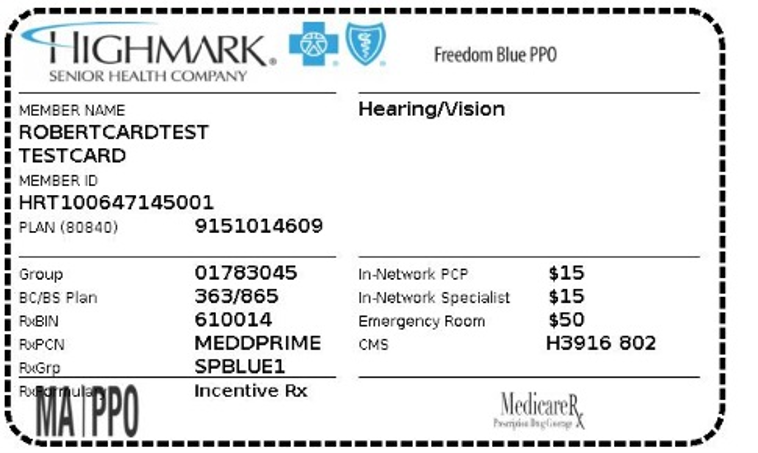
Older member ID cards may still feature the suitcase logo:

The “MA” in the suitcase indicates a member who is covered under the Blue Medicare Advantage PPO network sharing program. Members have been asked to not show their standard Medicare ID card when receiving services. Instead, members should provide their Blue Cross and/or Blue Shield Member ID card.
Eligibility and Benefits Verification
To verify eligibility and benefits for a Medicare Advantage PPO member, you can initiate a Secure Message via Availity®; submit an electronic inquiry to Highmark via a HIPAA 270/271 transaction; or call the BlueCard® Eligibility Line at 800-676-BLUE (2583). Be sure to ask if Medicare Advantage benefits apply.
Note: Be sure to have the member’s 3-character prefix for obtaining eligibility information.
Impact to Providers
If you are a contracted Highmark Medicare Advantage PPO provider in Pennsylvania or West Virginia, you must provide the same access to care for members of other participating Blue Medicare Advantage PPO Plans as you do for Highmark’s Medicare Advantage PPO members. You will be reimbursed in accordance with your contracted rate under your Freedom Blue PPO contract. These members will receive in-network benefits in accordance with their member contract.
If you are not a contracted Highmark Medicare Advantage PPO provider, you may see out-of-area Blue Medicare Advantage PPO members but are not required to do so.
Should you provide services to these members, you will be reimbursed for covered services at the Medicare allowed amount based on where the services were rendered and under the member’s out-of-network benefits. For urgent and emergency care, you will be reimbursed at the in-network benefit level.
Member Cost Sharing
A Medicare Advantage PPO member’s cost sharing level and copayment is based on their health plan. A Medicare Advantage PPO participating provider in Delaware, Pennsylvania, or West Virginia may collect the copayment amounts at the time of service or bill for any deductibles, coinsurance, and/or copayments. However, you may not balance bill the member the difference between your charge and the Medicare Advantage PPO allowance for a particular service.
To determine the member’s cost sharing, you should call the BlueCard Eligibility Line at 800-676-BLUE (2583).
How to recognize Medicare Advantage members Medicare Advantage members will not have a standard Medicare card; instead, a Blue Cross and/or Blue Shield logo will be visible on the ID card.
On older member ID cards, these images may illustrate how the different products associated with the Medicare Advantage program will be designated on the front of the member ID cards:

Newer cards may just reflect the product indicator text, such as MA HMO, MA POS, MA PPS, etc.
To verify eligibility and benefits for an out-of-area Medicare Advantage member, you can initiate a Secure Message via Availity®; submit an electronic inquiry to Highmark via a HIPAA 270/271 transaction; or call the BlueCard® Eligibility Line at 800-676-BLUE (2583). Be sure to ask if Medicare Advantage benefits apply.
Note: Be sure to have the member’s 3-character prefix in order to obtain eligibility information.
Medicare Advantage Claims Submission
Medicare Advantage is a separate program from BlueCard and delivered through its own centrally administered platform. However, claims for all out-of-area Blue Plan Medicare Advantage members are still submitted to your local Highmark plan under your current billing practices. You will receive payment from your local Highmark plan.
Important: Medicare should not be billed for any services rendered to a Medicare Advantage member.
NAIC Codes for Medicare Advantage Claims Submission
Claims for all out-of-area Blue Plan Medicare Advantage members can be submitted to your local Highmark plan via an electronic HIPAA 837 transaction using the applicable NAIC code for the Highmark plan with which you participate.
Please reference the following tables for NAIC codes for claim submission for Highmark Medicare Advantage products and for Medicare Advantage claims for out-of-area Blue Plans:
Delaware
|
NAIC Code |
Provider Type |
Products |
|---|---|---|
|
00070 |
Facility provider types (UB-04/837I) |
|
|
00570 |
All other provider types (1500/837P) |
|
New York
|
NAIC Code |
Provider Type |
Products |
|---|---|---|
|
55204 |
All provider types |
|
*Providers will continue to submit claims to Empire for Empire/Anthem members who are seen in — Albany, Clinton, Columbia, Essex, Fulton, Greene, Montgomery, Rensselaer, Saratoga, Schenectady, Schoharie, Warren, and Washington counties — that comprise the 13 counties of the Highmark Blue Shield (NENY) service region.
*Providers will continue to submit claims to Excellus for Excellus members who are seen in — Clinton, Essex, Fulton, and Montgomery counties — that comprise four of the 13 counties of the Highmark Blue Shield (NENY) service region.
Pennsylvania
|
NAIC Code |
Provider Type |
Products |
|---|---|---|
|
54771W |
Western Region facility type providers (UB-04/837I) |
|
|
54771C |
Central Region facility type providers (UB-04/837I) |
|
|
54771 |
All other provider types (1500/837P) |
|
|
15460 |
All provider types |
|
West Virginia
|
NAIC Code |
Provider Type |
Products |
|---|---|---|
|
54828 |
All provider types |
|
|
15459 |
All provider types |
|
For More Information
For complete information on all Highmark NAIC payer codes, see the section of this unit titled “NAIC Codes.”
Medicare Advantage Paper Claims Submission Addresses
Submit paper claims for Highmark Medicare Advantage products and out-of-area Blue Plan Medicare Advantage members to your local Highmark plan as follows:
|
Delaware |
New York |
Pennsylvania |
West Virginia |
|---|---|---|---|
|
Highmark Blue Cross Blue Shield (DE) |
Highmark |
Highmark Blue Shield |
Highmark Blue Cross Blue Shield (WV) |
Reimbursement for Medicare Advantage HMO, POS, and PPO – With a Plan Contract
If you are a Medicare participating provider and have a Medicare Advantage contract with Highmark, you will be reimbursed for covered services according to the Medicare fee schedule at the Medicare allowed amount when you render services to out-of-area Blue Plan Medicare Advantage HMO and POS members. Providers should make sure they understand the applicable Medicare Advantage reimbursement rules and their individual Plan contractual arrangements.
However, if you provide services to an out-of-area Medicare Advantage PPO Network Sharing member, you will be reimbursed in accordance with your contracted rate under your Freedom Blue PPO contract.
Other than the applicable member cost sharing amounts, reimbursement is made directly by Highmark. In general, you may collect only the applicable cost sharing (e.g., co-payment) amounts from the member at the time of service and may not otherwise charge or balance bill the member. Review the remittance notice concerning Medicare Advantage plan payment, member’s payment responsibility, and balance billing limitations.
Note: Out-of-area Medicare Advantage HMO members are generally covered only for emergency services; however, see below for the transplant services exception.
Medicare Advantage HMO Network Sharing for Transplant Services
Blue Cross Blue Shield Association (BCBSA) policy requires Blue Plans that offer Medicare Advantage HMO products to participate in network sharing for transplant services. Under the policy, Blue Plans with Centers for Medicare and Medicaid Services (CMS) approved transplant facilities included in their Medicare Advantage HMO networks are required to share contracted rates for transplant services with out-of-area Blue Plan Medicare Advantage HMO members.
Medicare Advantage HMO Network Sharing for Transplant Services will provide in- network access to all Blue Plans’ Medicare Advantage HMO provider networks for Blue Plan Medicare Advantage HMO members who may require a transplant service outside of their home Plan’s licensed service area.
Transplant facilities participating in Highmark’s Medicare Advantage HMO networks in Pennsylvania will be reimbursed according to their contracted Medicare Advantage HMO rate for approved transplant services for out-of-area Blue Plan Medicare Advantage HMO members. If you are a contracted Highmark Medicare Advantage HMO provider, you must provide the same access to transplant services for members of other Blue Plan Medicare Advantage HMO plans as you do for Highmark’s Medicare Advantage HMO members.
These members will receive in-network benefits for approved transplant services in accordance with their plan’s in-network benefits, with any applicable member cost sharing applied.
Reimbursement for Medicare Advantage HMO, POS, and PPO – With No Plan Contract
Based on the Centers for Medicare and Medicaid Services (CMS) regulations, if you are a Medicare participating provider who accepts Medicare assignment and you render services to a Medicare Advantage member but do not have a Medicare Advantage contract with Highmark, you will generally be considered a non-contracted provider and will be reimbursed the equivalent of the current Medicare allowed amount for all covered services (i.e., the amount you would collect if the beneficiary were enrolled in traditional Medicare).
Special payment rules apply to hospitals and certain other entities (such as skilled nursing facilities) that are non-contracted providers. Providers should make sure they understand the applicable Medicare Advantage reimbursement rules.
Other than the applicable member cost sharing amounts, reimbursement is made directly by a Blue Plan or its branded affiliate. In general, you may collect only the applicable cost sharing (e.g., co-payment) amounts from the member at the time of service and may not otherwise charge or balance bill the member.
Note: Enrollee payment responsibilities can include more than copayments (e.g., deductibles). Review the remittance notice concerning Medicare Advantage plan payment, member’s payment responsibility, and balance billing limitations.
Reimbursement for Medicare Advantage PFFS Members
If you have rendered services for a Blue out-of-area Medicare Advantage Private- Fee-For-Service (PFFS) member, you will generally be reimbursed the Medicare allowed amount for all covered services (i.e., the amount you would collect if the beneficiary were enrolled in traditional Medicare). Providers should make sure they understand the applicable Medicare Advantage reimbursement rules by reviewing the Terms and Conditions under the member’s Blue Plan.
Medicare Advantage PFFS Terms and Conditions might vary for each Blue Cross and/or Blue Shield Plan. We advise that you review them before servicing Medicare Advantage PFFS members.
A link is provided on the Provider Resource Center to access the Medicare Advantage PFFS Terms and Conditions for all Blue Plans.
Other than the applicable member cost-sharing amounts, reimbursement is made directly by a Blue Plan. In general, you may collect only the applicable cost sharing (e.g., co-payment) amounts from the member at the time of service, and may not otherwise charge or balance bill the member. Review the remittance notice concerning Medicare Advantage plan payment, member’s payment responsibility, and balance billing limitations.
The following are guidelines for the processing of traditional Medicare-related claims:
- When Medicare is the primary payer, submit claims to your local Medicare carrier or intermediary.
- Most Blue Plan claims are set up to automatically cross over to the member’s Blue Plan after being adjudicated by the Medicare intermediary.
How to Submit Medicare Primary/Blue Plan Secondary Claims
For members with Medicare primary coverage and Blue Plan secondary coverage, submit claims to your Medicare intermediary and/or Medicare carrier.
When submitting the claim, it is essential that you enter the correct Blue Plan name as the secondary carrier. This may be different from Highmark. Check the member’s ID card for the correct Blue Plan name.
Include the prefix as part of the member identification number. The member’s ID will include the prefix in the first three positions. The prefix is critical for confirming membership and coverage and key to facilitating prompt payments.
Review the Remittance Advice for Confirmation
When you receive the remittance advice from the Medicare intermediary, look to see if the claim has been automatically forwarded (crossed over) to the member’s Blue Plan:
- If the remittance advice indicates that the claim was crossed over, Medicare has forwarded the claim on your behalf to the appropriate Blue Plan and the claim is in process. Do not submit the claim to Highmark.
- If the remittance advice indicates that the claim was not crossed over, submit the claim to Highmark with the Medicare remittance advice.
- In some cases, the member identification card may contain a Coordination of Benefits Agreement (COBA) ID number. If so, be certain to include that number on your claim.
- For claim status inquiries, contact Highmark.
Claims submitted to the Medicare intermediary will be crossed over to the Blue Plan only after they have been processed. This process may take up to 14 business days.
This means that the Medicare intermediary will be releasing the claim to the Blue Plan for processing about the same time you receive the Medicare remittance advice. As a result, it may take an additional 14 to 30 business days for you to receive payment from the Blue Plan.
What to Do if You Have Not Received a Response
If you submitted the claim to the Medicare intermediary/carrier, and have not received a response to your initial claim submission, do not automatically submit another claim. You should:
- Review the automated resubmission cycle on your claim system
- Wait 30 days
- Check claim status before resubmitting
Sending another claim, or having your billing agency resubmit claims automatically, actually slows down the claim payment process and creates confusion for the member.
Questions?
If you have questions, contact Highmark Provider Service.
What is the BlueCard Executive?
The BlueCard Executive is a designated senior-level individual at Highmark who is accountable for resolving escalated issues regarding certain BlueCard claim payments. All other BlueCard issues must be addressed using existing dispute and/or appeals processes first.
Providers serviced by Highmark can request eligible escalations to Michael J. Edbauer, DO, MBA, SVP, Markets, by emailing BlueCardExecutive@highmark.com. Only members of the Provider MDL Settlement Class can engage the BlueCard Executive.
What claims can be escalated to the BlueCard Executive without first pursuing existing dispute and appeals processes?
BlueCard Executives can receive escalations for claims that meet the following criteria:
- Open BlueCard claims aged 45 calendar days or more from the submission date and billed charges of $1 million or more
- Open BlueCard claims aged 60 calendar days or more from the submission date and billed charges of $500,000 or more
- Open BlueCard claims aged 90 calendar days or more from the submission date and billed charges of $300,000 or more
How do I contact the BlueCard Executive?
You can contact your local Blue Plan’s BlueCard Executive by emailing BlueCardExecutive@highmark.com.
If the claim in question requires information or assistance from another Blue Plan, your BlueCard Executive will coordinate with the other Plan to resolve the inquiry. For additional information on the settlement, visit www.bcbsprovidersettlement.com.
The following entities, which serve the noted regions, are independent licensees of the Blue Cross Blue Shield Association: Western and Northeastern PA: Highmark Inc. d/b/a Highmark Blue Cross Blue Shield, Highmark Choice Company, Highmark Health Insurance Company, Highmark Coverage Advantage Inc., Highmark Benefits Group Inc., First Priority Health, First Priority Life, Highmark Care Benefits Inc., or Highmark Senior Health Company. Central and Southeastern PA: Highmark Inc. d/b/a Highmark Blue Shield, Highmark Benefits Group Inc., Highmark Health Insurance Company, Highmark Choice Company or Highmark Senior Health Company. Delaware: Highmark BCBSD Inc. d/b/a Highmark Blue Cross Blue Shield. West Virginia: Highmark West Virginia Inc. d/b/a Highmark Blue Cross Blue Shield, Highmark Health Insurance Company or Highmark Senior Solutions Company. Western NY: Highmark Western and Northeastern New York Inc. d/b/a Highmark Blue Cross Blue Shield. Northeastern NY: Highmark Western and Northeastern New York Inc. d/b/a Highmark Blue Shield.
All references to “Highmark” are references to the Highmark company that is providing the member’s health benefits or health benefit administration and/or to one or more of its affiliated Blue companies.
All revisions to this Highmark Provider Manual (the “manual” or “Highmark Provider Manual”) are controlled electronically. All paper copies and screen prints are considered uncontrolled and should not be relied upon for any purpose.