Unit 1: Product Overview
2.1 Preferred Provider Organization (PPO)
2.1 Exclusive Provider Organization (EPO)
2.1 Community Blue (Western PA Only)
2.1 Point of Service (NY Only)
2.1 Value-Based Benefits (PA Only)
2.1 Health Maintenance Organization (HMO)
2.1 Away from Home Care HMO Guest Membership
2.1 Traditional Fee-for-Service Plans
Highmark and its affiliates operate health insurance plans in Delaware, New York, Pennsylvania, and West Virginia. We offer a variety of health insurance plans in these service areas that are supported by our provider networks.*
Through its various product offerings, Highmark serves a wide array of large and small businesses, governmental agencies, individuals, and retirees.
All covered services are subject to specific benefit exclusions that are governed by the terms of the applicable contract and medical policy in effect at the time services are performed and are subject to change without prior notice.
*See Chapter 3, Unit 1: Network Participation Overview for information about Highmark’s provider networks and to learn how to participate in the networks.
**Medicare Advantage will not be addressed in this unit. See Chapter 2, Unit 2: Medicare Advantage Products and Programs for information on Medicare Advantage.
Highmark's Corporate Entities
Highmark is licensed to offer products under various corporate entities in Delaware, New York, Pennsylvania, and West Virginia. These corporate entities include, but may not be limited to, the following:
- Highmark Blue Cross Blue Shield (DE): Serving the entire state of Delaware.
- Highmark Blue Shield (NENY): Serving 13 counties of Northeastern New York.
- Highmark Blue Cross Blue Shield (WNY): Serving 8 counties of Western New York.
- Highmark Blue Cross Blue Shield (PA): Serving Western and Northeastern Pennsylvania.
- Highmark Blue Shield (PA): Serving Central Pennsylvania, the Lehigh Valley, and 5 counties in Southeastern Pennsylvania.
- Highmark Blue Cross Blue Shield (WV): Serving all of West Virginia.
- Highmark Choice Company: Serving the Western, Central, and Northeastern Regions of Pennsylvania.
- Highmark Health Insurance Company: Serving Western and Central Pennsylvania and the Lehigh Valley.
- Highmark Coverage Advantage: Serving Western Pennsylvania.
- Highmark Benefits Group: Serving Central Pennsylvania and the Lehigh Valley.
- Highmark Select Resources: Serving Central Pennsylvania and the Lehigh Valley.
- Highmark Senior Health Company: Serving Pennsylvania’s Western, Central, and Northeastern Regions.
- Highmark Senior Solutions Company: Serving West Virginia.
Reminder: Always Verify Benefits
In response to rising health costs, more customers are choosing health plans that require their employees to have more cost-sharing. These plans include higher deductibles, copayments, and/or coinsurance. Be sure to verify a member’s benefits and cost-sharing obligations at the time they receive services from you. Specific member information can be found in Availity Essentials.
What We Mean by Program and Product
When used in this manual, program and product have approximately the same meaning, but somewhat different usage. They both refer to the patient’s type of insurance coverage. They help to differentiate the types of insurance coverage, especially under a single insurance company.
- Program refers to the type of coverage (e.g., HMO, PPO, EPO, POS)
- Product refers to the brand name of the program (e.g., Freedom Blue PPO, PPO Blue, BlueCare Custom PPO).
Essential Health Benefits
Essential Health Benefits are defined as a set of health care services that must be covered by certain health plans — such as Highmark. The Affordable Care Act (ACA) ensures that health plans offer coverage that includes the following essential health benefits:
- Ambulatory patient services
- Emergency services
- Hospitalization
- Pregnancy, maternity, and newborn care
- Mental health and substance use disorder services, including behavioral health treatment
- Prescription drugs
- Rehabilitative and habilitative services and devices
- Laboratory services
- Preventive and wellness services
- Chronic disease management
- Pediatric services, including oral and vision care
Highmark, and all insurance carriers, must include coverage for essential health benefits in order to be certified and offer products through the Health Insurance Marketplace.
Medicare Advantage Products
Medicare Advantage plans are available for individuals who are enrolled in both Medicare Part A and Part B.
For information on Medicare Advantage plans, see Chapter 2, Unit 2: Medicare Advantage Products and Programs.
Partnership Products

Highmark recognizes that there are specific differences between the various regions that we serve; therefore, different strategies are being used to allow members to receive high quality care through lower-cost facilities within their communities.
In Pennsylvania, Highmark has partnered with certain hospitals, health systems, and independent providers to develop products that offer a variety of benefit structures and tiering options. These products are available in select counties served by these providers and include, but are not limited to, the following:
- Community Blue Flex Pennsylvania Mountains Healthcare Alliance
- Community Blue Flex Penn Highlands Region (available in the four-county Penn Highlands Region of western Pennsylvania)
- Lehigh Valley Flex Blue (Lehigh Valley Health Network [LVHN])
Managed care programs integrate the delivery and financing of medical care. The programs offer health care coverage through a network of contracted physicians who provide care to people who subscribe to the plan called members.
Managed care programs provide preventive coverage to members and use its network of physicians to assist in determining the appropriateness and the efficiency of the members’ care to promote and maintain good health while conserving resources.
Highmark currently offers the following types of managed care programs:
- Preferred Provider Organizations (PPOs)
- Exclusive Provider Organizations (EPOs)
- Point of Service (POS) and Open Access Programs
- Health Maintenance Organizations (HMOs)
- Independent Practice Associations (IPAs)
The following terms are commonly used in reference to managed care programs:
- Authorization: The official acknowledgement from Highmark that services/items requested meet the definition of “medically necessary and appropriate.”
- Covered Services: Those medically necessary and appropriate services and supplies that are provided as part of a benefit plan.
- Exclusions: Items or services that are not covered as part of a benefit plan.
- Primary Care Physician (PCP): PCP is a practitioner selected by a member in accordance with the member’s managed care program requirements. The practitioner provides, coordinates, or authorizes the health care services covered by the managed care program. The PCP may be a general practitioner, family practitioner, internist, pediatrician, or certified registered nurse practitioner (CRNP).
Preferred provider organization (PPO) programs typically offer members the ability to obtain care from a network participating provider at the higher in-network level of benefits and without the requirement to select a primary care physician (PCP).
PPO plans are offered in all of Highmark’s service areas in Delaware, New York, Pennsylvania, and West Virginia.
Outpatient Authorization Requirements
Highmark’s list of outpatient procedures/services requiring authorization apply to PPO products. These are the same authorization requirements that apply to other Highmark products (such as HMO and Medicare Advantage products).
The List of Procedures/DME Requiring Authorization is available on the Provider Resource Center's Obtaining Authorizations page.
General Characteristics of PPO Programs
PPO programs are generally characterized by the following:
- Benefits are offered at two levels (in-network and out-of-network) with the higher level of benefits received by using network participating providers. Some programs offer tiering at the in-network level of benefits, based on which providers render service.
- Members are usually not required to select PCPs to coordinate their care.
- Members can seek care without referrals.
- All practitioners are paid fee-for-service for care rendered to PPO members.
Note: See specific benefit details for the Medicare Advantage PPO products which vary from traditional PPOs.
In-Network and Out-of-Network Reimbursement
Payments made under PPO programs are based on the lesser of the applicable Highmark fee schedule allowance or the provider’s charge.
PPO programs provide higher-level reimbursement for services received from in-network providers and lower-level reimbursement for services received outside the network.
Network providers agree to accept Highmark’s allowance as payment in full for covered services, and to collect applicable co-payments, coinsurance and/or deductible amounts from their patient.
Network Providers for Delaware PPO Programs

Highmark Blue Cross Blue Shield Delaware's provider network supports the PPO products. This extensive network, the largest in the state, provides PPO members with access to leading health care professionals in all specialties and to all hospitals in the state.
In addition, ancillary providers in the network include, but are not limited to, suppliers of durable medical equipment, orthotics and prosthetics, home infusion therapy, and ambulance transportation.
Network Providers for New York PPO Programs

This extensive network provides PPO members with access to leading health care professionals in all specialties and to hospitals across Highmark Blue Cross Blue Shield (WNY) and Highmark Blue Shield (NENY) networks. We also contract with ancillary providers, which include, but are not limited to, suppliers of durable medical equipment, orthotics and prosthetics, home infusion therapy, and ambulance transportation.
Payments made under PPO programs are based on the terms of each provider’s contract as it relates to the service rendered. PPO programs provide reimbursement for services received from network providers at the in-network fee schedule rate and reimbursement for services received outside the network at the out-of-network fee schedule rate. The percentage of member coinsurance for in-network and out-of-network services is determined by the specific member contract.
Network Providers for Pennsylvania PPO Programs
The foundation of PPO programs is the network. In the Central region of Pennsylvania, the PremierBlue Shield network of preferred professional providers is located in the 21 counties of central Pennsylvania and the Lehigh Valley. Also included in the network are institutional and ancillary providers that contract with Highmark Blue Shield (PA) in this region. The PremierBlue Shield network also serves Highmark members with PPO plans in the Northeastern and Southeastern regions. In the 29 counties of western Pennsylvania, members have access to an additional network of professional, institutional, and ancillary providers. These providers will be reimbursed at the higher benefit level for covered services.
In addition, PPO products are available in Pennsylvania that use the select Community Blue networks and are designed to provide an affordable choice for customers seeking quality, lower-cost coverage and to encourage members to use hospitals and physicians who offer high quality and efficient care.
Also available are Community Blue Flex plans that give members two levels of in-network benefits, an “Enhanced Value Level” and a “Standard Value Level,” to let them choose the providers who will give them the most for their health care dollars. With Community Blue Flex, health care professionals and hospitals are grouped into two levels of in-network benefits. What the member pays for care is based on the level of benefits they choose. The plans give members more control over their health care costs. (Note: Community Blue Flex plans are available in the Central, Northeastern, and Western regions.)
Note: In Pennsylvania’s Central, Southeastern, and Northeastern regions, the PremierBlue Shield network of preferred professional providers provides high-level access for out-of-area Blue Plan PPO members through BlueCard. The Keystone Health Plan West (KHPW) managed care network supports BlueCard PPO programs in the 29-county Western region of Pennsylvania.
Network Work Providers for West Virginia PPO Programs

Highmark Blue Cross Blue Shield (WV)'s provider network is the basis for the PPO products. This extensive network provides PPO members with access to leading health care professionals in all specialties and to hospitals all across West Virginia. Also included in the network are ancillary providers, which include, but are not limited to, suppliers of durable medical equipment, orthotics and prosthetics, home infusion therapy, and ambulance transportation.
West Virginia Small Business Plan
The West Virginia Small Business Plan (WVSBP) is a PPO program created by the West Virginia State Legislature. The program makes health insurance coverage available to small businesses that meet certain eligibility criteria
Coverage is provided through health insurance plans offered by private insurance carriers. Highmark West Virginia is currently the only company that participates in the program.
Two features are unique to this program:
- First, carriers that participate can use the West Virginia Public Employees Insurance Agency’s (PEIA) reimbursement rates for West Virginia providers. In most instances, PEIA’s rates are significantly lower than those of private carriers.
- Second, all West Virginia providers who furnish services to PEIA members are automatically deemed to participate in the WVSBP unless the provider withdraws through an annual opt-out process administered by the PEIA each spring.
For its WVSBP product, Highmark West Virginia uses its regular PPO network minus those providers who have opted out of the WVSBP through the PEIA.
Reminder: Always verify benefits. For inquiries about eligibility, benefits, claim status, or authorizations, Highmark encourages providers to use the electronic resources available to them — Availity and the applicable HIPAA transactions — prior to placing a telephone call to the Provider Service Center.

Exclusive Provider Organization (EPO) plans provide members with coverage for a wide range of services when they are received from in-network providers. EPOs function like a PPO, but offer no out-of-network benefits except for emergency services. Members are not required to select a PCP to coordinate covered care, but it is recommended.
By utilizing the local Blue Plan PPO network, EPOs allow access to the largest provider network in the Highmark service area, as well as a large provider network across the country.
EPO Availability
Highmark offers EPO plans in Delaware, Northeastern New York, Western New York (ASO groups only), and Pennsylvania.
The following are general characteristics of EPO plans:
- There is no coverage when a member receives services from an out-of-network provider, except emergency services, which are covered at the in-network level.
- Members are not required to select PCPs to coordinate their care, but it is recommended.
- Some plans offer “tiering” of benefits, based on which providers render services.
- Highmark’s list of outpatient procedures/services requiring authorization will apply to EPO plans.
- Providers are required to contact Clinical Services to obtain authorization for in-network inpatient admissions.
Community Blue plans are offered in the western Pennsylvania service area.
Highmark’s Community Blue plans utilize a select network of high-quality practitioners and facilities within the Community Blue network. Community Blue plans provide an affordable choice for members who are seeking greater levels of cost-savings with quality, cost-efficient care. With Community Blue plans, both in-network and out-of-network benefit levels are offered. Community Blue qualified High-Deductible Health Plan (HDHP) options are available with a Health Savings Account (HSA).
Community Blue plans also offer “tiered” plans, which give the greatest level of cost-savings while still giving members the power to choose the care, the place, and the price that is right for them in their community.
General Types of Community Blue Plans
Community Blue EPO is offered in Pennsylvania’s Western Region. With all Community Blue EPO plans, members must receive services from providers participating in the Community Blue network. There is no out-of-network coverage, except for emergency services.
Community Blue Flex is offered in the Western Region. It is available as PPO or EPO plans. Flex plans have a “tiered” benefit design and offer two levels of in-network options for added cost savings:
- Enhanced Value offers a lower level of cost-sharing for the member.
- Standard Value has a higher level of cost-sharing for the member.
Community Blue HMO is only offered in Pennsylvania’s Western Region. Members must select a PCP and must receive services from providers participating in the Community Blue network. Similar to other HMO plans, there is no out-of- network coverage, except for emergencies.
Total Health Plan Design
Total Health is a specific EPO/PPO plan design that includes reduced member cost-sharing for a PCP office visit when a member uses a provider affiliated with a Patient Centered Medical Home (PCMH), Accountable Care Alliance (ACA), or Accountable Care Organization (ACO).
The plan also has reduced cost-sharing for certain services for members with chronic conditions such as asthma, chronic obstructive pulmonary disease (COPD), coronary artery disease (CAD), congestive heart failure (CHF), diabetes, high cholesterol, and hypertension.
Reminder: Always verify benefits. With the variety of products offered and various networks, it is more important than ever to always verify a member’s specific benefits prior to rendering services.
For inquiries about eligibility, benefits, claim status, or authorizations, Highmark encourages providers to use the electronic resources available to them – Availity and the applicable HIPAA transactions – prior to placing a phone call to the Provider Service Center.

Point of Service (POS) is a managed care benefit plan in which a member selects a primary care physician (PCP) and maximizes benefit coverage by securing care directly from, or under authorization by, the selected PCP. Members may incur additional out-of-pocket expenses or reduced benefits for using non-network providers.
Point of Service plans contain some elements of the fully managed care provided by HMOs, plus some of the freedom of choice provided by traditional benefit plans. Unlike an HMO, which typically covers services only when provided in the HMO network under the direction of the member’s PCP, a POS plan allows the member to select treatment by his or her PCP or choose to go to any other provider at the time care is needed (at the “point of service”). Benefits are highest when the member sees his/her PCP or is referred to another network provider by the PCP.
Point of Service plans are offered in Highmark’s New York service areas.
Highmark New York POS Plans
Point of Service members have coverage for eligible services by both in-network and out-of-network providers. Members are required to select a physician as their primary health gatekeeper who will render services directly to the member or coordinate their care with other specialists and/or facilities within the New York networks. POS members are also required to use Quest Diagnostics for laboratory services. Referrals are not required on any New York POS member services.
Members seeking services from non-network providers do not require a referral but will have a greater out-of-pocket cost under the out-of-network coverage. Members can be billed the difference between the allowed fee schedule amount and the physician/facility charge.
New York’s POS Wrap, or EX plan, functions like a PPO plan with access to the national BCBS PPO network but requires that the member enrolled in the plan live, work, or reside within the 13-county service area of Northeastern New York or the 8-county service area of Western New York. EX members are required to select a primary care physician and use Quest Diagnostics for elective laboratory procedures. Effective September 1, 2018, referrals are no longer required for New York POS plans.
Under this managed care plan, authorization and pre-certification are required for hospital admissions both in- and out-of-network. In addition, other targeted care may require authorization.
The provider may not bill the member for services covered except for any applicable co-pays, co-insurance, or permitted deductibles. A copayment, or copay, is a set amount paid to the provider by the member at the time of service. This amount is deducted from the reimbursement we make to you. Some of the services that require copayments are office visits, emergency room visits, diagnostic services, hospital admissions, and therapies. Copayments vary depending on the type of contract, provider (PCP or specialist) and service involved. Office visit copayments appear on most member identification cards.
In some cases, members are responsible for a coinsurance for covered services. Providers should submit the claim to Blue Cross Blue Shield for processing and then collect from the member their responsibility. Some products also have deductible amounts prior to copayments or coinsurance becoming applicable. Providers should submit the claim to Blue Cross Blue Shield to determine the member responsibility.

When caring for patients with chronic conditions, patient compliance is critical. Skipped medications or screenings can cause long-term damage; therefore, patient incentive can be a key to promoting patient compliance.
To give our members a “greater hand in their health,” Highmark created a Value-Based benefit design. In this benefit design, providers care for members with one or more chronic/targeted conditions by reducing or removing financial barriers to health care.
Benefit Options Available
Value-Based Benefits is coverage that promotes patient compliance in the management of chronic conditions. And, based on their unique employee populations, employer groups have some choices within the program. They can opt to cover all or some of the eight chronic/targeted conditions.
Employer groups can also choose to either waive or lower their employees’ cost-sharing (copays, coinsurance, etc.). These options apply to specific evidence-based, high-value medical services and prescriptions related to the selected condition(s).
Members with Value-Based Benefits who have a covered condition that an employer has selected will qualify if the member has signed up for that condition and completed the Wellness Profile. Reduced or waived cost sharing for services related to their health condition(s) will apply for the entire benefit year unless the member is required to complete certain protocols on a quarterly basis.
Targeted Conditions
The following are the chronic conditions targeted under Value-Based Benefits:
- Asthma
- Coronary artery disease (CAD)
- Congestive heart failure (CHF)
- Chronic obstructive pulmonary disease (COPD)
- Diabetes
- High blood pressure
- High cholesterol
Options Available for Verifying Coverage
Highmark advises providers to verify eligibility and benefits prior to rendering services to our members. You can use the appropriate HIPAA-compliant electronic transaction or our convenient, easy-to-use provider portal, Availity.
Program Options Continue to Expand
Value-Based Benefits offer many options to engage members. For example, employers may choose to:
- Require that certain health protocols related to the eight chronic/targeted conditions be met each quarter so employees continue to pay less for medical services and/or prescriptions to manage these conditions.
- Offer a reward for the completion of preventive services.
- Offer a waiver of an additional copay for specific surgeries if member engages in informed decision making and completes an online questionnaire.
A health maintenance organization (HMO) is a health care plan that provides comprehensive medical, surgical, hospital, and ancillary medical services including preventive care services. HMO plans are offered in Highmark service areas in New York and Pennsylvania. Members must use network participating providers to receive coverage for their care — except for emergency care in New York and Pennsylvania, and also urgent care in Pennsylvania.
Members receive this comprehensive benefits package in exchange for exclusive use of the HMO’s established provider network and compliance with its requirements. Care and case management services, along with authorization requirements, are inherent components of HMO programs and help ensure that care is medically necessary and provided in an appropriate setting.
The provider may not bill the member for services covered except for any applicable copays, coinsurance, or permitted deductibles. A copayment, or copay, is a set amount paid to the provider by the member at the time of service. This amount is deducted from the reimbursement we make to you. Some of the services that require copayments are office visits, emergency room visits, diagnostic services, hospital admissions and therapies. Copayments vary depending on the type of contract, provider (PCP or specialist) and service involved. Office visit copayments appear on most member identification cards.
In some cases, members are responsible for a coinsurance for covered services. Providers should submit the claim to Blue Cross Blue Shield for processing and then collect from the member their responsibility. Some products also have deductible amounts prior to copayments or coinsurance being applicable. Providers should submit the claim to Blue Cross Blue Shield to determine the member responsibility.
Important: New York Only
HMO members are also required to use Quest Diagnostics for laboratory services. Referrals are not required on any New York HMO member services.
In addition, effective Jan. 1, 2003, referrals were no longer required for HMO and HMO Senior members in New York. This means that primary care physicians can refer members directly to an in-network specialist without contacting the health plan for approval.
General Characteristics of HMOs

The following are general characteristics of HMO products:
- HMO products require members to select a network-participating primary care physician who provides preventive care services, directs patients to seek specialty care if required, and communicates with specialists to ensure continuity and coordination of care.
- For all HMO products, routine adult and pediatric physicals and pediatric immunizations must be performed by the member’s PCP to receive coverage.
- Members may change PCPs upon request.
- For services requiring authorization, the ordering physician should obtain the authorization.
- Blues On Call services and preventive care benefits
Coverage Outside the Service Area
Highmark’s commercial group/individual HMO members rely on a network of medical practitioners in the service area to supply medical care. However, members still have coverage when they are outside the network service area. The type of coverage that a member has depends on two elements:
- the care required; and
- whether they are traveling or living outside the service area.
Pennsylvania HMO Plans
In Pennsylvania’s 29-county Western Region only, Highmark offers HMO products through Highmark Choice Company, which utilizes the Keystone Health Plan West (KHPW) managed care provider network. HMO coverage requires you to select a primary care physician (PCP) who will become familiar with all aspects of your health and health care and, as your personal physician, will be responsible for treating you for your basic health care needs.
In the Northeastern Region, Highmark offers HMO products that are supported by providers participating in the First Priority Health (FPH) managed care network. The FPH network of professional providers and facilities spans throughout the 13-county service area and also includes several hospitals and their participating physicians in contiguous counties in Pennsylvania, New Jersey, and New York.
HMO Members are required to obtain preventive care (such as adult and pediatric routine physicals and pediatric immunizations) from their PCP, but can go directly to a network specialist for other covered services — without a referral.
The provider may not bill the member for services covered except for any applicable co-pays, co-insurance, or permitted deductibles. A copayment, or copay, is a set amount paid to the provider by the member at the time of service. This amount is deducted from the reimbursement we make to you. Some of the services that require copayments are office visits, emergency room visits, diagnostic services, hospital admissions and therapies. Copayments vary depending on the type of contract, provider (PCP or specialist) and service involved. Office visit copayments appear on most member identification cards.
In some cases, members are responsible for a coinsurance for covered services. Providers should submit the claim to Blue Cross Blue Shield for processing and then collect from the member their responsibility. Some products also have deductible amounts prior to copayments or coinsurance being applicable. Providers should submit the claim to Blue Cross Blue Shield to determine the member responsibility.
Required Care Definitions for HMO Members
The required care definitions for commercial group and direct pay HMO members are noted below. These definitions are not applicable to Medicare Advantage HMO products.
|
Care Required |
Definition |
|---|---|
|
Emergency Care |
The initial treatment:
|
|
Symptomatic Care |
Medical needs that are symptomatic but can be treated at the discretion of the physician and patient. Reasonable delays will most likely not affect the outcome of services. For HMO members, this type of care may be considered “urgent care” when traveling outside of the service area. Urgent care is defined as an unexpected illness or injury that cannot wait to be treated until the member returns home. Note: Urgent care requires authorization for Highmark Delaware members. |
|
Routine Asymptomatic and Preventive Care |
Medically asymptomatic conditions that can be addressed at the discretion of the physician and patient. Reasonable delays will not affect the outcome of services. For HMO members, this type of care may be considered “follow-up” care when traveling outside of the service area. Follow-up care is defined as ongoing services that a member requires, even when they are traveling, for care that was initiated while they were home (e.g. allergy shots, suture removal, cast check). Note: Routine preventive care services such as routine physicals, immunizations, or screening diagnostic tests would not be covered out-of-area as “follow-up care.” |
Away From Home Care® (AFHC) is a registered trademark of the Blue Cross and Blue Shield Association, an association of independent Blue Cross and Blue Shield Plans.
The Blue Cross and Blue Shield Association sponsors the AFHC Guest Membership Program through participating Blue HMOs at numerous locations throughout the United States. The Western Region commercial HMO product participates in this program both as a “home” HMO plan, offering this to our members, and also as a “host” HMO plan, where members from other Blue HMO plans may have a HMO guest membership in the western Pennsylvania, and Northeastern and Western New York service areas.
Note: This program is not available to Medicare Advantage HMO members in Pennsylvania’s Western Region. This program is also unavailable for Individual members in Western and Northeastern New York, including members in Essential Plans (Western NY).
Members Visiting the Highmark HMO Service Area
When home in a Highmark service area, our HMO members with a guest membership in another plan area who need non-emergency care may receive care only from a physician in the Highmark service area.
If the member had an established relationship with a Pennsylvania Western Region HMO, Delaware, or New York network PCP prior to their guest membership, this is the provider they should contact. If the member did not have an established PCP relationship prior to their guest membership, they should contact the Away From Home Care Coordinator at:
- In Delaware and Pennsylvania: 800-249-9579
- In New York: Call the number on the back of the member ID card
A physician must authorize any covered services received while at home. In an emergency, no prior approval is required. The member should go to the nearest medical provider. If follow-up care is needed while the member is at home, it can be arranged in the same manner as described above.
The Away From Home Care® (AFHC) Guest Membership program offered through the Blue Cross and Blue Shield Association allows members enrolled in other Blue Plan HMOs across the country to receive services covered under the “host” HMO benefit program if they are temporarily or permanently residing in the 29-county Western Region in Pennsylvania, in Delaware, 8 counties of Western New York, or 13 counties of Northeastern New York.
Hosting Guest Members
A Highmark PCP may be contacted by an AFHC coordinator from Highmark to host a member from another Blue Plan who will be temporarily or permanently residing in our region.
If a network PCP is chosen to host a member from another plan, they will be contacted by the AFHC coordinator by letter. This letter will notify them of their selection as well as providing member information such as name, address, birthday, and Member ID.
During the duration of the guest membership, all Highmark authorization policies and procedures apply to the treatment of guest members. The AFHC coordinator assigned to the case will assist you with any administrative concerns.
During the time HMO members have a guest membership in another Blue HMO, these members’ names will not appear on the PCP’s membership roster (except in New York).
Note: The AFHC Guest Membership Program is not available in all areas of the country.
Claims For Guest Members
Providers should submit claims in exactly the same manner as you would a claim for a local member.
Indemnity Programs
Under Traditional indemnity plans, Highmark members can seek care directly from any participating provider without coordination from a Primary Care Physician (PCP).
Participating providers agree to accept Highmark’s allowance as payment in full for covered services. The member is responsible for any applicable copayment, deductible, or coinsurance.
Providers For Indemnity Products
Highmark's traditional indemnity network includes inpatient and outpatient facilities, professional providers, and ancillary providers such as suppliers of home infusion therapy, durable medical equipment, orthotics and prosthetics, and ambulance transportation.
Payment
Payment for eligible services is based on the Plan Allowance. Participating providers agree to accept the Highmark allowance as payment in full and to collect all applicable copayments, deductible amounts, and/or coinsurance from their patient.
Billing
At the time of service, providers can collect applicable copayments, coinsurance, and/or deductible amounts. Participating providers must submit claims to Highmark for services rendered.

Major Medical benefits supplement the hospital and medical/surgical portions of basic coverage. The member shares in the cost of medical expenses through an annual deductible and coinsurance.
Major Medical requires a program deductible for the member and each dependent. The amount of the deductible varies according to the member’s contract. A new deductible amount is required each benefit period.
Generally, when the deductible is satisfied for the member or dependent(s), major medical pays 80 percent of the Plan Allowance for covered medical expenses, and the member is liable for the other 20 percent.
Major Medical extends the coverage available under basic contracts and provides coverage for additional services, such as:
- Ambulance service
- Blood products
- Doctors’ office visits
- Durable medical equipment
- Outpatient therapy and rehabilitation services
- Prescription drugs
If the member is enrolled in a standalone Major Medical program and, during the benefit period the member or dependent’s expenses exceed the deductible, the member should complete a Major Medical claim form. The member should submit the claim along with the provider's itemized bills, to the Blue Plan through which the member is enrolled.
In addition to being offered as a standalone benefit option, Major Medical can be incorporated into the traditional benefits package. Claims processing is automated through a feature called concurrent Major Medical processing -- which does not require a separate submission of a Major Medical claim form.
See Chapter 6, Unit 7: Payment/EOBs/Remittances for additional information.
The following entities, which serve the noted regions, are independent licensees of the Blue Cross Blue Shield Association: Western and Northeastern PA: Highmark Inc. d/b/a Highmark Blue Cross Blue Shield, Highmark Choice Company, Highmark Health Insurance Company, Highmark Coverage Advantage Inc., Highmark Benefits Group Inc., First Priority Health, First Priority Life, Highmark Care Benefits Inc., or Highmark Senior Health Company. Central and Southeastern PA: Highmark Inc. d/b/a Highmark Blue Shield, Highmark Benefits Group Inc., Highmark Health Insurance Company, Highmark Choice Company or Highmark Senior Health Company. Delaware: Highmark BCBSD Inc. d/b/a Highmark Blue Cross Blue Shield. West Virginia: Highmark West Virginia Inc. d/b/a Highmark Blue Cross Blue Shield, Highmark Health Insurance Company or Highmark Senior Solutions Company. Western NY: Highmark Western and Northeastern New York Inc. d/b/a Highmark Blue Cross Blue Shield. Northeastern NY: Highmark Western and Northeastern New York Inc. d/b/a Highmark Blue Shield.
All references to “Highmark” in this document are references to the Highmark company that is providing the member’s health benefits or health benefit administration and/or to one or more of its affiliated Blue companies.
All revisions to this Highmark Provider Manual (the “manual” or “Highmark Provider Manual”) are controlled electronically. All paper copies and screen prints are considered uncontrolled and should not be relied upon for any purpose.
Unit 2: Medicare Advantage Products and Programs
Medicare is the federal health insurance program for people who are age 65 or older, certain younger people with disabilities, and people with End-Stage Renal Disease (permanent kidney failure requiring dialysis or transplant, sometimes referred to as ESRD).
Medicare has:
- Part A Hospital Insurance that helps cover inpatient care in hospitals, including critical access hospitals and skilled nursing facilities (not custodial or long-term care), hospice care, and some home health care.
- Part B Medical Insurance that helps cover certain doctors’ services, outpatient care, medical supplies, and preventive services.
- Part D Prescription Drug Coverage is an optional benefit for prescription drugs available to all people with Medicare for an additional charge. This coverage is offered by insurance companies and other private companies approved by Medicare.
In an effort to make broader and more cost-effective coverage options available to people eligible for Medicare, the Centers for Medicare and Medicaid Services (CMS) created “Medicare Part C.” This term includes a wide variety of delivery models, which serve as replacements for Traditional Medicare. All of these models are funded through a combination of payments from the Medicare program and the member’s premium.
These plans, known as “Medicare Advantage” programs, are offered by private companies that contract with Medicare to provide members with Part A and Part B benefits. Most Medicare Advantage plans also offer prescription drug coverage. Medicare Advantage Plans include Health Maintenance Organizations (HMOs), Preferred Provider Organizations (PPOs), Private Fee-for-Service Plans (PFFS), Special Needs Plans, and Medicare Medical Savings Account Plans (MSAs).
While a person is a member of Medicare Advantage, services are not paid by Traditional Medicare except for services incurred during a hospice election period and routine costs associated with clinical trials paid by Medicare.
At a minimum, Medicare Advantage programs are required to provide coverage for the services covered by Traditional Medicare’s Part A and Part B coverage. They may also provide additional services and benefits such as routine dental and vision.
Highmark's Compliance Commitment to CMS Regulations
Highmark complies with all state and federal laws related to Medicare and our Medicare Advantage Products. In cases where Highmark policy, Highmark Medical Policy, settlement provisions, and/or Centers for Medicare and Medicaid (CMS) policy vary, the CMS regulation prevails.
For more information on specific CMS regulations, please visit cms.gov.
Note: From time to time, CMS will issue coverage of payment directives that are subject to the terms of the Medicare Advantage plans’ agreements in place with their participating providers. In those cases, Highmark will review our Medicare Advantage Provider Agreements and will determine whether the terms of the Medicare Advantage Provider Agreements will take precedence over the CMS directive. If Highmark, upon review of the Medicare Advantage Provider Agreement, makes the determination to reimburse pursuant to the CMS payment directive, such reimbursement will be subject to the terms of the Medicare Advantage Provider Agreement, any applicable administrative requirements, and any outcome-related goals as established by CMS and Highmark, collectively or individually.
Compliance Language and EOC Booklets
Medicare Advantage Compliance Language and Member Evidence of Coverage (EOC) Booklets are available in the Appendix of the Highmark Provider Manual.
Medicare Advantage HMO Network Sharing for Transplant Services

Blue Cross Blue Shield Association (BCBSA) policy requires Blue Plans that offer Medicare Advantage HMO products to participate in network sharing for transplant services. Under the policy, Blue Plans with Centers for Medicare and Medicaid Services (CMS) approved transplant facilities included in their Medicare Advantage HMO networks are required to share contracted rates for transplant services with out-of-area Blue Plan Medicare Advantage HMO members.
Medicare Advantage HMO Network Sharing for Transplant Services will provide in-network access to all Blue Plans’ Medicare Advantage HMO provider networks for Blue Plan Medicare Advantage HMO members who may require a transplant service outside of their home Plan’s licensed service area.
Transplant facilities participating in Highmark’s Medicare Advantage HMO networks in New York and Pennsylvania will be reimbursed according to their contracted Medicare Advantage HMO rate for approved transplant services for out-of-area Blue Plan Medicare Advantage HMO members. If you are a contracted Highmark Medicare Advantage HMO provider, you must provide the same access to transplant services for members of other Blue Plan Medicare Advantage HMO plans as you do for Highmark’s Medicare Advantage HMO members. These members will receive in-network benefits for approved transplant services in accordance with their plan’s in-network benefits, with any applicable member cost sharing applied.
Highmark offers the following Medicare Advantage products:
- Community Blue Medicare HMO – offered in select counties in Pennsylvania’s Western, Central, and Northeastern regions, and Western New York
- Community Blue Medicare PPO – offered in select counties in Pennsylvania’s Central and Northeastern regions
- Community Blue Medicare Plus PPO – offers exclusive access to Geisinger Danville facilities and doctors and is offered only to members living in select counties in Northeastern Pennsylvania
- Complete Blue PPO – offered across Delaware, Pennsylvania, and West Virginia
- Complete Blue HMO – offered in Western Pennsylvania
- Freedom Blue PPO – offered in Delaware, Pennsylvania, and West Virginia
- NENY Freedom HMO – offered in Northeastern New York
- NENY Medicare Advantage PPO – offered in Northeastern New York
- Security Blue HMO-POS – offered in Western Pennsylvania
- Together Blue HMO – offered in Western Pennsylvania
- WNY Forever Blue PPO – offered in Western New York
- WNY Medicare Advantage HMO – offered in Western New York
Community Blue Medicare HMO
(select counties in Pennsylvania’s Western, Central, and Northeastern regions, and Western New York)
Community Blue Medicare HMO is a select high-value network product that offers high quality at a lower cost for seniors. Members must seek care from providers participating in the Community Blue Medicare HMO network, with the exception of urgent and emergency care.
To enroll in Highmark’s Community Blue Medicare HMO, a member must have both Medicare Part A and Part B and must reside in the service area.
PLEASE NOTE: The Community Blue Medicare HMO network differs from the network associated with the commercial Community Blue products.
Community Blue Medicare HMO participating providers can be located by searching the Provider Directory in the applicable service area.
Community Blue Medicare PPO
(select counties in Pennsylvania’s Central and Northeastern regions)
Community Blue Medicare PPO has a broader network of providers than Community Blue Medicare HMO and provides flexibility to use out-of-network providers.
It also provides more freedom for members who travel by providing in-network cost sharing when members use Medicare Advantage PPO participating providers of other Blue Plans.
The benefit design and cost sharing for the Community Blue Medicare PPO Signature plans are similar to Community Blue Medicare HMO.
Community Blue Medicare Plus PPO
(select counties in Northeastern Pennsylvania)
Community Blue Medicare Plus PPO provides the same level of benefits as Community Blue Medicare PPO, with the addition of exclusive access to Geisinger Danville facilities and doctors. It also provides coverage for out-of-network hospitals and physicians at a higher level of cost sharing for the member.
Complete Blue PPO

(across Delaware, Pennsylvania, and West Virginia)
Complete Blue PPO plans are available across Delaware, Pennsylvania, and West Virginia. As with other Medicare Advantage products, a member must have both Medicare Part A and Part B and must reside in the service area. It also provides more freedom for members who travel by providing in-network cost sharing when members use Medicare Advantage PPO participating providers of other Blue Plans.
Complete Blue HMO
(Western Pennsylvania)
Complete Blue HMO is available in Highmark’s Western Pennsylvania region. As with other Medicare Advantage products, a member must have both Medicare Part A and Part B and must reside in the service area. It provides access to a broad network of hospitals and doctors in the plan's service area.
Freedom Blue PPO
(Delaware, Pennsylvania, and West Virginia)
Freedom Blue PPO is a Medicare Advantage Preferred Provider Organization plan.
Freedom Blue PPO offers members a choice of where they receive in-network care throughout the Freedom Blue PPO network and from providers who participate in other Blue Plan Medicare Advantage PPO networks in 35 states and Puerto Rico. Members also have access to covered services out-of-network, both in area and out-of-area. Freedom Blue PPO members are not required to select a PCP; however, they are encouraged to select a Physician of Record, such as a primary care practice that will provide routine care and coordinate specialist care.
Freedom Blue PPO provides coverage for all of the member’s health care needs, including medical, prescription drugs, routine dental, vision, hearing, and preventive care. Members are responsible for paying any applicable cost sharing for covered services.
NENY Freedom HMO
(Northeastern New York)
NENY Freedom HMO plans are available across Northeastern New York. It is a select high-value network product that offers high quality at a lower cost for seniors. Members must seek care from providers participating in the NENY Freedom HMO network, with the exception of urgent and emergency care.To enroll in NENY Freedom HMO, members must have both Medicare Part A and Part B and must reside in the service area..
NENY Medicare Advantage PPO
(Northeastern New York)
NENY Medicare Advantage PPO plans are available across Northeastern New York. As with other Medicare Advantage products, members must have both Medicare Part A and Part B and must reside in the service area. It also provides more freedom for members who travel by providing in-network cost sharing when members use Medicare Advantage PPO participating providers of other Blue Plans.
Security Blue HMO-POS
(Western Pennsylvania)
Security Blue HMO-POS, A Medicare Advantage HMO Point of Service product, requires members to choose a primary care physician (PCP) who coordinates care with network participating specialists and facilities when necessary.
Members can receive care from Security Blue HMO-POS network of providers, except in emergencies, but also have coverage out-of-network for certain benefits and may have a higher cost-share.
Together Blue HMO
(Western Pennsylvania)
Together Blue HMO is a select high-value network product that offers high quality at a lower cost for seniors. Members must seek care from providers participating in the Together Blue HMO network, with the exception of urgent and emergency care.To enroll in Highmark’s Together Blue HMO, members must have both Medicare Part A and Part B and must reside in the service area.
WNY Forever Blue PPO
(Western New York)
WNY Forever Blue PPO plans are available across Western New York. As with other Medicare Advantage products, members must have both Medicare Part A and Part B and must reside in the service area. It also provides more freedom for members who travel by providing in-network cost sharing when members use Medicare Advantage PPO participating providers of other Blue Plans.
WNY Medicare Advantage HMO
(Western New York)
WNY Medicare Advantage HMO plans are available across Western New York. It is a select high-value network product that offers high quality at a lower cost for seniors. Members must seek care from providers participating in the WNY Medicare Advantage HMO network, with the exception of urgent and emergency care.To enroll in WNY Medicare Advantage HMO, members must have both Medicare Part A and Part B and must reside in the service area.
Medicare Advantage HMO and PPO products provide Medicare Part B Prescription Drug coverage (MA-only plans). Some Medicare Advantage plans may also include Medicare Part D Prescription Drug Coverage benefits (MA-PD plans).
Part B Prescription Drug Coverage
Medicare Part B covers certain types of injectable and infusible drugs that are not usually self-administered. These include drugs that are furnished and administered as part of a service performed by a health care professional.
Highmark’s Medicare Advantage products also cover such drugs which can be categorized as follows:
- Drugs that include substances naturally present in the body, including blood clotting factors and insulin
- Clotting factors for patients with hemophilia
- Immunosuppressive drugs for patients who have had an organ transplant covered by Medicare
- Injectable osteoporosis drugs, for homebound patients with a bone fracture certified by a physician as related to post-menopausal osteoporosis
- Chemotherapy
- Drugs administered during outpatient dialysis, such as heparin, heparin antidote, topical anesthetics, erythropoietin (Epogen) or Epoetin Alfa and Darboetin Alfa
- Certain oral anti-cancer drugs and anti-nausea drugs
- Intravenous immune globulin for the home treatment of primary immune deficiency diseases
Highmark provides a link on the Provider Resource Center's Medicare Programs page to the Centers for Medicare and Medicaid Services (CMS) Medicare Part B Drug website. This website includes the Medicare Part B Drug Regulations, the Medicare Part B Drug Average Sales Price (ASP) tables, which are updated quarterly, and the quarterly ASP NDC-HCPCS Crosswalks.
Authorization May be Required
Some Medicare Part B drugs require authorization. Please check the List of Procedures/DME Requiring Authorization available on the Provider Resource Center's Obtaining Authorizations page.
Important: Verify Member Cost Sharing Via Availity®
If you have specific questions about the way Medicare Advantage members can obtain certain Part B prescription drugs, contact the Provider Service Center.
Medicare Part D Prescription Drug Coverage
Highmark offers Medicare Part D prescription drug coverage under many of its Medicare Advantage HMO and PPO plans as well as through the Medicare-approved stand-alone Blue Rx Prescription Drug Plans.
These plans provide coverage for prescription drugs that are covered under the Medicare Prescription Drug Benefit (Part D) and that are also on the Highmark Medicare-Approved Formulary for Medicare Products.
For More Information
To locate participating retail pharmacies for members, visit MyHighmark.com. Under Find top-quality care close by, click FIND DOCTORS AND RX. You'll need to enter your ZIP Code to be taken to the correct site for your region. Scroll down to Find a pharmacy.
Additional information for providers is also available on the Provider Resource Center's Medicare Formularies page.
Medicare Prescription Payment Plan
The Medicare Prescription Payment Plan is an alternative payment option for Medicare members that works with Highmark’s Part D drug coverage to help members manage out-of-pocket costs. While this option may help members manage their monthly expenses, it does not save members money or lower their total drug costs. To learn more about the Medicare Prescription Payment Plan, go here.
To be eligible to elect hospice care under Medicare Part A, an individual must be eligible for Medicare Part A and be certified as terminally ill. An individual is considered to be terminally ill if the medical prognosis is that the individual’s life expectancy is six months or less if the illness runs its normal course. Only care provided by (or under arrangements made by) a Medicare-certified hospice provider is covered under the Medicare Hospice Benefit. The Medicare beneficiary (or authorized representative) must elect hospice care to receive it.
Medicare beneficiaries enrolled in Medicare Advantage plans may elect hospice care under the Medicare Hospice Benefit. Federal regulations require that Original Medicare maintains payment responsibility for all Medicare-covered services during a hospice election period for all Medicare beneficiaries.
Effective Date of Hospice Election
A Medicare Advantage member (or the member's authorized representative) must elect hospice care to receive it. If the member (or authorized representative) elects to receive hospice care, he or she must file a hospice election statement with the hospice provider designating the Effective Date of Election, which is the same as the hospice admission date. An individual may not designate an Effective Date of Election that is retroactive (prior to the date the statement is filed and signed).
Original Medicare coverage begins on the Effective Date of Election, regardless of the day of the month. For example, if the member files a hospice election statement on March 9 with an Effective Date of Election of March 10, Original Medicare assumes payment responsibility beginning on March 10.
Member May Revoke Hospice Election
A Medicare Advantage member (or authorized representative) may revoke hospice election at any time in writing. Claims will continue to be paid by Original Medicare until the first day of the following month in which hospice election was revoked. The member’s Medicare Advantage plan will resume payment responsibility for covered services beginning on the first day of the month after hospice election was revoked.
For example, if the Medicare Advantage member revokes their hospice election on June 6, Original Medicare will be responsible for payment of hospice services related to the terminal prognosis through June 30. The member’s Medicare Advantage plan will provide coverage for all eligible services beginning July 1.
Services unrelated to the terminal illness Medicare-covered services unrelated to the treatment of the terminal condition for which hospice was elected, and which are furnished during a hospice election period, are billed to Medicare for payment. On professional claims, these services are coded with the GW modifier (“service not related to the hospice patient’s terminal condition”). These services are coded with Condition Code 07 (“Treatment of Non-terminal Condition for Hospice”) on institutional claims.
Claims for these services can be billed to Highmark with the GW modifier or 07 Condition Code, as applicable, for consideration of the Medicare cost sharing. The member’s Medicare Advantage plan will cover the Medicare cost sharing and apply the Medicare Advantage plan’s cost sharing for covered services according to the plan’s benefits.
Reminder: Since Medicare Advantage HMO plans do not have out-of-network benefits, the Medicare cost sharing will not be covered for services provided by an out-of-network provider.
Medicare Non-Covered Services
Services that are not covered by Medicare but are eligible under the member’s Medicare Advantage plan, whether or not they are related to the terminal prognosis, are billed to Highmark and reimbursed according to the member’s Medicare Advantage plan.
Hospital Inpatient Admissions
When a Medicare Advantage member requires an inpatient hospital admission, the designated payer at the time of the hospital admission is responsible for payment of the hospital stay.
For example, when a Medicare Advantage member is admitted as an inpatient in a hospital while in a hospice election period, Medicare is responsible for payment of the hospital stay through discharge even if the member revokes hospice election during the hospital stay. However, if a Medicare Advantage member elects hospice during an inpatient hospital stay, the Medicare Advantage plan is the responsible payer for the entire hospital stay from admission through discharge, with Medicare assuming payment responsibility after discharge.
For More Information
For more information about the Medicare Hospice Benefit, please see the following Centers for Medicare and Medicaid Services (CMS) online program manuals:
- Pub. 100.2, Medicare Benefit Policy Manual, Chapter 9 – Coverage of Hospice Services under Hospital Insurance
- Pub. 100.4, Medicare Claims Processing Manual, Chapter 11 - Processing Hospice Claims
“Dual eligible beneficiaries” is the general term that describes individuals who are enrolled in both Medicare and Medicaid. The term includes individuals who are enrolled in Medicare Part A and/or Part B and receive full Medicaid benefits and/or assistance with Medicare premiums or cost-sharing through one of the Medicare Savings Programs (MSPs):
- Qualified Medicare Beneficiary (QMB) Program: Helps pay for Part A and/or Part B premiums, deductibles, coinsurance, and copayments;
- Specified Low-Income Medicare Beneficiary (SLMB) Program: Helps pay for Part B premiums;
- Qualifying Individual (QI) Program: Helps pay for Part B premiums; and
- Qualified Disabled Working Individual (QDWI) Program: Pays the Part A premium for certain people who have disabilities and are working.
Medicare-covered services also covered by Medicaid are paid first by Medicare; Medicaid is generally the payer of last resort. Medicaid may cover the cost of care that Medicare may not cover or may partially cover (such as personal care and community-based services).
Qualified Medicare Beneficiary (QMB) Program
The goal of the Qualified Medicare Beneficiary (QMB) Program is to reduce financial barriers and ensure meaningful access to Medicare benefits for those individuals who are elderly and those with disabilities with limited assets and income under 100% of the Federal Poverty Level. It does so by requiring State Medicaid Plans to cover Medicare Part A and Part B premiums as well as the cost-sharing per service for which a Medicare beneficiary is normally liable.
Enrollees who meet the QMB program’s qualifying criteria fall into two groups: “QMB Only” and “QMB Plus.” QMB Only beneficiaries are entitled to QMB cost-sharing support for Medicare benefits, but do not qualify for any other Medicaid benefits; QMB Plus enrollees qualify for both QMB cost-sharing support and all services provided by their states’ full Medicaid programs.
Within broad national guidelines established by federal statutes, regulations, and policies, each state establishes its own eligibility standards; determines the type, amount, duration, and scope of services; sets the rate of payment for services; and administers its own Medicaid program.
The 1997 Balanced Budget Act clarified that a state is not obligated to pay providers up to the full amount of Medicare cost-sharing if the total payment (including both the Medicare portion and the State’s portion) would exceed the state’s Medicaid rate for that service. Instead, states may limit their reimbursement to the lesser of two amounts: the full amount of Medicare cost-sharing, or the difference between the Medicaid rate and the amount already paid by Medicare. The vast majority of states limit Medicare cost-sharing payment levels for QMB enrollees and other full-benefit dually eligible beneficiaries at their Medicaid rates.
Balance Billing Restrictions
An important component of the QMB Program is enrollee protection against “balance billing” (billing for Medicare cost-sharing, including deductibles, coinsurance, and copayments). Federal law prohibits all Medicare and Medicare Advantage providers from balance billing QMB individuals for all Medicare deductibles, coinsurance, or copayments. Medicare providers must accept the Medicare payment and Medicaid payment (if any) as payment in full for services rendered to a QMB beneficiary.
All original Medicare and Medicare Advantage providers — not only those that accept Medicaid — must abide by the balance billing prohibitions. Medicare and Medicare Advantage providers who violate these billing prohibitions are violating their Medicare Provider Agreement and may be subject to sanctions. Balance billing restrictions apply regardless of whether the State Medicaid Agency is liable to pay the full Medicare cost-sharing amounts. Even if payment is not available under the State Medicaid Plan, QMB enrollees are not liable for Medicare deductibles, coinsurance, and copayments.
Individuals in the QMB Program retain their protection from balance billing even when they cross state lines to receive care. Providers cannot charge QMB individuals even if the patient’s QMB benefit is provided by a different State than the State in which care is rendered. In addition, QMB enrollees cannot choose to “waive” their QMB status and pay Medicare cost-sharing (the federal statute supersedes Section 3490.14 of the State Medicaid Manual, which is no longer in effect).
Prohibition on Discrimination Based on QMB Status
Federal and state laws prohibit unlawful discrimination in the treatment of patients on the basis of race, ethnicity, national origin, religion, sex, age, mental or physical disability or medical condition, sexual orientation, claims experience, medical history, evidence of insurability (including conditions arising out of acts of domestic violence), disability, genetic information, or source of payment.
The Centers for Medicare and Medicaid Services (CMS) notes in the applicable anti-discrimination provisions that Medicare Advantage providers are prohibited from discriminating against patients based on their QMB status (see Managed Care Manual, Chapter 4, Section 10.5.2): “Discrimination based on ‘source of payment’ means, for example, that Medicare Advantage providers cannot refuse to serve enrollees because they receive assistance with Medicare cost-sharing from a State Medicaid program.”
Identifying QMB Enrollees
You can contact the Medicaid Agency in the State(s) in which you practice to learn about ways to identify QMB patients in your State and procedures applicable to Medicaid reimbursement for Medicare cost-sharing.
If you have questions concerning QMB status for Highmark Medicare Advantage members, contact the Provider Service Center.
Tips to Avoid Inappropriate Billing of QMB Beneficiaries
The following practices will help Medicare and Medicare Advantage providers to ensure compliance with balance billing restrictions for QMB beneficiaries.
- Contact the Medicaid Agency in the state(s) in which you practice to learn about identifying QMB enrollees and the processes in place to receive reimbursement for Medicare cost-sharing (different processes may apply for original Medicare and Medicare Advantage services).
- Determine whether a patient with original Medicare or Medicare Advantage coverage is a dual eligible beneficiary under the QMB program prior to providing services.
- Establish processes that identify QMB beneficiaries when a patient is first seen at a practice and during routine insurance information updates.
- Educate your administrative staff on the federal balance billing law and the policies regarding QMB individuals.
- Ensure that your billing software will exempt QMB individuals from Medicare cost-sharing billing and related collection efforts.
For more information on the QMB Program, refer to the Medicare Learning Network publication titled Prohibition on Balance Billing Dually Eligible Individuals Enrolled in the Qualified Medicare Beneficiary (QMB) Program.
Highmark provides a supplemental hearing aid and routine hearing exam benefit on most Medicare Advantage plans and all D-SNP plans. For these benefits, Highmark has a partnership with TruHearing™, a national hearing provider. This partnership is designed to ensure quality, exceptional service, and minimize our members’ out-of-pocket expenses.
As an exclusive hearing provider to contracted health plans, TruHearing negotiates prices with top hearing aid manufacturers. This allows health plans to make hearing aids more affordable for their members.
Important: Contract with TruHearing Required
In order for plan coverage to be considered in-network for hearing aids and/or routine hearing exams, the provider must be contracted with Highmark and TruHearing. Providers interested in contracting with TruHearing should contact TruHearing’s Provider Outreach:
- Email: ProviderContracting@TruHearing.com
- Phone: 801-938-1294
Benefit Coverage
For specific plan details surrounding hearing aid and routine hearing exam copays, limits, and specific model coverage, members should reference their Evidence of Coverage (EOC) booklet. As mentioned above, most plans offer this supplemental coverage.
Provider Responsibility
Highmark participating TruHearing providers conduct comprehensive hearing exams for eligible Highmark Medicare Advantage members, reviewing and discussing the results with the member. If the diagnosis requires treatment with hearing aids, the provider would recommend the appropriate hearing aids from the options available in the member’s benefit, including specifics on products, styles, technology levels, and costs.
The provider places the orders for hearing aids through TruHearing. TruHearing ships the hearing aids to the provider’s office for fitting and programming for Highmark’s members. The member receives 12 months of follow-up visits for programming, fitting, and adjustments that are included in the purchase of the hearing aid.
To receive payment, participating providers must collect the applicable copays for both the routine hearing exams and hearing aids from the member, and then confirm the copay amounts in Echo, TruHearing’s online provider portal.
Questions?
For questions about the billing and payment process, contact TruHearing’s Provider Outreach by email at ProviderContracting@TruHearing.com, or by telephone at 801-938-1294.
Non-Covered Services
If it is believed that a service or item is not covered or may not be covered for a Highmark Medicare Advantage member, providers must advise the member that a written coverage decision ("pre-service organization determination") is required from Highmark before the service or item can be provided. Providers can request a pre-service organization determination on the member’s behalf or direct members to request a pre-service organization determination by calling the phone number on their identification card.
If a provider supplies a non-covered hearing aid and a pre-service organization determination has not been issued, the member or Highmark will not be responsible for payment.
*Medicare Advantage PPO plan members should contact the health plan if they have questions about out-of-network reimbursement for hearing services.
Directing Members
Highmark Medicare Advantage members can reference their Evidence of Coverage (EOC) booklet for their plan’s hearing aid benefit and call Highmark Member Services with any questions. Member Services can transfer calls, when applicable, to a TruHearing Customer Care Representative.
TruHearing’s personal consultants will answer any questions, check a member’s insurance eligibility, including verifying copayment amounts, and set up appointments with Highmark participating TruHearing providers.
For More Information
To learn more about the benefits under Highmark’s Medicare Advantage plans, you can access Medicare Advantage Evidence of Coverage (EOC) booklets on our public website at medicare.highmark.com.
Highmark launched the House Call Program to support Medicare Advantage, Affordable Care Act (ACA), Dual Eligible Special Needs Plan (D-SNP), and Medicaid members, and continues to expand the program to new geographies, as applicable. At no cost to the member, the House Call program is aimed at helping members who have chronic conditions or who are at risk of further health complications to better understand their conditions and how they can access the resources they need.
Highmark identifies members with chronic conditions and those who may be disengaged from their normal care routines through claims data. Once identified, we are able to reach out to them through the House Call program to evaluate the situation and to ensure their complete health needs are being met.
Visit Focus
Highmark has contracted with vendors to administer the House Call Program. Members are contacted and asked if they would invite a licensed health professional into their homes to perform a health assessment, at no additional cost, that lasts approximately one hour. The visit focuses on four primary areas:
- Assessing the member’s current health status
- Reviewing the member’s current medications
- Answering any health-related questions the member may have
- Ensuring the member’s medical history is accurate and up to date with complete documentation
Since the assessments are conducted in the members’ homes, or virtually via telehealth, members may feel more comfortable discussing additional health issues or concerns. The in-home setting also can bring light to issues that may be difficult to detect in a clinical setting, such as fall risk, home safety, medication adherence, and dietary and nutrition concerns. Recommendations from the visit are provided to the member and a summary of the visit is mailed to the primary care physician (PCP) or other provider indicated by the member. At the conclusion of the sessions, members are strongly encouraged to follow up with their PCPs to discuss the findings.
Note: The House Call Program does not replace or bypass the member’s relationship with his or her PCP. The program is intended to complement the PCP-member relationship by helping to identify any health issues that may arise between office visits and to reinforce the importance of regular preventive care. A House Call is not performed or billed as a routine physical or as an Annual Wellness Visit (AWV).
Scheduling a Patient for a House Call Appointment
Providers can schedule a House Call appointment on behalf of their patient if the patient is covered by one of Highmark’s Medicare Advantage, Medicaid, D-SNP, or ACA products. For vendor-specific scheduling information/visit requests, call the number on the back of the member's ID card.
What is the Annual Wellness Visit?
The Annual Wellness Visit (AWV) benefit for Medicare beneficiaries, including Medicare Advantage members, is intended to encourage individuals to take an active role in accurately assessing and managing their health, and consequently improve their well-being and quality of life. This service also includes a comprehensive health risk assessment to provide a personalized prevention plan for services. Unlike much of medical care, which is primarily directed at treating acute and chronic illnesses, the AWV aims to prevent the onset of disease and disability or to slow the progression and exacerbation of existing illnesses. It is not to be considered a “physical exam.”
The AWV extends but does not replace the Initial Preventive Personal Examination (IPPE), also known as the “Welcome to Medicare Visit,” that is provided to new beneficiaries within 12 months of enrolling in Medicare. The AWV is not covered during the first 12 months of a beneficiary’s enrollment in Medicare.
The Medicare AWV and IPPE visits are both important aspects of Highmark’s overall wellness and prevention initiatives, and we feel that it is important for network physicians to conduct these assessments for our Medicare Advantage members. Highmark is offering incentives to members as well as to providers for completing the AWV.
Billing for AWVs
All Medicare Advantage members are eligible for an initial AWV as long as they have been Medicare beneficiaries for at least 12 months. Subsequent AWVs are covered once every calendar year. The Centers for Medicare and Medicaid Services (CMS) has created three HCPCS codes for AWVs:*
- G0438: The initial AWV is to be billed using code G0438, which is defined as “annual wellness visit, includes a personalized prevention plan of service first visit.” Procedure code G0438 is a once-in-a-lifetime benefit.
- G0439: The subsequent AWVs are to be billed with code G0439, which is defined as an “annual wellness visit, includes a personalized prevention plan of service subsequent visit.”
- G0468: The initial IPPE or AWV when performed by a Federally Qualified Health Center (FQHC)
Providers should submit a claim using a preventive diagnosis code; there are no required diagnosis codes. Deductibles and coinsurance do not apply for AWVs; the member has no financial responsibility.
Note: If the member is receiving care for any medical condition at the same time, deductibles and coinsurance do apply and the member should be advised if this may occur.
*HCPCS code G0402 is used when filing claims for the IPPE.
All Blue Medicare Advantage PPO Plans participate in reciprocal network sharing. Under this inter-Plan arrangement, Blue Medicare Advantage PPO members — including Highmark’s Freedom Blue PPO, Community Blue Medicare PPO/Plus PPO (in PA only), Complete Blue PPO (in WPA only) — will receive in-network benefits when traveling or living in the service area of any other participating Blue Medicare Advantage PPO Plan. As long as covered services are provided by participating Medicare Advantage PPO providers, the member’s in-network benefit level will apply.
Identifying Out-of-Area Members
Newer member ID cards no longer have the suitcase logo; instead, they will just have the product indicator, such as MA PPO. Below is an example of a newer card for out-of-area Medicare Advantage PPO members covered under the Blue network sharing program.
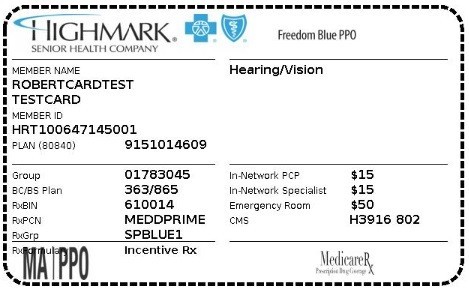
Older member ID cards will have the following logo:

The “MA” in the suitcase indicates a member who is covered under the Blue Medicare Advantage PPO network sharing program. Members have been asked to not show their standard Medicare ID card when receiving services. Instead, members should provide their Blue Cross and/or Blue Shield member ID card.
Eligibility and Benefits Verification
To determine whether a Medicare Advantage PPO member from another Blue Plan is covered under the network sharing program, please call the BlueCard Eligibility Line at 800-676-BLUE (2583).
Note: Be sure to have the member’s three-character alpha prefix in order to obtain eligibility information.
Impact to Highmark Medicare Advantage PPO Providers
If you are a contracted Highmark Freedom Blue PPO Community Blue Medicare PPO/Plus PPO, and/or Complete Blue PPO provider, you should provide the same access to care for members of other participating Blue Medicare Advantage PPO Plans as you do for Highmark’s Medicare Advantage PPO members.
You will be reimbursed in accordance with your contracted rate under your Medicare Advantage PPO contract. These members will receive in-network benefits in accordance with their member contract.
If You are Not Contracted with Highmark for Medicare Advantage PPO Plans
If you are not a contracted Highmark Medicare Advantage PPO provider, you may see out-of-area Blue Medicare Advantage PPO members but are not required to do so.
Should you provide services to these members, you will be reimbursed for covered services at the Medicare allowed amount based on where the services were rendered and under the member’s out-of-network benefits. For urgent and emergency care, you will be reimbursed at the in-network benefit level.
Member Cost Sharing
A Medicare Advantage PPO member’s cost sharing level and copayment is based on their health plan. A Medicare Advantage PPO participating provider may collect the copayment amounts at the time of service or bill for any deductibles, coinsurance, and/or copayments. However, you may not balance bill the member the difference between your charge and the Medicare Advantage PPO allowance for a particular service.
To determine the member’s cost sharing, you should call the BlueCard Eligibility Line at 800-676-BLUE (2583).
The following entities, which serve the noted regions, are independent licensees of the Blue Cross Blue Shield Association: Western and Northeastern PA: Highmark Inc. d/b/a Highmark Blue Cross Blue Shield, Highmark Choice Company, Highmark Health Insurance Company, Highmark Coverage Advantage Inc., Highmark Benefits Group Inc., First Priority Health, First Priority Life, Highmark Care Benefits Inc., or Highmark Senior Health Company. Central and Southeastern PA: Highmark Inc. d/b/a Highmark Blue Shield, Highmark Benefits Group Inc., Highmark Health Insurance Company, Highmark Choice Company or Highmark Senior Health Company. Delaware: Highmark BCBSD Inc. d/b/a Highmark Blue Cross Blue Shield. West Virginia: Highmark West Virginia Inc. d/b/a Highmark Blue Cross Blue Shield, Highmark Health Insurance Company or Highmark Senior Solutions Company. Western NY: Highmark Western and Northeastern New York Inc. d/b/a Highmark Blue Cross Blue Shield. Northeastern NY: Highmark Western and Northeastern New York Inc. d/b/a Highmark Blue Shield.
All references to “Highmark” in this document are references to the Highmark company that is providing the member’s health benefits or health benefit administration and/or to one or more of its affiliated Blue companies.
All revisions to this Highmark Provider Manual (the “manual” or “Highmark Provider Manual”) are controlled electronically. All paper copies and screen prints are considered uncontrolled and should not be relied upon for any purpose.
Unit 3: Other Government Programs
Highmark offers Medicare supplemental products for individual direct-pay customers. It is designed to help beneficiaries cover certain out-of-pocket costs not paid by Medicare, such as deductibles, coinsurance, and other specific expenses, depending on the plan design. These plans are marketed as Medigap Blue in Delaware, Pennsylvania, and West Virginia, and as Medicare Supplement in New York.
Standardization Among Medigap Plans
The Omnibus Budget Reconciliation Act (OBRA) required insurers throughout the United States to standardize the benefits available under their direct-pay Medigap products. The purpose of this standardization was to simplify seniors’ purchasing decisions for Medicare supplemental coverage. All “Plan A” products, for example, must provide the same benefits. Therefore, the only real points of comparison among the contenders would be price and customer service.
The legislation established a maximum of 10 standardized benefit plans. States were permitted to further limit these plans, and Highmark, as the insurer, selects which plans to offer. The chart below outlines the Medigap/Medicare Supplement plans Highmark offers in Delaware, Pennsylvania, West Virginia, and New York. Please note that not all plans are offered in every state.
Important: Plans E, H, and I have been closed to new enrollment; however, historic enrollment may still exist in these plans.
|
Plan A |
Plan B |
Plan C |
Plan D |
Plan F |
Plan F HD* |
Plan G |
Plan G HD* |
Plan N |
|
|---|---|---|---|---|---|---|---|---|---|
|
Medicare Part A deductible |
X |
X |
X |
X |
X |
X |
X |
X |
|
|
Medicare Part A coinsurance and hospital costs (up to an additional 365 days after Medicare benefits are used) |
X |
X |
X |
X |
X |
X |
X |
X |
X |
|
Skilled nursing facility coinsurance |
X |
X |
X |
X |
X |
X |
X |
||
|
Medicare Part B deductible |
X |
X |
|||||||
|
Medicare Part B coinsurance |
X |
X |
X |
X |
X |
X |
X |
X |
X Copay applies |
|
Foreign travel emergency |
X |
X |
X |
X |
X |
X |
|||
|
Part B excess charges |
X |
X |
X |
X |
*Note: Plans F and G have a High-Deductible option, which requires paying a plan deductible before the plan begins to pay. Once the deductible is met, the plan pays 100% of covered services for the rest of the calendar year.
Plan N pays 100% of the Part B coinsurance, though certain services may still be subject to copayments.
All of Highmark’s Medicare supplement benefit packages provide the following core benefits:
- Hospital coinsurance for days 61 through 90.
- Hospital coinsurance for Lifetime Reserve Days – days 91 through 150.
- An additional 365 hospital days after Lifetime Reserve Days have been exhausted.
- First three pints of blood (not covered by Medicare).
- Medicare Part B coinsurance.
Reminder: Always verify benefits. Providers are responsible for confirming that the member’s benefit plan includes the appropriate coverage for the anticipated date of service before services are rendered. You can verify a member’s coverage by using Availity Essentials, performing an electronic HIPAA Eligibility/Benefit Inquiry, or by calling Provider Service.
Medigap Supplemental General Information
For members enrolled in Medicare Part B with supplemental Medigap Supplemental coverage, Medicare is the primary carrier. Claims should be submitted to the member's Medicare carrier first for processing.
The Medicare Overcharge Measure (MOM) Act prevents the majority of all health care providers in the state of Pennsylvania and New York from billing Medicare beneficiaries any amount in excess of the Medicare reasonable charge. There are certain providers and suppliers who may charge beneficiaries for the difference between the billed amount and the Medicare allowance. You should contact the appropriate Medicare office for a listing of those types of providers.
Medigap Claim Submission
If you do not submit claims electronically and payment under the supplemental coverage has not been received within 30 days of Medicare payment, after verifying claim status, send a copy of the Explanation of Medicare Benefits (EOMB) statement to:
|
Delaware, Pennsylvania, and West Virginia |
New York |
|---|---|
|
Medigap Claims |
Medigap Claims |
- Do not highlight any information on the EOMB statement. Instead, use an asterisk (*) or another notation to clearly mark the patient whose claims require processing under supplemental coverage.
- The member’s contract identification number and correct address should be on the EOMB statement; otherwise, submit a completed CMS-1500 claim form.
- For Medicare electronic remittance, submit a screen print of the electronic remittance along with a copy of the CMS-1500 Claim Form to the address listed above. The beneficiary’s Highmark agreement number and correct address should appear in the upper left corner of all documents submitted for processing.
Medicare Complement Plans
Highmark offers the following health insurance plans that complement traditional Medicare for retired employees:
- Delaware – Medicfill
- New York – Medigap
- Pennsylvania – Signature 65
- West Virginia – Medifill
For these plans, Medicare is the primary payer, and Highmark is the secondary payer. Usually, the individual retiree or dependent must be enrolled in Medicare Parts A and B to be eligible for coverage.
These plans are designed to fill in the coverage gaps of traditional Medicare. Highmark may pay the Medicare cost sharing for certain Medicare benefits, such as the following (benefits vary by group):
- Medicare Part A deductible
- Medicare Part A hospital coinsurance
- Medicare Part A skilled nursing facility coinsurance
- The first three pints of blood per calendar year
- Medicare hospice copayments
- Medicare Part B deductible
- Medicare Part B coinsurance
In addition, some groups may offer benefits for additional services which are not covered by Medicare, such as the following (benefits vary by group):
- Emergency care in a foreign country
- Additional hospital days
- Additional skilled nursing facility days
- Prescription drugs
Medicare Carve-Out Plans
There are many groups that purchase the same benefits for their Medicare-eligible retired employees as they do for their employees who are under age 65. In these plans, when the member is enrolled in Medicare, claims are processed by Medicare first, and then by Highmark as secondary to Medicare. Any payment made by Medicare is subtracted (carved-out) from the payment made by Highmark. Payment is made only for those services eligible under the group’s Highmark benefits, whether the services were covered by Medicare or not.
Highmark makes health care programs available to uninsured children in Pennsylvania through the subsidized Children’s Health Insurance Program of Pennsylvania (CHIP). Highmark Healthy Kids (CHIP) coverage offers programs for all uninsured children regardless of household income.

Highmark Healthy Kids (CHIP) is modeled after the Caring Program for Children, which was pioneered by Highmark through its Caring Foundation. CHIP expanded with the legislation to Cover All Kids and now offers coverage to every uninsured child in Pennsylvania, regardless of household income. CHIP covers children from birth through 18 years of age.
This program is administered by Highmark on behalf of the Commonwealth of Pennsylvania Department of Human Services (DHS).
The more a child’s family earns, the more cost sharing they will have in the form of higher premiums and copays.
- Free CHIP is funded through a portion of the state cigarette tax as well as federal funding. Families owe nothing for their child’s premium and there are no copayments for office/ER visits and drugs.
- Low-Cost CHIP includes three levels with varying costs based on family income. Families pay some of the cost of CHIP coverage for each level of Low-Cost CHIP and copays for office/ER visits and drugs. Low-Cost CHIP began receiving federal money in addition to state money when CHIP expanded under Cover All Kids.
- Full-Cost CHIP provides health care coverage to children in households who are over the income limits for Free and Low-Cost CHIP. Families pay the full cost of CHIP coverage at this level and copays for office/ER visits and drugs.
It is only through a partnership with our providers that these programs are successful, and Highmark can continue its social mission to provide health care coverage to as many children in Pennsylvania as possible.
Highmark extends its sincere appreciation to its providers for their continued commitment to provide services to children who qualify for these programs.
Please remember that you do not have to verify income or eligibility for these programs. Eligibility and income are determined before enrollment and annually thereafter by the Department of Human Services (DHS).
Utilizes Highmark Provider Networks
One of the keystones of this program is that families are “held harmless” from balance billing when covered services are provided by a network provider. To achieve that, members enrolled in CHIP prior to July 1, 2022, use the Premier Blue Shield preferred provider network to provide services to these children in the Central Region, the Keystone Health Plan West (KHPW) managed care network in the 29-county Western Region, and the First Priority Health (FPH) managed care network in the 13-county Northeastern Region. Members enrolled in CHIP after July 1, 2022, are enrolled in the Highmark Healthy Kids (CHIP) HMO network.
Prescription drugs are provided using the National Network. Vision coverage is administered by Davis Vision and dental coverage is provided by United Concordia’s network.
PROMISe™ ID Enrollment Required
Providers are required to complete a PROMISe™ ID enrollment application with Pennsylvania’s Department of Human Services (DHS) and obtain a PROMISe ID to provide services to Highmark Healthy Kids (CHIP) members and receive reimbursement.
For more information about this requirement, see the Highmark Provider Manual’s Chapter 3, Unit 1: Network Participation Overview.
Payment Directly to Participating Providers
As with our commercial group programs, Highmark pays providers in our Premier Blue Shield, KHPW, and FPH network (members enrolled in CHIP prior to July 1, 2022) and Highmark Healthy Kids (CHIP) HMO network (members enrolled after July 1, 2022) directly, and they agree to accept our payments as payment-in-full for covered services.
Highmark sends payments for services of out-of-network providers directly to the child’s parents, who are responsible for paying the charges. Out-of-network providers are not obligated to accept Highmark’s payment as payment in full. It is critical in all cases that members check the network status of their provider.*
Note: Highmark will deny any claims from providers who have not completed enrollment with Pennsylvania’s DHS and obtained a valid PROMISe ID.
For more information about CHIP payment, see the Highmark Provider Manual's Chapter 6, Unit 7: Payment/EOBs/Remittances.
*Does not apply to emergency care.
Eligibility Requirements for Highmark Healthy Kids (CHIP)
The Department of Human Services (DHS) performs eligibility and enrollment functions for children with Highmark Healthy Kids (CHIP) coverage. The Individual Markets area performs marketing and outreach for CHIP to locate children and educate the community about the CHIP program. Children must meet these eligibility guidelines:
- Be a resident of Pennsylvania prior to applying for this coverage (except newborns);
- Be a U.S. citizen, a U.S. national, a permanent legal alien, or a refugee as determined by the U.S. Immigration and Naturalization Service;
- Be under age 19;
- Not be covered by any health insurance plan, self-insured plan, or self-funded plan and not be eligible for or covered by Medical Assistance offered through the Department of Human Services or other governmental health insurance;
- Be eligible based on income.* The number of children in a family affects the premium level assigned;
- For all new applicants whose family's annual income falls in the Low-Cost and Full-Cost CHIP ranges, they must show that the child has lost health insurance because a parent lost their job, or the child is moving from another public insurance program (not applicable if the child is under the age of two); and
- Full-Cost CHIP families must also show that access to coverage is unavailable and unaffordable.
*Depending on income levels, children may be eligible for Medicaid Free or Low-Cost CHIP insurance. If eligible for Low-Cost or Full-Cost CHIP insurance, families will be required to pay a monthly premium based upon income for their child’s health insurance (as well as some copays).
PH-95 Eligibility for Medical Assistance
In Pennsylvania, children under the age of 18 with certain disabilities or special health needs may qualify for Medical Assistance (also known as Medicaid), regardless of parental income. This eligibility is called PH-95, “Children with Special Needs.” The Pennsylvania Department of Human Services requires Highmark to review billing and claims management information to identify any child that may be potentially eligible for PH-95 Medical Assistance.
Each child identified with certain special health conditions that would likely qualify for Medicaid PH-95 Program will be sent to the treating provider for completion of a Physician Certification for Child with Special Needs form. These forms will be sent via fax.
If a child is identified as eligible for Medical Assistance per PH-95, the child will be referred to the Central Unit at County Assistance where the information will be reviewed, and a determination made.
To complete the Physician Certification for Child with Special Needs form:
- The certification must be completed by a psychologist, physician, or medical professional under the physician’s supervision and authority (e.g., physician assistant or certified nurse practitioner).
- The treating physician must note if the child is not considered disabled at all; temporarily disabled for less than 12 months; temporarily disabled for MORE than 12 months; or permanently disabled.
- The date, name of each diagnosis (the ICD-10 code and the description), and any functional limitations and their impacts must be supplied.
- The form must be signed by the treating physician.
Highmark Healthy Kids (CHIP) ID Cards
A child enrolled in CHIP will have a Highmark Choice Company and Highmark Healthy Kids insurance card as any commercial or group member. The symbol “Y-18” will appear on ID cards for CHIP members. It can be found in the bottom left-hand corner on the front of the card. You may use Availity to determine eligibility, coverage, and claim status.
Central PA Region
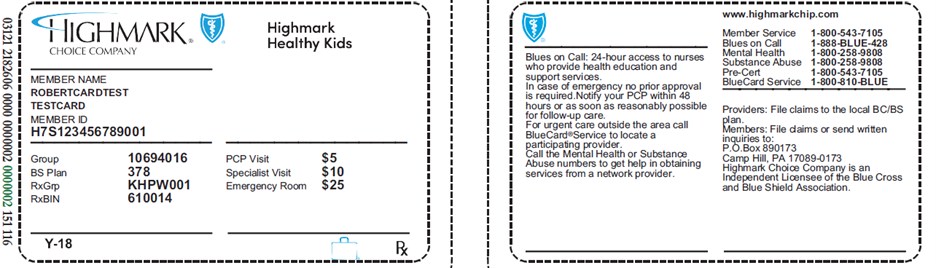
Western and Northeastern PA Regions
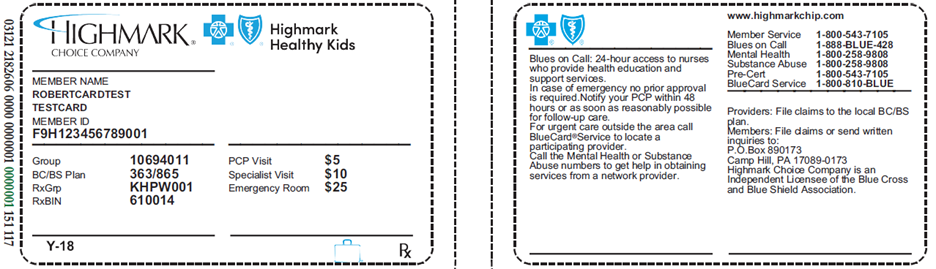
CHIP benefits are offered through an HMO product utilizing the PA CHIP Network.
Important: PCP Required
All Highmark Healthy Kids (CHIP) members must select a PCP to manage their care.
Parents of members are encouraged to select a PCP within 10 days of enrollment in CHIP. If a PCP is not chosen, a PCP will be assigned. Parents/members can change the PCP assignment at any time.
Effective Oct. 1, 2024, the assigned PCP will no longer appear on the member ID card.
Information for PCPs of Highmark Healthy Kids (CHIP) Members
Since the CHIP products offered in the Western, Central, and Northeastern Regions are managed care products, all CHIP members and their parents must select a PCP to coordinate their care. All Act 146 and managed care regulations, including complaint and grievance rights, apply to the HMO product in PA.
Highmark Healthy Kids (CHIP) members will have an identification card with the Highmark Healthy Kids in the upper right corner (see ID card samples above).
Although CHIP members are required to select a PCP to oversee their care, traditional “referrals” are not required. If it is necessary to recommend that a CHIP member see a specialist or other provider, PCPs should make every attempt to refer members to providers within the network with a valid PROMISe ID.
Members must use Highmark Healthy Kids (CHIP) HMO network providers to receive 100 percent coverage unless the non-emergency covered benefits are not available within the network and are pre-authorized by Highmark.
Member Rights and Responsibilities for CHIP members are available in the Highmark Provider Manual's Chapter 1, Unit 5: Member Rights and Responsibilities.
Accessibility Expectations for Highmark Healthy Kids (CHIP) Providers
To stay healthy, Highmark members must be able to see their physicians when needed. To support this goal, Highmark sets expectations for accessibility of primary care physicians (PCPs), medical specialists, behavioral health specialists, and obstetricians.
In addition, the Department of Human Services has set standards for specific time frames in which network providers should respond to Highmark Healthy Kids (CHIP) member needs based on symptoms. Note that some standards for CHIP members may differ from those Highmark sets for Commercial members.
|
Highmark Healthy Kids (CHIP) PCP and Medical Specialist Expectations |
|---|
Patient’s Need: |
Performance Standard: |
Emergency/life-threatening care Sudden, life-threatening symptom(s) or condition requiring immediate medical treatment (e.g., chest pain, shortness of breath) |
|
PCP urgent care appointments An urgently needed service is a medical condition that requires rapid clinical intervention due to an unforeseen illness, injury, or condition (e.g., high fever, persistent vomiting/diarrhea) |
|
PCP regular, non-urgent sick appointments Non-urgent but in need of attention appointment (e.g., headache, cold, cough, rash, joint/muscle pain) |
|
PCP initial health assessment or routine physical Routine wellness appointments
Subsequent routine appointments Progress follow-up, ongoing treatment for an injury or condition, laboratory blood draw, additional screening, medication management, testing, etc. |
|
PCP follow-up visits |
|
Specialist emergent care Any sudden, life-threatening symptom(s) or condition requiring immediate medical treatment |
|
Specialist urgent care appointments Urgent medical condition |
|
Specialist routine care appointments Routine care appointments for the following specialty types:
All other specialty provider types. |
|
Specialist follow-up visits |
|
Persons with HIV/AIDS initial routine care PCPs and specialists are to have scheduling procedures in place to allow for scheduling of appointments for members whom Highmark identifies at enrollment to be HIV positive or diagnosed with AIDS. |
|
After-hours care Access to practitioners after the practice’s regular business hours. |
Acceptable process in place to respond 24 hours per day, 7 days a week to member issues may be either directly or through an on-call arrangement with another Highmark credentialed participating practitioner of the same or similar specialty and of the same networks:
|
In-office waiting times
|
|
|
Highmark Healthy Kids (CHIP) Obstetrics and Gynecology (Ob/Gyn) and Maternity Care Expectations |
|---|
Patient’s Need: |
Performance Standard: |
Ob/Gyn or Maternity emergency |
|
Ob/Gyn or Maternity urgent care |
|
Ob/Gyn or Maternity initial routine care |
|
Ob/Gyn or Maternity subsequent, regular routine visits |
|
Ob/Gyn or Maternity follow-up visits |
|
Maternity first trimester – initial prenatal care |
|
Maternity second trimester – initial prenatal care |
|
Maternity third trimester – initial prenatal care |
|
Maternity high-risk – initial prenatal care |
|
|
Highmark Healthy Kids (CHIP) Behavioral Health Provider Expectations |
|---|
Patient’s Need: |
Performance Standard: |
Care for a life-threatening emergency Immediate intervention is required to prevent death or serious harm to patient or others. |
|
Urgent care Timely evaluation is needed to prevent deterioration of patient condition. |
|
Care for a non-life-threatening emergency Rapid intervention is required to prevent acute deterioration of the patient’s clinical state that compromises patient safety. |
|
Initial routine behavioral health office visit Patient’s condition is considered to be stable. Physical and behavioral health assessments, general physical examination, and first examination must be scheduled within 3 weeks of enrollment. |
|
Regular, subsequent routine appointments Ongoing mental health treatment for an addiction or mental health disorder, care intended to stabilize, sustain, and facilitate the member's recovery. |
|
Behavioral health follow-up visits |
|
After-hours care Access to practitioners after the practice’s regular business hours. |
|
In-office waiting times
|
|
Acceptable After-Hours Methods
The chart below outlines acceptable methods of handling after-hours calls from your Highmark Healthy Kids (CHIP) patients.
|
Answering Process |
Response/Message |
Comments |
|---|
Answering Service or Hospital Service |
Caller transferred directly to physician. |
|
Service pages the physician on call (see comments). |
A physician or clinical staff person is expected to return the call within 60 minutes. |
|
Answering Machine |
Message must provide the caller with a way to reach the physician on call by telephone or pager. |
Provide clear instructions on how to record a message on a pager (i.e., “you will hear a series of beeps, please enter your phone number, including area code, by pressing the number keys on your phone, then hang up”). A physician or clinical staff person is expected to return the call within 60 minutes. |
Instruct caller to leave a message (see comment). |
A physician or clinical staff person is expected to return the call within 60 minutes. |
Outreach Following Missed Appointments
PCPs and specialists must conduct affirmative outreach whenever a Highmark Healthy Kids (CHIP) member misses an appointment. Three attempts to contact the member must be made and documented in the member’s medical record.
Attempts to contact the member may include, but are not limited to, written attempts, telephone calls, and home visits. However, at least one attempt must be a follow-up telephone call.
Preventive Services
Highmark Healthy Kids (CHIP) follows the Highmark Preventive Health Guidelines. This schedule is reviewed and updated periodically based on the advice of the American Academy of Pediatrics (AAP) and Bright Futures™, the U.S. Preventive Task Force, the Blue Cross and Blue Shield Association, and medical consultants. Accordingly, the frequency and eligibility of services are subject to change.
Highmark’s Preventive Health Guidelines are available on the Provider Resource Center's Preventive Health Guidelines page.
The Bright Futures periodic screens must be conducted for all eligible CHIP members to identify health and developmental problems. These screens must be in accordance with the most current periodicity schedule and recommended pediatric immunization schedules based on guidelines issued by the AAP and Centers for Disease Control and Prevention (CDC).
To view the current periodicity schedule, click on the following link: Bright Futures Periodicity Schedule
Over-The-Counter (OTC) Allergy Medications
Highmark Healthy Kids includes certain OTC allergy medications. The medications require a prescription from the physician to be covered at no cost to the member. The list of covered drugs can be found here. Scroll down to the CHIP OTC Allergy Flyer. This drug list is subject to change at any time.
Blood Lead Levels Testing
Pediatric preventive care must include blood lead levels testing of all children at ages one and two years old. In addition, blood lead level tests must be completed for all children aged three through six without a confirmed prior lead blood test consistent with current Pennsylvania Department of Health and Medical Assistance program requirements.
The following requirements/procedures apply for lead blood tests for Highmark Healthy Kids (CHIP) members:
- The lead blood test must be performed by a laboratory that participates in the PA CHIP network.
- The lead blood test can be performed with the routine hemoglobin test for anemia at 12 months, per Bright Futures; or, one finger stick can be completed for both the hemoglobin and lead tests without a blood draw.
- You must submit claims for both the hemoglobin and lead blood tests if they are performed together.
- The lead blood test is reimbursable if submitted using procedure code 83655.
- There is no out-of-pocket cost to members for lead blood tests.
- Members with a venous lead draw showing an Elevated Blood Lead Level of ≥ 3.5 μg/dL, should be referred for an Environmental (Home) Lead Investigation (ELI).
Important: You must submit the claim with the date that the lead blood test was performed along with the results of the test.
Environmental Home Lead Testing
A provider should submit an order to our environmental home lead testing provider for a comprehensive environmental lead investigation for a Highmark Healthy Kids CHIP member under 19 years of age with a venous blood lead screening result of at least ≥ 3.5 µg /dL to assess for environmental influences of lead contamination.
The order for a comprehensive environmental lead investigation must include a primary diagnosis code of toxic effect of lead and its components. Highmark Healthy Kids (CHIP) will cover environmental home lead testing for members under 19 years of age who are enrolled in Highmark Healthy Kids CHIP within the following parameters:
- Services must be provided by a participating environmental home lead testing provider.
- Member must have a venous BLL result of at least ≥ 3.5 µg /dL based on venous draw.
- A provider order is required.
- No prior authorization from Highmark Healthy Kids is needed.
Questions regarding Highmark Healthy Kids environmental home lead testing program can be directed via email at HighmarkCHIP@highmark.com.
Developmental Screenings
Developmental screenings can assist in early detection and intervention of autism, learning disabilities, and developmental delays. Currently, providers who care for CHIP members are required to perform developmental screenings for patients according to AAP guidelines for annual screening of children three years of age and younger for developmental disabilities.
Providers have the following responsibilities for developmental screenings for CHIP members:
- Perform developmental screenings during well-child visits.
- Submit claims for both the developmental screening and the well-child visit if you perform the developmental screening during a well-child visit.
- Developmental screenings are reimbursable if submitted using procedure code 96110.
- Ensure that all relevant medical information, including the results of the screens, are incorporated into the member's medical record.
- If unable to conduct the necessary screens, you must arrange for another network provider to do so.
- Report encounter data associated with screens to the Managed Care Organization (MCO) within 90 days from the date of service.
- Contact new members who have not had an encounter within the first six months of enrollment, or who have not complied with the periodicity schedule.
Note: There is no out-of-pocket cost to members for developmental screenings.
Maternal Depression Screening
Highmark Healthy Kids (CHIP) policy requires that maternal depression screening is covered per the Bright Futures Periodicity Schedule and CMS.
- Screening may be done in the PCP or pediatrician’s office as part of the well-child visit and covered under the child’s benefit when screening is for the direct benefit of the child.
- This screening must occur at the child's well-child visits at 1, 2, 4, and 6 months of age.
- Screening Tool: The screening must be performed using a validated screening tool specific to maternal depressions screening, such as the Edinburgh Postnatal Depression Scale or Post-Partum Depression Screening Scale.
- If the screening indicates a need for further assessment or treatment, the Managed Care Organization (MCO) must ensure that the mother is referred for appropriate follow-up care.
- The results of the screening and any referrals must be documented.
- Claims for maternal depression screening under the child’s benefit are to be submitted with procedure code 96161 with diagnosis codes that designate screening is done for the welfare of the child.
- There is no out-of-pocket cost to members for maternal depression screening performed as a preventative service as part of the well-child visit.
Mental Health Assessments
If PCPs determine that a mental health assessment is needed, they must inform the member, or member’s parent or legal guardian, on how to access these mental health services and coordinate access to these services, when necessary.
Authorization Requirements
Authorization for select services is required for the Highmark Healthy Kids (CHIP) HMO products.
The following services require authorization for CHIP members:
- All inpatient admissions including mental health/substance abuse.
- Any service that may potentially be considered experimental/investigational or cosmetic in nature.
- Home health services.
- Selected injectable and specialty tier program drugs.
- Durable medical equipment (DME) and orthotics and prosthetics.
- Highmark’s list of outpatient procedures requiring authorization is available on the Provider Resource Center's Obtaining Authorizations page.
CHIP Enhanced Member Supports and Case Management
CHIP coverage includes a comprehensive, community-based, care coordination program for children with special health care needs or chronic conditions. Nurses and other health care staff work directly with Highmark Healthy Kids (CHIP) members and their parents/guardians to help them understand their child’s medical condition and treatment; coordinate services among physicians; help them locate and receive the services available to meet their child’s needs; provide them with educational materials; and link to the community resources that can help their family.
For questions regarding the program, call 866-823-0892 Monday through Friday, 8:30 a.m. to 4:30 p.m. EST. If outside of business hours, leave a message. All calls are returned within two business days.
Information regarding the program can also be accessed here by entering your ZIP code to access the Highmark Healthy Kids (CHIP) program page for your service area. Select CHIP Resources and CHIP Enhanced Member Supports and Case Management from the menu on the left for access to more detailed information about the program.
Pediatric Disease Management Program
Highmark offers a pediatric disease management program to assist Highmark Healthy Kids (CHIP) members with four targeted conditions: diabetes, asthma, obesity, and tobacco use – prevention and cessation.
The program is designed to reinforce the physician’s treatment plan for the patient. Its goal is to proactively engage these members and their families for better understanding of their conditions and, with assistance from Highmark Case Management staff, to help them manage their disease.
All children enrolled in Highmark Healthy Kids (CHIP) through Highmark who are identified as having diabetes, asthma, obesity, or using tobacco are automatically registered as participants in the disease management program.
The program will provide the following services to Highmark Healthy Kids (CHIP) members and their families:
- Support from Highmark case management nurses and other health care staff to better manage their condition and periodically evaluate their health status;
- Educational and informational materials to assist them in understanding and managing the medications prescribed by their doctors; and
- Assistance in effectively planning for office visits with their physicians and reminders as to when those visits should occur.
The Highmark Case Management staff will notify a physician’s office by letter or a telephone call to inform them when any of their CHIP patients are enrolled in the program. The assistance in care coordination and communication among the various entities involved in the child’s care will be of benefit to the physician as well. Since membership in the program is voluntary, the CHIP member who wishes to stop participating in the program can do so with a telephone call. To discuss a CHIP patient’s involvement in the program, contact us at 866-823-0892.
Highmark Healthy Kids (CHIP) Benefits and Services
CHIP covers a wide range of benefits and services, including medical care, prescription drugs, and dental and vision services. Except for emergency care and emergency ambulance services, benefits are provided only for services performed by a network provider with a valid PROMISe ID.
Commonly used CHIP medical benefits are outlined here. For detailed benefit information, verify a CHIP member’s medical coverage via Availity Essentials Eligibility and Benefits prior to rendering services.
|
Medical Benefits |
|
|---|---|
|
Ambulance Services |
Prior authorization required for non-emergent only |
|
Hospital Services |
Inpatient Care – Pre-admission review required:
Outpatient Services:
|
|
Maternity |
|
|
Medical Visits |
|
|
Mental Health |
|
|
Preventive Care (Follows the Highmark Preventive Schedule) |
Includes the following, with no cost sharing or copays:
|
|
Private Duty Nursing |
Requires prior authorization |
|
Substance Abuse |
|
|
Surgical Services |
|
|
Habilitative Services |
Limited to a total of 30 outpatient visits per year per type of therapy. For outpatient habilitation services, the combined visit limit for physical, occupational, and speech therapy is 180 days per calendar year. This limit does not apply when services for habilitative purposes are prescribed for the treatment of mental illness or substance abuse. |
|
Therapy and Rehabilitative Services |
|
|
Other Medical Services |
|
|
Other Highmark Health Kids (CHIP) |
Covered Services |
|---|---|
|
Dental (administered by United Concordia) |
The dental plan for CHIP members meets the Minimum Essential Health Benefits requirements for pediatric oral health as required under the federal Affordable Care Act. |
|
Hearing |
|
|
Prescription Drugs |
|
|
Vision |
*Davis Vision network providers accept reimbursement as payment in full for standard services. Non-Davis network providers are reimbursed at an out-of-network fee schedule. |
Highmark Healthy Kids (CHIP) Claims Submission
All claims, except dental and vision claims, should be submitted just like any other Highmark Blue Shield claim. They may be submitted electronically or on a paper claim form. Note that in all cases, the child is the member. Report “Patient’s relationship to insured” as “self.” Do not report the name of the parent.
Electronic claims are preferred. However, if necessary, paper claims can be submitted to the following addresses:
Central Region
Highmark Blue Shield
P.O. Box 890173
Camp Hill, PA 17089-0173
Western and Northeastern Regions
Highmark Blue Shield
P.O. Box 898819
Camp Hill, PA 17089-8819
Dental
United Concordia Companies, Inc.
Claims Processing
P.O. Box 69421
Harrisburg, PA 17106-9421
Routine Vision
Davis Vision
Vision Care Claims Unit
P.O. Box 1501
Latham, NY 12110
Timely Filing
The Pennsylvania Children’s Health Insurance Program (CHIP) requires providers to submit all claims for services provided to Highmark Healthy Kids (CHIP) members to Highmark within 180 days from the date of service or discharge.
Complaints and Grievances
Under Pennsylvania CHIP, a member or member’s representative, which may include the member’s provider, may file a complaint or grievance. For detailed information, see the CHIP section in the Highmark Provider Manual's Chapter 5, Unit 5: Denials, Grievances, and Appeals.
FQHC/RHC Payment and Claim Submission
Section 503 of the Children’s Health Insurance Program Reauthorization Act of 2009 (CHIPRA) requires payment for services provided by Federally Qualified Health Centers (FQHCs) and Rural Health Clinics (RHCs) to be at least equivalent to Medicaid Prospective Payment System (PPS) rates for all CHIP encounters. The PPS rates are all-inclusive rates for encounter services provided, except for vaccine services.
For more information, including claim submission guidelines, see the Highmark Provider Manual's Chapter 6, Unit 7: Payment/EOBs/Remittances.
Highmark Healthy Kids (CHIP) Enrollment
If you know of children who may qualify for this program, refer them to the appropriate telephone number for the Highmark CHIP Administrative Unit (PA Western, Central, and Northeastern Regions):
- 800-KIDS-105 (800-543-7105); TTY Service: Dial 711
For more information on CHIP, visit Pennsylvania’s “We Cover All Kids” website.
All federal government employees and qualified retirees are entitled to health insurance benefits under the Federal Employees Health Benefits (FEHB) Program. The FEHB allows insurance companies, employee associations, and employee unions (e.g., the National Association of Letter Carriers) to develop plans to be marketed to government employees.
Federal employees are given a wide range of insurance options, from catastrophic coverage plans with high deductibles to health maintenance organizations (HMOs). Some plans are offered nationwide while others are regionally available plans. The number of choices for individual employees varies based on where they reside.
The Blue Cross Blue Shield Association (BCBSA) fee-for-service plan is offered to federal employees nationwide. The Federal Employee Program (FEP), also known as the Service Benefit Plan, has been part of the FEHB Program since its inception in 1960. More than 50 percent of all federal employees and retirees nationwide have chosen to receive their healthcare benefits through FEP. These subscribers and their families receive health coverage through the local Blue Plan where they reside.
FEP Benefit Plan Options
Federal employees have traditionally been offered two Preferred Provider Organization (PPO) benefit packages nationally through FEP -- Standard Option and Basic Option. The same types of services are covered under both options, but at different payment levels. Additionally, FEP includes the FEP Blue FocusSM option.
- Standard Option PPO allows FEP members to seek covered services from both network participating and non-participating providers. When members use participating PPO providers, their out-of-pocket expenses, such as coinsurance and copayment amounts, will be less.
- Basic Option PPO has a lower premium than Standard Option and no deductibles, but members must use participating preferred providers to receive benefits.
- FEP Blue Focus is also a PPO product that uses the same network as the Standard and Basic options with no out-of-network benefits, except in certain situations such as emergency care. The “Core” benefits, which provide coverage for all the essentials of good preventive health, are the base of the program. The Core benefits are covered at little or no cost to members when they use network providers.
The benefits under FEP Blue Focus are divided into three key categories: Core, Non-core, and Wrap. These categories describe the cost share the member will pay based on the services used.
- Core benefits, the base of the program, have a low or no copayment and are not subject to deductible or coinsurance. These benefits are mostly used to receive general care and to maintain overall health and well-being, in addition to coverage for accidental injuries.
Members are responsible for copays under the Core benefits for the first 10 visits to a primary care provider, specialist, or other health care provider, such as a mental health doctor. Each member on the subscriber’s coverage receives 10 visits per calendar year.
On the 11th visit in the calendar year, the member’s cost-sharing will change to include the plan’s deductible and 30 percent coinsurance. Preventive care visits, such as an annual physical, do not count toward the 10-visit limit and are at no cost to members.
- Non-core benefits provide coverage for any unexpected medical costs that may occur during the calendar year. All these services are subject to annual deductible and coinsurance. When the catastrophic out-of-pocket maximum is met, then services for the remainder of the calendar year are paid at 100 percent of the Plan allowance for services.
- Wrap benefits provide the final layer of protection and complete, or “wrap-up,” the FEP Blue Focus benefit package. These are benefits that members may or may not have a need to use during the year. These benefits have visit limitations and/or different copayments or coinsurance than the Core and Non-core benefit levels. The calendar year deductible does not apply to these benefits.
FEP Blue Focus does not provide benefits for some services that are covered under the Standard and Basic options, such as routine dental care. A complete list of benefit exclusions is available at fepblue.org. The appeals process for FEP Blue Focus is the same as for the Standard and Basic options.
Important: Additional services require prior authorization under FEP Blue Focus that do not require prior authorization under the Standard and Basic options.
For prior authorization requirements for all FEP products, including a list of services requiring prior authorization, see the Highmark Provider Manual's Chapter 5, Unit 2: Authorizations.
For a full list of services that require prior authorization, go the Provider Resource Center's Obtaining Authorizations page.
Identifying FEP Members
Members who are part of the Blue Cross Blue Shield Association’s Federal Employee Program (FEP) can be identified by the following:
- The letter "R" in front of their member ID number instead of a three-letter alpha prefix.
- The BlueCross BlueShield Federal Employee Program logo on their ID card.
- The FEP Blue Focus ID card has a thin blue border around the perimeter, which distinguishes it from the Standard Option card, which has a solid white border, and the Basic Option card, which has a shaded blue front.
Note: Only the primary card holder’s name will appear on the ID card.
Sample: Standard Option ID card
Sample: Basic Option ID card
Sample: FEP Blue Focus ID card
Verifying Eligibility and Benefits
Eligibility and benefits can be verified through Availity for FEP members residing in Delaware, New York, Pennsylvania, and West Virginia.
For out-of-state FEP members or FEP members in Highmark’s service areas, if Availity is not available, call the appropriate FEP Provider Service department:
- Delaware: 800-721-8005
- New York: 800-234-6008
- Pennsylvania: 866-763-3608
- West Virginia: 800-535-5266
Hours of Availability:
- Delaware, Pennsylvania, and West Virginia: 8:30 a.m. to 5 p.m. EST, Monday through Friday
- New York: 8:30 a.m. to 5 p.m. EST, Monday through Thursday; and 9 a.m. to 5 p.m. EST on Friday
Note: Provider Service is unavailable from 12 – 1 p.m. daily.
Claim Submission
Claims for FEP members should be submitted to the local Blue Plan where services were rendered. Each local Plan is responsible for processing and paying claims for services received within that area. Highmark participating providers should submit all claims for FEP members to Highmark, except for the following:
- Lab providers should file FEP claims in the state where the lab tests were performed, not where the specimen is drawn. The provider locations are determined by the mailing address.
- DME and Home Infusion Therapy (HIT) providers should file FEP claims in the state where the provider is located, not where the DME supplies and/or HIT are delivered. The provider locations are determined by the mailing address.
- Facilities (UB/837I billers) must submit claims for FEP members to their local Blue Cross plan.
- Since Highmark is the only Blue Cross Blue Shield licensee in Delaware and in West Virginia, facilities located in Highmark Blue Cross Blue Shield (DE) and Highmark Blue Cross Blue Shield (WV) service areas will always submit claims for FEP members to their local Highmark plan.
- In New York, Highmark is the Blue Cross licensee in the Western region. Therefore, facilities in the following counties would submit claims to Highmark: Allegany, Cattaraugus, Chautauqua, Erie, Genesse, Niagara, Orleans, and Wyoming. In the Central and Northeastern regions, facilities must submit claims for FEP members to those Blue Cross plans (Excellus; Anthem) in those regions.
- In Pennsylvania, Highmark is the Blue Cross licensee in the Western and Northeastern Regions. Therefore, facilities in those service areas would submit claims for FEP members to Highmark. However, in the Central and Eastern Regions, where other Blue Plans hold the Blue Cross licensing for the service areas, facilities must submit claims for FEP members to those Blue Cross plans (Capital Blue Cross in the Central Region; Independence Blue Cross in the Eastern Region).
For special tips on professional claim submission for FEP members, see the section on FEP Processing in the Highmark Provider Manual's Chapter 6, Unit 4: Professional (1500/837P) Reporting Tips.
For more information on the Blue Cross Blue Shield Federal Employee Program, visit fepblue.org.
Highmark Blue Cross Blue Shield (WNY) offers Medicaid, Health and Recovery Plan (HARP), Child Health Plus (CHP), and Essential Plan (EP) in our western New York service area. For more information, please review the associated Provider Manual.
The following entities, which serve the noted regions, are independent licensees of the Blue Cross Blue Shield Association: Western and Northeastern PA: Highmark Inc. d/b/a Highmark Blue Cross Blue Shield, Highmark Choice Company, Highmark Health Insurance Company, Highmark Coverage Advantage Inc., Highmark Benefits Group Inc., First Priority Health, First Priority Life, Highmark Care Benefits Inc., or Highmark Senior Health Company. Central and Southeastern PA: Highmark Inc. d/b/a Highmark Blue Shield, Highmark Benefits Group Inc., Highmark Health Insurance Company, Highmark Choice Company or Highmark Senior Health Company. Delaware: Highmark BCBSD Inc. d/b/a Highmark Blue Cross Blue Shield. West Virginia: Highmark West Virginia Inc. d/b/a Highmark Blue Cross Blue Shield, Highmark Health Insurance Company or Highmark Senior Solutions Company. Western NY: Highmark Western and Northeastern New York Inc. d/b/a Highmark Blue Cross Blue Shield. Northeastern NY: Highmark Western and Northeastern New York Inc. d/b/a Highmark Blue Shield.
All references to “Highmark” in this document are references to the Highmark company that is providing the member’s health benefits or health benefit administration and/or to one or more of its affiliated Blue companies.
All revisions to this Highmark Provider Manual (the “manual” or “Highmark Provider Manual”) are controlled electronically. All paper copies and screen prints are considered uncontrolled and should not be relied upon for any purpose.