Unit 1: Network Participation Overview
3.1 Introduction to Network Participation
3.1 PROMISe Enrollment Required for Pennsylvania CHIP
3.1 Electronic Transaction Requirements
3.1 Select DME Network (PA Only)
3.1 Directing Care to Network Providers
3.1 How to Register With Highmark
3.1 How to Become a Participating Provider (PA Only)
3.1 Participation in Highmark Credentialed Networks
3.1 Provider Tax Identification Numbers
Highmark pays claims for services performed by licensed, eligible health care providers. Eligible providers may sign an agreement to participate in one or more of Highmark’s provider networks. Providers who choose not to participate in Highmark’s networks must register with Highmark prior to submitting claims for covered services.
As a participant in any of Highmark’s networks, providers agree to provide services to Highmark members according to the terms of their agreement, the regulations that outline their obligations to Highmark members, and any relevant administrative requirements. Although they do not sign an agreement with Highmark, out-of-network providers are required to accurately report services performed and fees charged.
All providers who submit claims to Highmark must obtain an individual National Provider Identifier (NPI) number. Highmark will only make payments for eligible services rendered by a provider with a valid NPI. To learn more about obtaining an NPI, see the section in this unit titled National Provider Identifier (NPI).
Non-Discrimination Policy
In selecting and credentialing providers for the associate networks, Highmark does not discriminate in terms of participation or reimbursement against any health care professional who is acting within the scope of their license or certification. In addition, Highmark does not discriminate against professionals who serve high-risk populations or who specialize in the treatment of costly conditions. If Highmark declines to include a provider in its networks, Highmark will furnish written notice of the reason for its decision to the affected provider.
Compliance with the Mental Health Parity and Addiction Equity Act
In compliance with the Mental Health Parity and Addiction Equity Act of 2008 (“MHPAEA”), Highmark applies the same network admission and provider credentialing standards to all providers in comparable manner regardless of whether the provider renders medical services, behavioral health services, or substance abuse treatment services.
Eligible Organizational Providers (Facility and Ancillary)
Highmark holds contracts with organizational providers (facility and ancillary) and credentials them to ensure they are in good standing with all regulatory and accrediting bodies.
- Eligible facility type providers include, but are not limited to, acute care hospitals, psychiatric facilities, substance abuse treatment centers, skilled nursing facilities, ambulatory surgical centers, hospice, and home health.
- Eligible ancillary providers include freestanding and facility-based providers including, but not limited to, independent laboratories, durable medical equipment, home infusion, and ambulance.
For more information specifically on organizational provider participation, see the manual’s Chapter 3 Unit 4: Organizational Provider Participation.
Who is an Eligible Professional Provider?
Eligible professional providers include:
- Certain certified registered nurses
- Doctors of Chiropractic (DC)
- Doctors of Dentistry (DDS/DMD)
- Doctors of Medicine (MD)
- Doctors of Optometry (OD)
- Doctors of Osteopathy (DO)
- Doctors of Podiatry (DPM)
- Licensed audiologist
- Licensed clinical social workers
- Licensed dietitian – nutritionist
- Licensed marriage and family therapists
- Licensed occupational therapists
- Licensed physical therapist
- Licensed professional counselors
- Licensed psychologist*
- Licensed speech-language pathologist
- Nurse midwives
*Effective May 19, 2025, only eligible for the Medicare Advantage network if practitioner has a PhD, PsyD, or EdD.
Additional Providers Eligible in West Virginia

Highmark Blue Cross Blue Shield (WV) also contracts with the following provider types for networks and/or programs as indicated:
- Massage Therapists – for Commercial networks only
- Certain diabetic educators – for all provider networks*
- Licensed Physician Assistants – for all provider networks*
*Including Medicare Advantage
Additional Providers Eligible in Delaware

Highmark Blue Cross Blue Shield (DE) also contracts with the following provider types for networks and/or programs as indicated:
- Licensed Physician Assistants in all networks
- Doula – for Commercial network only
Additional Providers Eligible in New York

Licensed Mental Health Counselors (LMHC) are eligible in all Commercial networks.
Effective Jan. 1, 2024, LMHCs are also eligible in Medicaid and Medicare Advantage networks.
Effective Jan. 1, 2024, Psychoanalysts with a Psychoanalyst license are eligible in all Commercial networks.
Acupuncturists

Acupuncturists are not eligible to contract with Highmark for our Commercial networks in Delaware, Pennsylvania, and West Virginia. However, they may be eligible to provide services for certain government programs, including FEP and Medicare Advantage, when these practitioners meet eligibility requirements. See 3.2 Highmark Network Credentialing Policy for additional information.
Acupuncturists
Acupuncturists in New York are eligible for Medicare Advantage, FEP, and Commercial networks when these practitioners meet eligibility requirements. See 3.2 Highmark Network Credentialing Policy for additional information.
Medical Doctors (MDs) and Doctors of Osteopathic Medicine (DOs) with an additional qualification on their license that states they are certified to practice acupuncture are also eligible for Medicare Advantage and Commercial networks.
Physician Assistants
Physician Assistants (PA-Cs) in Pennsylvania and New York are not eligible to participate in Highmark’s commercial or Medicare Advantage networks as independent practitioners; however, PA-Cs can bill as a rendering provider once they enumerate within Highmark’s systems.
PA-Cs in West Virginia and Delaware can independently bill if they have met Highmark’s credentialing requirements. Providers who have not met Highmark’s credentialing requirements are not eligible to participate in Highmark’s commercial or Medicare Advantage networks as independent practitioners; however, PA-Cs can bill as a rendering provider once they enumerate within Highmark’s systems.
For more information on Physician Assistants billing as a rendering provider, review Reimbursement Policy 010: “Incident To” Billing.
Practitioners Who May Serve as PCPs
A physician (MD or DO) who is a family practitioner, general practitioner, internal medicine practitioner, Geriatricians, Adolescent Medicine, Obstetrics/Gynecologists, or pediatrician is entitled to participate as a primary care physician (PCP). The physician must complete the credentialing process.
In addition, certified registered nurse practitioners (CRNPs) have the opportunity to offer their clinical expertise as a primary care CRNP to Highmark members. Qualified CRNPs must complete a credentialing application and meet credentialing requirements to receive designation as a primary care CRNP with Highmark. CRNPs cannot be dual credentialed and serve as both a CRNP specialist and a PCP within the same group practice. However, a CRNP can be dual credentialed for different group practices, serving as a CRNP specialist in one group and as a PCP in another group practice.
In West Virginia and Delaware only, physician assistants (PAs) may also participate as PCPs.
Practitioner Availability Monitoring
Since Highmark requires members to utilize a designated practitioner network, Highmark must ensure that there are adequate numbers and geographic distribution of primary care, behavioral health, and specialty care practitioners to meet member needs. Highmark monitors practitioner availability annually against its standards and initiates action, as needed, to improve member access to covered services.
Practitioner availability monitoring is completed for primary care practitioners, high-volume specialty care practitioners, and behavioral health practitioner types. All behavioral health practitioner types (not just high-volume types) are assessed on an annual basis.
General Conditions of Participation
In order to participate in Highmark’s networks, a provider must:
- Execute the appropriate network participation agreement(s), which include the terms of payment, and complete fully any required application or information forms;
- Abide by the terms and conditions of such agreement(s), including any amendments;
- Satisfy and remain in compliance with applicable Highmark credentialing and recredentialing standards;
- Cooperate and comply with Highmark’s health services management programs, including but not limited to: precertification, prior authorization, care and case management, disease management, clinical quality improvement, and other programs and initiatives that may be adopted;
- Provide timely written responses to complaints or clinical quality issues upon request from Highmark;
- Follow Highmark’s appeals processes and other dispute resolution mechanisms; and
- Adhere to Highmark’s billing, claims submission, and other administrative guidelines and requirements, including this Highmark Provider Manual.
Important: Network and Product Participation
Contracted providers do not need to request to be added to certain networks or products. Contracted providers will be designated for network and product participation if they meet all eligibility requirements for the network or product. Eligibility requirements include but are not limited to credentialing requirements, contract requirements, geographic location requirements, and other business rules particular to the network or product.
To verify whether you have been designated for participation in a network or product, you should verify the member’s benefit by calling the member service number on the back of their ID card or visiting Availity Essentials for network status.
Open/Closed Networks
Highmark accepts applications in any of its networks, with only a limited area closed to new practitioners of specific provider types. Highmark reserves the right, however, to close one or more of its networks to specific types of providers or to additional service locations if:
- Highmark determines that it has contracted with a sufficient number and distribution of providers to serve its members adequately; or
- Highmark determines that closing the network would otherwise be in the best interests of its members, the company, and network providers.
If Highmark elects in the future to close a network, notice of such policy will be communicated.
Mutual Roles and Obligations for Network Participating Providers and Highmark
As a participant in any of Highmark’s networks, providers agree to a set of regulations that outline their obligations to Highmark members. Highmark has obligations to its network participants as well. The agreements and regulations that providers execute when joining the network contain the mutual obligations.
Key contractual provisions include:
- Network providers will accept the network allowance as payment-in-full for covered services, less any applicable copayments, deductibles, and/or coinsurance.
- Highmark will make payment directly to network providers and will notify members of any responsibility they may have (such as non-covered services, coinsurance, and/or deductibles).
- Network providers will handle basic claims filing paperwork for the member.
- Highmark will encourage members to obtain health care services from network providers which could increase the provider’s patient base.
- Network providers will recommend their patients see other network providers when necessary.
- Providers participating in any of Highmark’s professional provider networks are eligible to become actively involved with Highmark as corporate professional members and as members of the company’s various professional committees and advisory councils.
Equal Access and Non-Discrimination in Treatment of Members
In addition to requirements contained in your provider agreement and in any other applicable administrative requirements, network providers agree to requirements of equal access and non-discrimination of Highmark members within this manual. Complaints will be investigated as appropriate and referred to the Credentialing Committee for appropriate action.
Providers will give members equal access at all times to provider services. Providers agree not to discriminate in the treatment of Highmark members, or in the quality of services delivered, on the basis of place of residence, health status, race, color, ethnicity, national origin, religion, sex, age, mental or physical disability or medical condition, sexual orientation, claims experience, medical history, evidence of insurability (including conditions arising out of acts of domestic violence), genetic information, or source of payment. Further, providers shall not deny, limit, discriminate or condition the furnishing of provider services to members based on their known or believed relationship or association with an individual or individuals of a particular race, color, national origin, sex, age, or disability.
Meeting Cultural and Linguistic Needs
Network providers must ensure that services, both clinical and non-clinical, can meet the cultural and linguistic needs of all members, including those with limited English proficiency, disabilities, reading skills, diverse cultural and ethnic backgrounds, sexual orientation, and the homeless; and are responsive to member needs and preferences.
Highmark may be able to assist a provider to locate translator or interpreter services for members who are non-English speaking or hearing impaired. The provider or member should call the Highmark Member Service telephone number on the back of the member’s ID card.
Non-Retaliation for Exercise of Rights and Remedies
Providers are encouraged to become knowledgeable of the rights and remedies available to them under their agreement(s) with Highmark, this Highmark Provider Manual, and other administrative policies and procedures.
It is our policy to treat providers courteously, professionally, and fairly in all circumstances. Providers can be assured that they will not be subject to discriminatory treatment or retaliation in any form of exercising rights and remedies afforded them pursuant to their agreements with Highmark.

The Pennsylvania Department of Human Services (DHS) implemented the Affordable Care Act (ACA) Provider Enrollment and Screening provisions that require all providers who render, order, refer, or prescribe items or services to Children’s Health Insurance Program (CHIP) members to have a valid PROMISe™ ID.
Providers who provide services to Highmark Healthy Kids (CHIP) members must complete a Provider Reimbursement and Operations Management Information System (PROMISe) enrollment application for their provider type for each service location where they see CHIP members. Once enrolled, the provider is issued a PROMISe ID, which is required to provide services to CHIP members and receive reimbursement.
PROMISe ID Enrollment Requirements
PROMISe enrollment is required to provide services to Highmark Healthy Kids (CHIP) members and receive payment for claims. The enrollment requirements apply to all providers who provide services to CHIP members covered under the Pennsylvania CHIP program. The Pennsylvania Office of CHIP requires every provider servicing CHIP members to have a PROMISe ID assignment for each service location and for each provider NPI (includes practitioner, group, vendor, and billing NPI).
To enroll, you must complete an enrollment application appropriate for your provider type and for each service location. A service location is defined as a physical street address where a practitioner: 1) maintains an office; 2) holds office hours/sets appointments; and 3) renders services. Once enrolled, you will receive a 13-digit PROMISe ID unique to each service location.
If you are already enrolled in PROMISe ID for the Pennsylvania Medical Assistance Program (also called “Medicaid”), you do not need to enroll again for CHIP. However, if you are enrolled with another state’s Medicaid or CHIP program or are enrolled in Medicare, you must enroll with Pennsylvania’s DHS to service CHIP members in Pennsylvania.
Note: Most providers are not required to pay the application fee, which typically applies to larger facilities.
Important: Avoid Claim Denials
Highmark is required to deny claims if we are unable to match the provider’s NPI reported on the claim to a PROMISe enrollment record for the service location where the services were performed. To avoid claim denials, ensure that you have enrolled and received a PROMISe ID for all service locations prior to that date. In addition, always report any changes to your practice in a timely manner to avoid any future claim denials.
Service Location Enrollment Guidelines
The following explains how specific types of providers are to enroll service locations.
Individual Providers
Individual providers must enroll every service location where they provide services to Highmark Healthy Kids (CHIP) members, except as noted below. This results in each service location having its own unique service location number. Providers who work at multiple locations or offices must enroll each location at which they provide services.
Institutional Locations
Individual providers who have clinical privileges at an institutional location do not need to enroll these places of service. The institutional locations are those using the following Place of Service (POS) codes:
|
POS Code |
Place of Service Name |
|---|---|
|
21 |
Inpatient Hospital |
|
22 |
On Campus — Outpatient Hospital |
|
24 |
Ambulatory Surgical Center |
|
31 |
Skilled Nursing Facility |
|
32 |
Nursing Facility |
However, if the individual provider is employed by the institution and the only place they provide services is the institutional location, the individual provider must enroll at the institutional location.
Midlevel Providers
Midlevel providers are not required to have a separate PROMISe ID for each service location if their supervising provider has a PROMISe ID for that location; however, both the midlevel provider (as rendering provider) and the supervising provider (as supervising provider) must be identified on the claim.
Radiologists and Anesthesiologists
Individual providers enrolled with the following provider types and specialties, who may have enrolled previously at only one service location, must enroll at every service location where they provide services, unless they are providing services at an institutional location as described above.
|
Provider Type |
Specialty |
|
|---|---|---|
|
Radiologist |
31 |
341 |
|
Anesthesiologist |
31 |
311 |
|
Certified Registered Nurse Anesthetist (CRNA) |
32 |
320 |
Provider Groups
Provider groups must enroll all of their service locations and receive a separate service location number for each location. Additionally, each group member must enroll as an individual provider at each service location where the individual provider practices.
Highmark Healthy Kids (CHIP) Promise ID Enrollment Application
Providers can complete a PROMISe ID application to enroll in Highmark Healthy Kids (CHIP) and/or Pennsylvania Medical Assistance. If completing an application for CHIP only, you would not be enrolled as a Medical Assistance provider and you would not be required to service Pennsylvania Medical Assistance beneficiaries.
CHIP PROMISe ID enrollment information and applications, both electronic and printable PDF versions, are available on the DHS website.
How the PROMISe ID is Determined
The PROMISe ID is a 13-digit number based on the Federal Tax ID Number, provider type and specialty (s), and the physical location where services are provided. The first nine digits are assigned for a given Federal Employer Identification Number (FEIN) or Social Security number (SSN). The last four numbers reflect a 4-digit Service Location Code that is based on provider type, specialty, and physical location. Click on the link to access the list of provider types/specialties that are reflected in Service Location Codes.
Your PROMISEe ID is Automatically Added to Highmark’s Provider File
Highmark receives a listing of the PROMISe IDs for Highmark-affiliated providers electronically from the Pennsylvania Department of Human Services, and these IDs are automatically uploaded into Highmark’s Provider Information Management system for each individual provider.
Important: The demographic information on your PROMISe ID must match what you have provided to Highmark. If there is conflicting information, this might impede the automatic load and result in possible claim denials.
Reporting Changes
Any changes to your practice must be reported to DHS in a timely manner. Information and forms for various types of changes are available on the DHS website.
Revalidation
All providers must revalidate their PROMISe enrollment for each service location every five years. Providers should log into PROMISe to check the revalidation dates of each service location and submit revalidation applications at least 60 days prior to the revalidation dates. The online enrollment (revalidation) instructions can be found here.
Frequently Asked Questions
To learn more about PROMISe ID enrollment requirements and reimbursement for caring for Highmark Healthy Kids (CHIP) members, view the frequently asked questions.
For More Information
For more information about the CHIP program in Pennsylvania, see the Highmark Provider Manual’s Chapter 2, Unit 3: Other Government Programs.
Providers participating in Highmark’s provider networks must comply with the terms and conditions of their provider agreement(s) and meet acceptable standards for quality of clinical care, resource utilization, and administrative compliance to ensure that the networks operate in an effective and efficient manner. This also ensures that members receive high quality, medically appropriate, and cost-effective care.
Providers who are not compliant are subject to the network corrective action policy providing for corrective action, sanctioning, suspension, and termination of providers arising from non-compliance with contractual obligations or failure to meet acceptable standards of clinical care, resource utilization, and/or administrative compliance.
Categories of Non-Compliance
Non-compliance can be divided into three categories:
- Quality-of-care concerns
- Unacceptable resource utilization
- Administrative non-compliance
Quality-of-Care Concerns
A quality-of-care concern arises when an episode of care deviates from accepted medical standards. The occurrence of an adverse outcome does not, in and of itself, indicate a breach of accepted medical standards and/or warrant action.
Examples of Quality-of-Care Concerns
Examples of quality-of-care concerns include, but are not limited to:
- Actions or omissions that result or may result in an adverse effect on a patient’s well-being
- Delayed services/referrals
- Missed diagnoses
- Medication errors
- Delayed diagnosis/treatment
- Unexpected operative complications
- Invasive procedure complications
- Inappropriate procedures
- Unanticipated, unexplainable death
- Actions requiring a report to the National Practitioner Data Bank (NPDB) or other adverse actions
Unacceptable Resource Utilization
Unacceptable resource utilization is defined as a pattern of utilization that is at variance with recognized standards of clinical practice or with specialty-specific aggregated data.
Examples of Unacceptable Resource Utilization
Examples of patterns of unacceptable resource utilization include but are not limited to:
- Inappropriate or unnecessary admissions
- Inappropriate utilization of emergency services
- Inappropriate or unnecessary inpatient hospital stay days
- Patterns of inappropriate utilization of outpatient surgery
- Patterns of inappropriate PCP encounters per member per year
- Patterns of inappropriate utilization of referrals
- Under-utilization (i.e., withholding) of necessary and appropriate medical services
Administrative Non-Compliance
Administrative non-compliance is defined as behavior that does not comply with applicable laws, regulations, or Highmark policies or procedures, or that is detrimental to the successful functioning of Highmark as a health plan or to its members’ rights or benefits under their plan.
Examples of Administrative Non-Compliance
Examples of administrative non-compliance include but are not limited to:
- Direct or unauthorized billing for services
- Balance billing a member for services
- Failure to cooperate/comply with Highmark’s administrative quality improvement, utilization review, credentialing, member service, reimbursement, and other procedures
- Conduct that is unprofessional toward members, family members, and/or staff of Highmark
- Failure to comply with any contractual obligation
- Failure to comply with policies and procedures of Highmark
- Failure to comply with or violation of state or federal laws or regulations
Use of Information and Data for Quality Improvement and Transparency and Compliance Requirements
Providers acknowledge and will cooperate with Highmark's quality improvement and transparency programs and initiatives, which include, but are not limited to, programs developed to support Highmark’s member and provider initiatives, and satisfy the compliance requirements of the National Committee for Quality Assurance (NCQA), other accreditation entities, and any applicable regulatory body (collectively, “Quality Initiatives”).
In connection with Quality Initiatives, Highmark may use the Provider Data for such purposes, including but not limited, as follows:
- Utilize, publish, disclose, and display any information and data related directly or indirectly to the Provider’s delivery of health care services, such as, but not limited to, performance or practice data, information relating to Provider’s costs, charges, payment rates and quality, utilization, outcome and other data (“Provider Data”);
- Disclose the Provider Data to Highmark’s contracted vendors and agents to assist in the review, analysis, and reporting of the Provider Data;
- Report the Provider Data to other providers to assist such providers in the management of care costs, quality outcomes, and other efficiencies;
- Report the Provider Data to Members and customers (including third parties who supply information and analysis services to group customers); and
- Use the Provider Data to support Provider’s participation in certain benefit value levels (such as network tiers).
Providers acknowledge and agree that any Provider Data is proprietary to Highmark, a highly confidential trade secret of Highmark, and is entitled to protection as such. In the event that a provider receives any Provider Data (which may be the provider’s own Provider Data or the Provider Data of a provider other than the provider), the provider agrees to maintain the Provider Data as confidential and to use it for the purpose or purposes for which the Provider Data was provided by Highmark or its contractor or agent and agrees to not publish or publicly share the Provider Data, except as expressly permitted by Highmark in writing.
Without limiting the foregoing, any provisions in the provider’s participating agreement or Administrative Requirements that address the confidentiality of information and data, such as the Provider Data, shall remain in full force and effect and such provisions shall govern the Provider Data in addition to this section of Chapter 3.1 of the Highmark Provider Manual.
In support of the Health Information Technology for Economic and Clinical Health (HITECH) Act of 2009, Highmark has taken steps to eliminate paper transactions with our contracted providers. Because of the inherent speed and cost-effectiveness, electronic and online communications are integral in today’s business world and Highmark requires that all network providers participate in electronic programs sponsored or utilized by Highmark now or in the future.
Enrollment in Availity, EFT, and Paperless EOBs/Remittances Required for All Participating Providers
All Highmark network participating providers are required to enroll in Availity®, Electronic Funds Transfer (EFT), and paperless Explanation of Benefits (EOB) statements and Remittance Advices. All new assignment accounts must sign up for Availity and also enroll in EFT and paperless EOBs/remittances.
Availity is an easy online solution linking physician offices and facilities with Highmark and other health plans. Availity integrates all insurer-provider transactions into one system (e.g., eligibility and benefit inquiries, claim status inquiries, claim submission, authorization requests, etc.). This service is available at no cost to Highmark network participating providers.
Participating providers are also required to enroll to receive electronic funds transfers and paperless EOB statements/ remittances.
- EFT is a secure process that directs Highmark claim payments to the provider’s checking or savings account as directed by your office. Payments are typically in the designated bank account by Wednesday of each week. This information is also available for viewing within PNC’s Healthcare’s ECHO Health platform.
- Paperless EOB statements and remittances reduce the amount of paper flowing into the provider’s office. They are available for viewing on Monday morning via Availity – which is two days earlier than receiving them by mail. This information is also available for viewing within PNC’s Healthcare’s ECHO Health platform.
How to Sign Up for Availity
Providers who are not currently registered to use Availity should go to the Register and Get Started with Availity Essentials webpage.
Enrolling in EFT and Paperless EOBs
Claims payments are generated by PNC-ECHO Health Trust. Electronic Remittance Advices (ERAs) are distributed using the following ECHO Payer IDs:
- Delaware, Pennsylvania, and West Virginia: 58379
- New York: 55204
Providers may elect to receive EFT only or 835/EFT through the ECHO Health platform. To sign-up to receive EFT on the ECHO Health platform, visit their EFT/ERA enrollment page.
Virtual Credit Cards: Providers who have not registered to accept payments electronically will receive virtual credit card payments with their EOBs. Offices opted in to virtual credit cards (VCC) will receive notification for each payment via mail or fax, which will include a unique virtual credit card number and instructions for processing. Providers may opt out of VCC by visiting/calling ECHO Health at 800-890-4124.
Additional Payment Options: ECHO also offers payments via Medical Payment Exchange (delivers payments and EOBs electronically and gives providers the option to print a check at no cost, receive a virtual card payment, or enroll for EFT) or paper check. Explore more details about these options on ECHO Health’s platform.
Once providers are enrolled and start receiving EFT payments, providers will no longer receive paper EOB statements or remittances. Providers will still be able to view the claims status and a copy of the EOB through Highmark’s provider portal. However, providers will need to visit ECHO’s provider platform to manage/change payment information.
Health Information Exchange Programs
Network providers are also required to participate in any Highmark, Highmark-sponsored, and/or Highmark-designated state or community-sponsored health information exchange program, which supports and/or facilitates the availability and exchange of claims-based information and clinical information for the treatment and ongoing management of Highmark members and/or other patients of network providers.
Any requirements relating to participation in such health information exchange program shall be provided through Highmark communications and/or administrative requirements in advance of such participation requirement and shall be binding on network providers and Highmark.
Overview of Pennsylvania Networks
This section provides brief descriptions of Highmark’s professional provider networks in the state of Pennsylvania and contiguous counties.
Commercial networks in Pennsylvania include:
- Participating Provider Network
- Premier Blue Shield statewide provider network
- Keystone Health Plan West (KHPW) managed care network (Western Region only)
- Community Blue select network
Medicare Advantage networks in Pennsylvania:
- Freedom Blue PPO
- Community Blue Medicare PPO/Plus PPO
- Medicare Advantage HMO (Western Region only)
- Community Blue Medicare HMO
Participating Provider Network
Highmark has agreements with thousands of Participating Providers representing every major specialty. Any eligible professional provider licensed to practice in Pennsylvania may apply for participating status by completing the Participating Provider Agreement With Highmark Blue Shield.
This is not a credentialed network – a professional provider’s admission to the network is based solely on Pennsylvania licensure and the execution of a Participating Provider Agreement. This network services our traditional Highmark Blue Shield programs, including traditional BlueCard® as well as BlueCard Point of Service (POS) and Health Maintenance Organization (HMO) programs.
Premier Blue Shield Network
The Premier Blue Shield Network is Highmark’s statewide selectively contracted preferred provider network in Pennsylvania. Any eligible facility and professional provider licensed to practice medicine in Pennsylvania may apply for the Premier Blue Shield network. You must meet the network’s credentialing criteria to be accepted into the network.
Because Premier Blue Shield supports managed care products, Highmark must ensure the network complies with the regulations of the Pennsylvania Department of Health governing Managed Care Organizations (28 PA Code, Chapter 9). These regulations require that we ensure network providers meet certain standards. As a result, Highmark staff conducts site visits and medical record reviews of primary care practitioners, obstetricians/gynecologists, high-volume behavioral health provider offices, and facilities.
This network supports a variety of coverage programs. Premier Blue Shield also supports the BlueCard Preferred Provider Organization (PPO) programs in Pennsylvania’s Central Region and is used by other carriers who have an arrangement with Highmark. The Federal Employee Program (FEP) is the largest customer that utilizes this network in the Central, Eastern, and Northeastern Regions of Pennsylvania.
Western Region KHPW Managed Care Network
The Keystone Health Plan West (KHPW) managed care network in the 29-county Western Region of Pennsylvania supports the managed care products in Highmark’s Western Region only. These include health maintenance organization (HMO) coverage plans and the Children’s Health Insurance Program (CHIP). This network also supports the Federal Employee Program (FEP) in the western part of Pennsylvania. In addition, this network supports BlueCard PPO programs in the 29-county Western Region.
The network is comprised of highly qualified PCPs, leading medical specialists, and facilities offering a broad range of care. Eligible licensed professional providers practicing medicine in Highmark’s Western Region may apply for participation in the network. Professional providers must meet credentialing criteria and sign a Highmark Choice Company Professional Provider Agreement.
Since it supports Highmark’s managed care products in the Western Region, this network must also comply with Pennsylvania Department of Health regulations governing managed care organizations. Therefore, Highmark also conducts site visits and medical record reviews of network participating providers’ offices and facilities to ensure they meet necessary standards.
Highmark Healthy Kids (CHIP)
The PA CHIP Network supports the CHIP health maintenance organization (HMO) product in 62 counties of Pennsylvania’s service areas. The network is comprised of providers who have secured a PROMISe ID with the Pennsylvania Department of Human services.
Community Blue Commercial Network
The Community Blue networks, located in Pennsylvania’s Western and Central Regions, are select networks that support the commercial Community Blue PPO and EPO products. These products were designed to provide an affordable choice for customers seeking lower cost coverage while still being able to receive high quality, cost-efficient care from highly reputable health care providers.
The Community Blue hospital networks include community and world-renowned hospitals while the physician network includes primary care physicians and specialists who are also part of the larger managed care networks in each region.
Members can locate participating Community Blue providers by using the applicable regional Provider Directory accessible on MyHighmark.com by selecting Find Doctors and RX.
First Priority Health Network
The First Priority Health managed care network in the 13-county Northeastern Region of Pennsylvania supports the health maintenance organization (HMO) products in this service area. This includes, but is not limited to, BlueCare® HMO, BlueCare® HMO Plus, and the Children’s Health Insurance Program (CHIP).
The First Priority Health network of professional providers and facilities spans throughout the 13-county service area and includes several hospitals and their participating physicians in contiguous counties in Pennsylvania, New Jersey, and New York. To be included in the network, practitioners and facilities must maintain high-quality standards and meet strict credentialing criteria.
Medicare Advantage Networks
The networks are the cornerstones of the Medicare Advantage HMO and PPO programs in Pennsylvania. Medicare Advantage HMO members are required to obtain services from providers participating in the applicable Medicare Advantage network – except for urgent or emergent care. Members with Medicare Advantage PPO plans have both in-network and out-of-network benefit options.
The Medicare Advantage preferred provider network supporting Freedom Blue PPO spans a 62-county service area, including all Pennsylvania counties except Bucks, Chester, Delaware, Montgomery, and Philadelphia in the Eastern Region.
The Medicare Advantage network supporting Security Blue HMO members (in Pennsylvania’s Western Region only) includes an expansive network of professional and facility providers in the 28-county service area.
Community Blue Medicare HMO and PPO networks are select, high-value networks in select counties throughout Highmark’s regions supporting the Community Blue Medicare products. Community Blue Medicare PPO has a broader network of providers than Community Blue Medicare HMO, while the Community Blue Medicare Plus PPO network is limited to Clinton, Lycoming, Sullivan, and Tioga counties with exclusive access to Geisinger Danville facilities and doctors.
To be included in a Medicare Advantage provider network, a provider must participate in the Medicare program itself. For more information on Medicare Advantage, please visit Chapter 2 Unit 2: Medicare Advantage Products and Programs.
Note: The Community Blue Medicare HMO network differs from the network associated with the commercial Community Blue products.
ACA Select Network
The ACA Select Network supports Highmark Affordable Care Act (ACA) my Direct Blue HMO and EPO products that are available in certain counties in Pennsylvania. The ACA Select Network is comprised of select local physicians and hospitals that provide quality outcomes at an affordable cost for my Direct Blue ACA members in those counties.
Physician practices employed by a hospital or health system in the ACA Select Network will also participate in the network. Network participating providers can be located by using the online Highmark Provider Directory.
Note: Highmark continues to offer ACA PPO plans in most regions that use the broader networks, as applicable.
Delaware
The Delaware Provider Network spans all three counties in the state of Delaware and also contiguous counties of neighboring states. Highmark Blue Cross Blue Shield (DE) has participating provider contracts with more than 90 percent of Delaware’s physicians and health care providers and includes all hospitals in Delaware.
As the leading health benefits company in the state, Highmark Delaware strives to provide members access to leading health care professionals in all specialties. All physicians and practitioners requesting network status with Highmark Delaware are required to complete and participate in the application and credentialing process.
Highmark Delaware’s Participating Provider Network supports all products available from Highmark Delaware, including Blue Classic traditional, Blue Choice PPO, Simply Blue EPO, Blue Select POS, the MedicFill Medicare supplemental program, and the Blue Care Independent Practice Association (IPA) managed care HMO product. The network also supports FEP and BlueCard.
West Virginia
Highmark Blue Cross Blue Shield (WV) contracts with providers who have service locations within either the state of West Virginia or a contiguous county. Highmark West Virginia uses provider networks for all of its health benefits lines of business.
Highmark West Virginia professional provider networks include the following:
- Indemnity
- Preferred Provider Organization (PPO)
- Point of Service (POS)
- Medicare Advantage Freedom Blue PPO
Providers sign a Network Agreement, which includes an Addendum I to Network Agreement for Super Blue PPO and POS Participants. The Network Agreement includes an Addendum II to Network Agreement for Super Blue Select Primary Care Physicians for those primary care physicians who act as care coordinators for members in Highmark West Virginia POS products.
Participation in the Freedom Blue network is governed by an Amendment to Network Agreement for Medicare Advantage PPO Program(s); for certain providers not participating in Highmark West Virginia’s commercial networks, this may be a standalone agreement.
New providers contracting with Highmark West Virginia are required to participate in the indemnity, PPO, and POS commercial networks. New providers are encouraged but not required to participate in the Medicare Advantage Freedom Blue PPO network. Network providers may elect to opt out of the Freedom Blue network by providing written notice to Highmark West Virginia pursuant to the Medicare Advantage amendment/agreement.
The West Virginia Small Business Plan (WVSBP) uses the Highmark West Virginia commercial PPO network. Providers may opt out of the WVSBP but remain in the Highmark West Virginia PPO network through an annual opt-out process administered by the West Virginia Public Employees Insurance Agency (PEIA).
To provide high-quality, cost-effective options to Highmark members in Pennsylvania, Highmark has contracted with certain durable medical equipment (DME) providers to form the Select DME Network. The more efficient, lower-cost network will provide a better value for Highmark members’ health care dollars.
Highmark has carefully evaluated and selected providers for the Select DME Network to ensure that all counties in Pennsylvania have adequate coverage to meet members’ needs. Additionally, there are several Select DME Network providers that provide DME on a national scale and are able to serve all counties in Pennsylvania.
Select DME Network
The Select DME Network is the exclusive network for all Highmark Medicare Advantage plans in Pennsylvania. For coverage of eligible DME services or supplies, Medicare Advantage members must obtain the services or supplies from a provider participating in the Select DME Network.
For Highmark commercial benefit plans, the Select DME Network applies to the highest tier level of Pennsylvania tiered health plans. For example, for a 3-tiered plan such as Connect Blue in western Pennsylvania, the Select DME Network applies to the Preferred tier level. In a two-tiered plan such as Community Blue Flex, Community Blue Premier Flex, and Alliance Flex Blue, the Select DME Network applies to the Enhanced tier level. Highmark commercial members with tiered plans have the option of choosing other DME participating providers not in the Select DME Network; however, receiving services or supplies from non-Select DME Network providers may result in higher out-of-pocket costs for members.
For More Information
Highmark provides two versions of the current list of providers in the Select DME Network. You can select a list of all participating providers or a list organized by category, which includes telephone numbers. These lists of providers in the Select DME Network are also available on the Provider Resource Center. From the main menu at the top of the page, select Provider Network, then High-Performance Networks and then choose Select Durable Medical Equipment Network.
Select DME Network providers can be contacted directly if you have any questions about the products or services they provide.
Referring Highmark Members to DME Providers
Providers should refer their Highmark Medicare Advantage patients to Select DME Network providers for their DME equipment and supplies. Receiving services from non-Select DME Network providers would result in higher out-of-pocket costs for the member.
Highmark commercial members can continue to use providers from the broader DME network; however, you should refer Highmark commercial members to Select DME Network providers to receive the highest level of benefits possible.
Highmark network providers must refer members who need additional, non-emergent services to other providers who participate in the network associated with the member’s benefit plan (i.e., PPO, POS, Medicare Advantage). This protects the member from higher costs that may be incurred if services are received from a out-of-network provider.
Background
Many of Highmark’s products have a requirement that members have all their care rendered by providers who hold a contract with the appropriate Highmark network.
- Health Maintenance Organization (HMO), Independent Practice Association (IPA), and Exclusive Provider Organization (EPO) products provide no benefits for non-emergent services rendered by out-of-network providers. An HMO, IPA, or EPO member is responsible for the entire cost of out-of- network services unless in rare cases where a service is not available in the network.
- Preferred Provider Organization (PPO), Point of Service (POS), and open access products feature a lower level of payment when non-emergent services are rendered by an out-of-network provider. A PPO, POS, or open access member who receives a service from an out-of-network provider is responsible for out-of-network deductible and coinsurance amounts before the insurance begins to cover the expense unless in rare cases where the service is not available in the network.
For additional program and product information, please see the Highmark Provider Manual’s Chapter 2: Product Information.
Participating Provider Responsibilities
It is the obligation of providers who participate in a managed care network to provide services at the most appropriate level and to protect Highmark members from business practices that expose them to unnecessary out-of-pocket expenses. This means, among other things, that when your Highmark members require services that you are not able to provide, you are obligated to direct those members to other providers who participate in the network associated with their benefit program.
You are not permitted to direct Highmark members to out-of-network providers unless the member elects to use an out-of-network provider, has out-of-network coverage, and/or the use of such providers has been authorized by Highmark’s Clinical Services or, in some cases, by a Highmark Medical Director.
Locating Network Providers
The online Highmark Provider Directory allows providers to search for Highmark network participating providers. It can be accessed from the footer on the homepage of Highmark’s Provider Resource Center website.
Providers can also search for participating providers through Availity.
Out-of-Network Services
If a treating provider cannot identify a physician or facility (in or out of network) to which to refer a patient (e.g., for highly specialized, unusual, or infrequently performed services), then the provider may contact Highmark’s Clinical Services for assistance.
Highmark care management staff will attempt to identify one or more in-network providers who perform the service in question. If we cannot locate an in-network provider, we will work with other sources to identify out-of-network providers who may perform the service. If the services are medically necessary, Clinical Services will authorize the use of an out-of-network and approve in-network benefits.
Type of Provider Choice
When more than one type of provider can furnish a particular service or item covered by the member’s benefit plan, Highmark generally does not restrict a member’s or referring provider’s choice of what type of provider to use.
Consistent with provider anti-discrimination law, Highmark plans do not impose limitations or conditions on services, diagnoses, or treatment by a particular type of provider that do not apply equally to all types of licensed providers that customarily provide such services.
Highmark’s benefit plans do generally provide services that must be:
- Furnished by licensed (or certified, where applicable) providers practicing within the scope of their license;
- Rendered according to generally accepted medical standards and practices;
- Provided by someone other than an immediate family member; and
- The most appropriate supply or level of service which can be safely and adequately provided to the member in the most cost-effective setting.
To be registered on Highmark’s files and submit claims to Highmark, eligible providers who are not participating in Highmark’s networks must submit their rendering and billing National Provider Identifiers (NPIs).
Information on obtaining an NPI is provided in the section within this unit titled “National Provider Identifier (NPI).”
Submit NPIs to Highmark
To be registered on Highmark’s files in these service areas, eligible providers must submit their rendering and billing NPIs to Highmark.
Mail to: Highmark Blue Shield
Provider Information Management
P.O. Box 898842
Camp Hill, PA 17089-8842
Highmark’s Participating Provider Network (Par Network) in Pennsylvania — which services Highmark’s traditional programs as well as BlueCard® traditional, point of service (POS), and health maintenance organization (HMO) programs — is not a credentialed network. A professional provider’s admission to the network is based solely on Pennsylvania licensure and the execution of a Highmark Professional Agreement.
Participating Providers agree to perform services for members according to the applicable Participating Provider provisions (Part I and Part II) of the Highmark Blue Shield Regulations for Participating Providers and Premier Blue Shield Providers, Pennsylvania state laws, the corporate bylaws governing Highmark Blue Shield, and master contracts.
Highmark Professional Agreement Form
A provider who completes the credentialing process to participate in Highmark’s Pennsylvania credentialed networks will automatically be sent a Highmark Professional Agreement and be eligible to participate in the Par Network. However, if a provider would like to forego credentialing and participate only in the Par Network, a provider must complete a “Highmark Professional Agreement” by submitting the completed agreement. A solo practitioner is entering into the agreement as both “Participating Provider” and “Practitioner”. In a group practice, the Participating Provider is entering into the agreement on its own behalf and on behalf of each of its employed practitioners.
The “Highmark Professional Agreement” can be requested through the Request for Assignment Account form or, if not setting up a new Assignment Account, through the Request to be a Highmark Professional Pennsylvania Participating Provider form on the Provider Information Management Forms page of the Provider Resource Center. You will also find the Regulations for Participating Providers on this page.
Facility and Ancillary providers can use the Initial Application for Facility and Ancillary Providers under the Credentialing section of the Provider Resource Center.
The completed Highmark Professional Agreement can be sent to Highmark along with a copy of your current license if a solo practitioner. If a group practice, submit a copy of the license of each practitioner. The Participating Network Agreement and license(s) can be sent by using the Contract Upload Form on the Provider Information Management Forms page of the Provider Resource Center.
Once the completed agreement is received and processed, you will be notified in writing of the effective date of your participation.
To participate in Highmark’s credentialed networks, the professional provider begins the application process through CAQH ProView™ – the online credentialing database developed by the Council for Affordable Quality Healthcare (CAQH). The CAQH ProView national standardized online system eliminates the need for multiple credentialing applications and significantly streamlines the credentialing process. Practitioners complete one standard application that meets the needs of Highmark and other participating health plans and health care organizations.
Highmark uses CAQH ProView as the exclusive provider credentialing system for all applicable networks. All Highmark network providers in the Pennsylvania and Delaware service areas must use CAQH for credentialing and recredentialing.
Once CAQH ProView registration is completed, the provider will receive additional information for completing the application process for participation in the networks within our service areas.
After careful review of your application, Highmark will advise you in writing of your acceptance or non-acceptance into the network(s). A formal appeals process is available to any provider whose application is not accepted. This information is detailed in the communication you will receive.
Important: Mandated WV Uniform Credentialing Form
To initiate the credentialing process, Highmark Blue Cross Blue Shield (WV) physicians and allied health practitioners must complete the most recent version of the State of West Virginia Uniform Credentialing Form (application), preferably by entering information into the CAQH database, as long as it is printed on the mandated West Virginia Uniform Credentialing Form (application).
For More Information
For complete details on CAQH ProView and the credentialing process, please see Chapter 3 Unit 2: Professional Credentialing.
Some customers choose to have more than one professional provider network support their managed care coverage program in Pennsylvania. These programs have both a primary provider network and a secondary network comprised solely of Highmark Blue Shield’s Participating Provider network. The Pennsylvania Insurance Department and Pennsylvania Department of Health have approved these dual-network programs.
Dual-network managed care programs use a separate, supplemental member contract. This contract applies when a member chooses to receive services from a participating provider not in the primary network. Payment under the supplemental contract is based on Usual, Customary, and Reasonable (UCR). Service benefits apply when a Highmark Blue Shield participating provider renders the services.
The Explanation of Benefits form that accompanies the UCR payment states that a Participating Provider must accept the UCR allowance as payment in full for covered services, in accordance with the terms of the Participating Provider agreement. The participating provider may collect any applicable coinsurance or deductibles from the member.
An assignment account is an account established by Highmark to permit one or more individual professional providers, practicing together, to direct Highmark payments to an entity other than the individual provider(s).
An assignment account will be permitted only if the provider(s), as well as the entity to which payment is being directed, meet and continue to comply with guidelines set forth by Highmark.
Eligible Entities and Arrangements
To establish an assignment account, the following conditions must be met:
- The billing entity must be arranged in one of these manners:
- Incorporated solo practitioner – An incorporated solo practitioner who desires to have the corporation recognized as the entity or to use a tax identification number to receive payment from Highmark.
- Sole proprietorship – A sole proprietorship is unincorporated, owned by one individual, and its liabilities are the sole proprietor’s personal liabilities. The sole proprietor takes the risks of the business for all assets owned. For legal and tax purposes, the business does not exist separately from the owner.
- Group practice – Two or more providers practicing as a group may establish an assignment account to have the group recognized as a single entity for purposes of billing and payment. Examples of a typical group practice arrangement are:
- Two or more providers practice as a partnership;
- A group of providers form a professional corporation and the corporation becomes the employer of the providers;
- A provider employs one or more other providers as associates in his or her practice.
- A provider not participating in a Highmark provider network may not be included in a Highmark assignment account which also contains participating providers.
How to Establish an Assignment Account
To establish an assignment account, complete the Request for Assignment Account electronic form. This form can also be found on the Provider Resource Center – select Resources and Education, then Provider Information Management Forms.
Note: To establish a Medicare assignment account, call Medicare Provider Enrollment Services at 866-488-0549.
Important: Assignment Account Regulations
For complete guidelines for assignment accounts, including detailed descriptions of eligible entities, please refer to the Assignment Account Regulations.
The regulations are also available on the Provider Resource Center under Forms, and then Provider Information Management Forms.
Electronic Transactions Required
All Highmark network participating providers are required to enroll in Availity®, Electronic Funds Transfer (EFT), and paperless Explanation of Benefits (EOB) statements. All new assignment accounts must sign up for Availity and also enroll in EFT and paperless EOBs.
Availity is Highmark’s provider portal, which integrates all insurer-provider transactions into one system (e.g., eligibility and benefit inquiries, claim status inquiries, claim submission, authorization requests, etc.). EFT is a secure process that directs Highmark claim payments to the provider’s checking or savings account as directed by your office. Paperless EOB statements reduce the amount of paper flowing into the provider’s office.
For information on enrolling in Availity, EFT, and paperless EOBs, please see the Electronic Transaction Requirements section of this unit.
Keeping Assignment Account Information Up-to-Date
Please inform Highmark of any changes to your assignment account. Failure to keep this data current may lead to incorrect listing in directories viewed by Highmark members, missed mailings or checks, and, possibly, incorrect payments.
Please notify Highmark immediately when any of the following changes:
- Hours of operation
- Practice address (physical location)
- Mailing address if different from practice address
- Specialty (requires signatures of Assignment Account members if you are changing their individual specialties as well)
- Tax Identification Number (TIN)
- Additions/deletions of Assignment Account members
- Telephone number, including area code (member access phone number)
- Fax number
Notification of New or Departing Practitioners
When a practitioner leaves or a new practitioner joins your assignment account, please provide prior notice to Highmark.
Please notify Highmark of a departing provider’s new address and tax identification number – an employer identification number or Social Security number, as appropriate. Highmark will send written notification to departing providers to advise them of the transfer of their profiles to their individual provider number.
Availity is the preferred method for notifying Highmark of practitioner changes. Please continue reading this unit for additional information on making changes to an existing assignment account.
Restrictions
Highmark has the right to deny a request to add or delete any practitioner from an Assignment Account. Highmark will always deny such a request when a utilization case is open that is pending resolution.
How to Make Changes to an Existing Assignment Account
You can notify Highmark of any changes to your existing assignment account quickly and easily by using Availity, Highmark’s preferred method for updating your assignment account information. Select Provider Data Maintenance or Provider File Management (Delaware, Pennsylvania, and West Virginia only) in Availity's Payer Spaces.
- Practitioner Updates: For new practitioners, click on the Add a Practitioner link. To change information for an existing practitioner or to remove a practitioner, select the practitioner, and then click on Edit or Delete, as applicable.
- Address Updates: To add a new location, click on Add an Address. To make changes to an existing address, select the address, and then click Edit or Delete, as applicable.
If you are not Availity-enabled, complete the applicable form as follows:
- Practitioner Updates: For practitioner changes, use the Addition to Existing Assignment Account electronic form.
- Address Updates: For adding new practice locations or to make changes to an existing location, complete the Provider Directory Update Form.
These forms can also be accessed on the Provider Resource Center – select Resources and Education, and then Provider Information Management Forms.
The completed Provider File Maintenance Request form can be mailed as follows:
Mail to: Highmark Blue Shield
Provider Information Management
P.O. Box 898842
Camp Hill, PA 17089-8842
Note:
New York: After becoming Availity-enabled, providers must also enroll in electronic funds transfer (EFT) and paperless Explanation of Benefits (EOB) statements. To do this, please contact the Provider Service Center.
Delaware, Pennsylvania, and West Virginia: Changes to your electronic funds transfer (EFT) can be done through the ECHO portal. Please see the Electronic Transaction Requirements section of this unit for more information on how to contact ECHO/change your EFT preferences.
Important!
If going from a solo practice to a group practice and adding practitioners, you will need to create a new assignment account.
Highmark’s Use of Provider Tax Identification Numbers
In addition to claims processing, Highmark uses a provider’s tax identification number to accurately identify providers for other business functions and with outside vendors/partners during the normal course of business operations.
Highmark strongly discourages the use of Social Security numbers in lieu of business tax identification numbers whenever it requests a provider’s tax identification number.
A provider who chooses to submit his or her Social Security number as a tax identification number hereby acknowledges, understands, and agrees that Highmark will treat the Social Security number in the same manner in which it handles other providers’ business tax identification numbers and shall not be liable to such provider for any intentional or unintentional disclosures of such Social Security number.
How to Obtain a Federal Employer Identification Number (EIN)
To avoid using your Social Security number as your provider tax identification number, you may instead use a Federal Employer Identification Number (EIN) issued by the Internal Revenue Service (IRS).
To obtain an EIN, please visit irs.gov.
The Administrative Simplification provisions of the Health Insurance Portability and Accountability Act of 1996 (HIPAA) mandated the adoption of standard unique identifiers for health care providers and health plans.
The purpose of these provisions is to improve the efficiency and effectiveness of the electronic transmission of health information. The Centers for Medicare and Medicaid Services (CMS) developed the National Plan and Provider Enumeration System (NPPES) to assign these unique identifiers.
What is the “NPI”?
The National Provider Identifier (NPI) is a 10-digit numerical identifier for providers of health care services. The NPI is a result of the CMS mandate which supports the HIPAA simplification standards. All eligible health care providers receive one standard number which they are required to use when submitting health care transactions. It is intended to improve the efficiency of the health care system and to help reduce fraud and abuse.
Individual practitioners receive one NPI even when they are dual licensed under multiple provider types (e.g., a practitioner holds both an MD and DMD license). Organizational providers (group practices and facilities) receive one NPI for the legal entity and any subpart that meets the covered health care provider definition if it were a separate legal entity. Organizations may request additional NPIs for subparts as long as the identifying data is unique.
How to Obtain an NPI
NPPES is the central electronic enumerating system in place for assigning NPIs. Health care providers can apply for NPIs in one of three ways:
- Complete the web-based application process online.
- Download and complete a paper application from the NPPES website and mail to NPPES.
- Call NPPES for a paper application: 800-465-3203 (800-692-2326)
The following entities, which serve the noted regions, are independent licensees of the Blue Cross Blue Shield Association: Western and Northeastern PA: Highmark Inc. d/b/a Highmark Blue Cross Blue Shield, Highmark Choice Company, Highmark Health Insurance Company, Highmark Coverage Advantage Inc., Highmark Benefits Group Inc., First Priority Health, First Priority Life, Highmark Care Benefits Inc., or Highmark Senior Health Company. Central and Southeastern PA: Highmark Inc. d/b/a Highmark Blue Shield, Highmark Benefits Group Inc., Highmark Health Insurance Company, Highmark Choice Company or Highmark Senior Health Company. Delaware: Highmark BCBSD Inc. d/b/a Highmark Blue Cross Blue Shield. West Virginia: Highmark West Virginia Inc. d/b/a Highmark Blue Cross Blue Shield, Highmark Health Insurance Company or Highmark Senior Solutions Company. Western NY: Highmark Western and Northeastern New York Inc. d/b/a Highmark Blue Cross Blue Shield. Northeastern NY: Highmark Western and Northeastern New York Inc. d/b/a Highmark Blue Shield.
All references to “Highmark” in this document are references to the Highmark company that is providing the member’s health benefits or health benefit administration and/or to one or more of its affiliated Blue companies.
All revisions to this Highmark Provider Manual (the “manual” or “Highmark Provider Manual”) are controlled electronically. All paper copies and screen prints are considered uncontrolled and should not be relied upon for any purpose.
Unit 2: Professional Provider Credentialing
3.2 Introduction to Credentialing
3.2 Highmark Network Credentialing Policy
3.2 Practitioner Credentialing Rights
3.2 The Recredentialing Process
3.2 Credentialing Requirements for Facility-Based Providers
3.2 Emergency Medicine Credentialing Requirements
3.2 Credentialing Requirements for Behavioral Health
3.2 Dual Credentialing/Recredentialing As Both PCP and Specialist
3.2 Practitioner Quality and Board Certification
3.2 Malpractice Insurance Requirements
3.2 Termination from The Networks
Where the Highmark professional provider networks are utilized to support managed care products, Highmark must credential providers and utilize procedures to comply with National Committee for Quality Assurance (NCQA); the Centers for Medicare and Medicaid Services (CMS); State of Delaware Regulation 1403 Managed Care Organizations; New York State Department of Financial Services and New York Department of Health; Commonwealth of Pennsylvania Department of Health (DOH) regulations; and State of West Virginia regulations.
Providers are initially credentialed prior to network admission and recredentialed at least every three years. Highmark conducts verification of the practitioners as defined by their policies, state and federal regulations, and in accordance with accrediting standards.
This unit focuses on the credentialing process and presents a general description of Highmark’s credentialing criteria and process. This is not intended to be a complete description of all credentialing requirements and procedures.
Note: Throughout this unit, the use of “Highmark” implies the Highmark service areas of Delaware; New York’s Northeastern and Western regions; Pennsylvania’s Central, Northeastern, and Western regions; and West Virginia, unless otherwise noted.
Purpose
The credentialing and recredentialing processes are performed by Highmark employees who work cooperatively with network practitioners to ensure members have access only to those practitioners who meet Highmark’s high standards of professional qualifications.
Online Process Utilized
Highmark utilizes ProView, the standardized national online credentialing system developed by the Council for Affordable Quality Healthcare (CAQH), as our exclusive provider credentialing system. All Highmark network providers must use the CAQH ProView™ system for credentialing and recredentialing.
Initial Credentialing
Highmark staff follows an established process to credential professional providers for the Commercial Exclusive Provider Organization (EPO) and Independent Practice Association (IPA) networks in Delaware; the Point of Sale (POS) and Health Maintenance Organizing HMO networks in Western and Northeastern New York; the Premier Blue Shield, Western Region managed care, and Medicare Advantage networks in Pennsylvania; and the Commercial Preferred Provider Organization (PPO) and Point of Service (POS) networks and the Medicare Advantage network in West Virginia.
In addition, we have delegated credentialing arrangements with a limited number of institutions that we have audited to assess their compliance with our credentialing standards.
The initial credentialing process includes, but is not limited to:
- Completion of a CAQH online application
- Signed attestation verifying all information on the application and stating any reasons for inability to perform essential duties, lack of illegal drug use, loss of license/privileges, felony, and disciplinary action
- Primary source verification
- Inquiry to National Practitioner Data Bank for sanction history
- Medicaid eligibility confirmation, if applicable
- Other verification as needed
To be considered a participating practitioner and support Highmark managed care products, including Medicare Advantage, all new practitioners must complete the CAQH online credentialing application, be approved by Highmark through a routine assessment process or by the Highmark Network Quality and Credentials Committee, as applicable, and then sign a contract.
The practitioner’s participation and ability to treat Highmark members does not begin until the signed contract is returned and the contract is executed by Highmark. A welcome letter specifying the effective date of participation will be sent along with a copy of the executed contract.
For providers, the welcome letter will not be sent out until the fully executed group contract has been received by Highmark and the provider has successfully been added to our networks.
Recredentialing
Highmark completes the recredentialing process at least once every three years with any applicable physicians and allied health professionals in the Commercial EPO and IPA networks in Delaware, the Point of Sale (POS) and Health Maintenance Organizing HMO networks in Western and Northeastern New York; the Premier Blue Shield, Western Region managed care, and Medicare Advantage networks in Pennsylvania; and the PPO and POS networks and the Medicare Advantage network in West Virginia. Our internal policies require recredentialing for the protection of our members. Additionally, Highmark’s three-year credentialing cycle is consistent with NCQA, CMS, State of Delaware, New York Department of Health, New York State Department of Financial Services, Pennsylvania Department Of Health, and State of West Virginia standards.
The recredentialing process includes most of the same components as initial credentialing with some added components. At the time of recredentialing, a quality review is conducted. This review includes, when available, member satisfaction, member complaints related to both administrative and quality of care issues, malpractice history, medical record reviews, and office site information. Information regarding clinical quality actions or sanction activity will also be considered for continued network participation.
Ongoing Monitoring
Highmark’s Provider Information Management Department routinely monitors the ongoing compliance of network providers with credentialing/recredentialing criteria. Such monitoring includes, but is not limited to:
- U.S. Department of Health and Human Services, Office of Inspector General (OIG), List of Excluded Individuals/Entities (providers excluded from participation in Medicare, Medicaid program in all states, and other federal or governmental health programs) (monthly)
- Licensing Board queries (monthly)
- Medicare Part B Opt-Out List (monthly)
If it is determined or suspected that a provider no longer complies with credentialing, recredentialing, or contracting requirements (e.g., revocation or suspension of a license, state or federal government program sanction), the matter will be investigated and presented to the Highmark Network Quality and Credentials Committee (or the medical director in urgent situations) for appropriate action including termination of provider agreements and participation in credentialed networks (as necessary).
Network Quality and Credentials Committee
The Highmark Network Quality and Credentials Committee (DE/NY/PA/WV) consists of practitioners from the applicable regions who are practicing physicians of various specialties who participate in Highmark’s network in those regions. The Committee meets monthly to allow expeditious processing of exception practitioners.
The Committee is chaired by Highmark medical directors, who oversee the clinical aspects of the credentialing program. Other Highmark executive staff members serve on the Committee as non-voting members.
The primary responsibilities of the Network Quality and Credentials Committee are:
- Review and make recommendations regarding credentialing/recredentialing exception cases.
- Request additional information if needed to review a provider.
- Review and make recommendations regarding credentialing policies and procedures.
- Recommend corrective action or termination if a provider fails to meet reasonable standards of care or to comply with credentialing or contracting requirements.
- Consult with appropriate specialists if needed to review a credentialing application or issue.
Note: The Highmark Network Quality and Credentials Committee is a formally constituted peer review body, which meets the definition of review organization under West Virginia Code §S30-3C-1. As such, their proceedings and records are confidential and privileged as provided by WV Code §S30-3C-3.
Physicians and any applicable allied health professionals must be credentialed by Highmark to participate in the Commercial EPO and IPA networks in Delaware; the HMO POS networks in Western and Northeastern New York, the Premier Blue Shield, Western Region managed care, and Medicare Advantage networks in Pennsylvania; and the Commercial PPO and POS networks and the Medicare Advantage network in West Virginia.
Types of Professional Providers Credentialed
Highmark currently credentials the following types of professional providers:
|
Physicians |
Allied Health Professionals |
|---|
Doctors of Chiropractic (DC) |
Occupational Therapists |
Doctors of Dental Surgery/Dental Medicine (DDS/DMD): |
Optometrists |
|
Acupuncturists1 |
|
Psychologists7 |
|
Registered Dieticians |
|
Registered Nurse Anesthetists |
|
Registered Nurse Midwives |
Doctors of Osteopathic Medicine (DO) |
Clinical Social Workers |
Podiatrists (DPM) |
Counselors and Therapists |
Medical Doctors (MD) |
Audiologists |
- Delaware (DE), Pennsylvania (PA), and West Virginia (WV) – FEP networks; New York (NY) – Commercial and FEP networks. All states for Medicare Advantage, if providers meet eligibility requirements, effective March 22, 2026.
- NY and WV only.
- DE and NY only.
- Not eligible for New York Medicaid.
- DE and WV networks only – requires collaborative agreement in DE and practice notification in WV.
- NY only.
- Effective May 19, 2025, only eligible for the Medicare Advantage network if practitioner has a PhD, PsyD, or EdD.
- DE Commercial network only.
When are Practitioners Credentialed?
A practitioner who has never been credentialed by Highmark must be credentialed when:
- Starting a solo practice, or
- Beginning to practice with an established network practice.
In addition, a practitioner who wishes to return to the network(s) will be required to undergo initial credentialing if:
- The practitioner submitted a signed, explicit document stating that he or she no longer wishes to be a participating provider, and there has been a break in service/contract of greater than 30 days.
- The practitioner was terminated by Highmark during the recredentialing process, and there has been a break in service/contract of greater than 30 days.
Note: A practitioner returning to the network(s) may also be required to execute a new agreement.
If a network(s) credentialed practitioner moves from one network practice to another, no further credentialing is required if the notification from the practitioner is received within 30 days and is 90 days prior to the recredentialing due date.
If the notification from a practitioner is received more than 30 days after the move to another network practice or is not within 90 days of the practitioner’s recredentialing date, the practitioner will not be terminated; however, initial credentialing will be required.
Highmark will primarily communicate with you via email regarding your credentialing. Please ensure your email address on file is current and accurate. Responding promptly to emails from our team will avoid any delays in processing your application.
When Credentialing is Not Required
An established practitioner who has already been credentialed by Highmark is not required to be credentialed again when:
- Joining another established network practice of the same specialty in a different geographic area within six months; or
- Joining another established network practice of the same specialty in the same geographic area within six months; or
- Leaving a group practice to begin a solo practice.
However, if a credentialed practitioner joins an existing participating group of the same specialty, Highmark must be notified within 30 days.
Availity-enabled providers can make those changes through Provider Data Maintenance or Provider File Management (Delaware, Pennsylvania, and West Virginia only) in Payer Spaces. For those providers not Availity-enabled, click here for an electronic form that can be used to notify us. This form is also available on the Provider Resource Center – select Forms from the left menu, choose Provider Information Management Forms, and then select:
- Request to Add a New Practitioner to an Existing Participating Practice
General Credentialing Criteria
The following is a general summary of Highmark’s credentialing criteria for all practitioners.
- Active state license in each state where the practitioner provides services.
- Acceptable five-year work history for initial credentialing.
- Professional liability insurance in compliance with regulations in state(s) in which the physician practices (see the section in this unit on malpractice insurance requirements).
- Acceptable malpractice history.
- Have not opted out of the Medicare Part B program for the Medicare Advantage network(s).
- No Medicare, Medicaid, or other state or federal government program sanctions.
In addition, physicians (MDs, DOs, DDSs/DMDs, and DPMs), Physician Assistants (West Virginia and Delaware only), CRNPs, Clinical Nurse Specialists (West Virginia and Delaware only), and Nurse Midwives must furnish proof of the following:
- Active Drug Enforcement Agency (DEA) certificate in each state where the practitioner is prescribing controlled substances or a plan of action listing an in-network provider who could prescribe on their behalf, if applicable.
- Privileges at a network or participating Blue Cross Blue Shield hospital, as applicable.
- Availability to see Highmark members at least 20 hours a week (for primary care practitioners).
- Physician Assistants:
- Delaware: Must be practicing within Delaware and must have a Physician Assistant license issued by the state licensing board.
- New York: Must have a New York Provider Identification (PID) number or Medicaid Management Information System (MMIS) number, if applicable.
- West Virginia: Must have a Practice Agreement in place and practice location must be within West Virginia.
Additional Criteria for Acupuncturists
To be eligible for the Medicare Advantage line of business, acupuncturists must meet the following requirements, effective March 22, 2026:
Physicians
- MD or DO must have current acupuncturist license from their applicable state licensing board.
Mid-Level Providers
- Certified Registered Nurse Practitioners (CRNPs), Clinical Nurse Specialists (CNSs), and Certified Physician Assistants (PA-Cs)* must meet the following requirements:
- A master's or doctoral level degree in acupuncture or Oriental Medicine from a school accredited by the Accreditation Commission on Acupuncture and Oriental Medicine (ACAOM).
- A current, full, active, and unrestricted license to practice acupuncture.
Important Note: All other licensed acupuncturists are not eligible for the Medicare Advantage network.
*Only applies to PA-Cs in Delaware and West Virginia.
Acupuncturist Supervisors
- Acupuncturist Supervisors can only participate in the Pennsylvania FEP Network as Acupuncturist Supervisors. Pennsylvania Acupuncturist Supervisors (in the FEP Network) must have registration from either the PA State Board of Medicine or the PA State Board of Osteopathy listing them as a supervisor of acupuncturists.
Additional Criteria for Allied Health Practitioners
- Evidence of appropriate education and training (licensure often verifies education);
- Registered nurses (RNs) must have an active advanced practice certification by an entity approved by the state licensing board; and
- Physician Assistants:
- Delaware: Must have a collaborating agreement with an in-network provider.
- West Virginia: Must have a practice notification/collaborating agreement with a physician/group who is credentialed and contracted in the same networks.
- Certified Diabetic Educators (CDE):
- New York: Must be certified by the National Certification Board for Diabetic Educators (NCBDE) and have a Registered Nurse license.
- West Virginia: Must be certified by the Association of Diabetes Care and Education Specialists (ADCES), formerly the American Association of Diabetes Educators.
- Doula for Delaware Commercial only (Effective Jan. 1, 2026):
- Must complete the Initial Credentialing Request Form
- The doula must be located in the state of Delaware.
- Verify certification through the Delaware certification board.
- Must be free from any government sanctions.
See the applicable sections in this unit for criteria specific to Emergency Medicine, Facility-Based, and Behavioral Health providers.
Mid-Level and Advanced Practice Provider (APP) Enumeration
To submit an enumeration request, please complete the Advanced Practice Provider (APP) Enumeration Form.
Providers Eligible for Enumeration
Below are the providers eligible for enumeration by state, provider type, and line of business (LOB).
|
Provider Type |
PA Commercial |
PA Medicare Advantage |
DE Commercial |
DE Medicare Advantage |
NY Commercial |
NY Medicare Advantage |
WV Medicare Advantage |
|---|---|---|---|---|---|---|---|
|
Clinical Nurse Specialist |
X |
X |
X |
X |
X |
X |
X |
|
Certified Registered Nurse Practitioner |
X |
X |
X |
X |
X |
X |
X |
|
Licensed Clinical Social Worker |
X |
X |
X |
X |
X |
X |
X |
|
Physician Assistant |
X |
X |
X |
X |
X |
X |
X |
|
Licensed Marriage and Family Therapist |
X |
X |
X |
X |
X |
X |
X |
|
Licensed Professional Counselor |
X |
X |
X |
X |
X |
||
|
Licensed Social Worker |
X |
X |
X |
X |
X |
X |
X |
|
Licensed Associate Marriage and Family Therapist |
X |
X |
|||||
|
Licensed Associate Professional Counselor |
X |
X |
More Information
For more information for advanced practice providers, please see Medical Policy Z-27: Eligible Providers and Supervision Guidelines and Reimbursement Policy 068 (RP-068): Mid-Level Practitioners and Advanced Practice Providers.
Note: A completed Mid-Level/Advanced Practice Provider (APP) Enumeration Form, as well as a fully executed group contract, must be received by Highmark in order for the provider to be affiliated to the appropriate networks. Once network affiliation is complete, a welcome letter will be generated. Please be aware that APPs will not be listed in the directory.
Physician Education and Training
All physicians must furnish proof of graduation from an American Council for Graduate Medical Education (ACGME) or American Osteopathic Association (AOA) accredited training program. MDs and DOs may possess current Educational Commission for Foreign Medical Graduation (ECFMG) certification and have passed the Federation Licensing Examination (FLEX) or United States Medical Licensing Exam (USMLE).
Oral and maxillofacial surgeons, general dentists, and orthodontists must have completed training accredited by the Commission on Dental Accreditation (CODA). Podiatrists must have completed an accredited program recognized by the American Board of Podiatric Medicine (ABPM) or the American Board of Foot and Ankle Surgery (ABFAS).
Specialty Training and Provider Directory Listing
MDs and DOs may be credentialed and listed in the provider directories in a specialty recognized by the American Board of Medical Specialties (ABMS) or American Osteopathic Association (AOA) if they have completed an ABMS or AOA accredited residency program in that specialty.
Oral and maxillofacial surgeons may be credentialed and listed in the provider directories in a specialty recognized by the American Board of Oral and Maxillofacial Surgery (ABOMS) if they have completed an accredited residency program in that specialty.
Podiatrists may be credentialed and listed in the provider directories in specialties recognized by either the ABPM or the ABFAS if they have completed an accredited residency program in that specialty. If ABPM or ABFAS boards are not available to the practitioner, the American Board of Medical Specialties in Podiatry (ABMSP) will be recognized.
Completion of Applications
For practitioners who fail to complete the credentialing or recredentialing process, or fail to supply all required information, this action will be deemed as a practitioner’s intention to voluntarily withdraw from the applicable network(s) or result in discontinuation of the credentialing process for initial applicants.
The provider will be able to reapply for credentialing once he/she is able to comply with all initial credentialing requirements. For recredentialing practitioners, you will be notified in writing and your members may receive notification that you no longer participate in the network(s).
Malpractice Information
Credentialing representatives may ask detailed questions regarding malpractice cases. If physicians do not submit the requested information, they could be denied or terminated from the network(s). To receive an accurate score, please submit the requested information regarding malpractice.
Medicare Opt-Out
Practitioners who have opted out of Medicare are not eligible to see Medicare Advantage members.
24/7 Availability Requirements
Highmark requires that all credentialed network practitioners provide coverage for members 24 hours a day, seven days a week. This can be accomplished either directly or through an on-call arrangement with another Highmark credentialed participating practitioner of the same or similar specialty and of the same network(s).
An answering service, pager, or direct telephone access whereby the practitioner or his/her designee can be contacted is acceptable.
Effective Dec. 1, 2025, a referral to a crisis line/center will only be acceptable for Allied behavioral health providers, including:
- Behavior Analysts/Behavior Specialists
- Licensed Clinical Social Workers (LCSWs)
- Licensed Mental Health Counselors (LMHCs)
- Licensed Professional Counselors (LPCs)
- Licensed Psychoanalysts
- Licensed Social Workers (LSWs)
- Marriage and Family Therapists (MFTs)
- Psychologists
For the Allied behavioral health providers listed above: A signed attestation statement that confirms individualized crisis plans are developed based on the members/patients’ needs and diagnoses, including action plans for after hours.
Effective Dec. 1, 2025, the crisis line/center option will not be acceptable for the following types of behavioral health practitioners:
- Certified Registered Nurse Practitioners (CRNPs)
- Clinical Nurse Specialists (CNSs)
- Physician Assistant-Certified (PA-Cs)
- Physicians (both MDs and DOs)
The following specialties are exempt from the 24/7 requirements:
- Audiologists
- Certified Diabetic Educators
- Dermatopathologists
- Dietitians/nutritionists
- Massage therapists
- Occupational therapists
- Oral and maxillofacial pathologists (only if working outside of the acute care setting)
- Pathologists (only if working outside of the acute care setting)
- Physical therapists
- Preventive medicine specialists
- Psychologists who perform neuropsychological testing or psychological evaluations only
- Read-only practitioners
- Speech/language pathologists
Availability for Urgent and Routine Care
At the time of initial credentialing, Primary Care Practitioners (PCPs) applying for Pennsylvania networks and not joining an existing group must provide office hours accessible to members a minimum of 20 hours a week. (Only applies to networks in Pennsylvania.)
Admitting and Clinical Privilege Requirements
Primary care physicians (family practitioners, pediatricians, internists, Geriatricians, Adolescent Medicine, Obstetrics/Gynecologists, and general practitioners) and Primary Care Physician Assistants (Delaware and West Virginia only) are required to have admitting privileges in good standing at a network participating hospital. Applicable physician specialists and physician assistant specialists (Delaware and West Virginia only) are required to have clinical privileges in good standing at an in-network hospital. Primary care certified registered nurse practitioners (CRNPs) must have full admitting privileges or a plan of action with a network participating primary care physician.
The hospital clinical privilege requirement is waived for the following specialties:
- Anesthesiology
- Dental anesthesiology
- Emergency medicine
- Nuclear medicine
- General dentistry
- Hospice and palliative medicine
- Oral maxillofacial surgery
- Oral maxillofacial pathology
- Oral maxillofacial radiology
- Pathology
- Non-surgical podiatry
- Physiatry/physical medicine
- Physician assistant specialist
- Psychiatry
- Radiology
Clinical privilege requirements, including admitting, will be waived for all physicians who, on the application, document arrangements that are acceptable to Highmark for adequate coverage through another credentialed in-network practitioner.
The practitioner must have privileges at an in-network hospital or belong to a credentialed in-network group of the same specialty. The name(s) of the covering physician(s) must be provided on the application (a co-signed document from the covering physician[s] is not required).
First Priority Health Network Admitting and Clinical Privilege Requirements
Primary care physicians and specialists who are in the First Priority Health (FPH) network in northeastern Pennsylvania must meet the following admitting and clinical privilege requirements:
- Each FPH primary care physician applicant shall have hospital privileges in the specialty for which they are applying at a FPH participating hospital or have an alternative arrangement for admitting a member, approved by the Plan.
- Each FPH specialist applicant shall have hospital privileges in the specialty for which they are applying at a FPH participating hospital or have an alternative arrangement for admitting a member, approved by the Plan.
Important!
Highmark practitioners are required to use participating practitioners for all coverage arrangements, including ambulance.
Confidentiality and Anti-Bias Statements
All practitioner information obtained in the credentialing process, except as otherwise provided by law, is kept confidential.
Credentialing and recredentialing decisions will not be based on an applicant’s race, religion, ethnic/national identity, gender, age, sexual orientation, or the type of procedures or patients in which the practitioner specializes.
Time Frame
Highmark is required to verify all completed application information within 120 days from the date the practitioner signs the attestation statement.
The Network Quality and Credentialing area will not submit any application for the Network Quality and Credentials Committee’s review that is signed and dated more than 120 days prior to the Committee date for initial or recredentialing providers. These time frames also apply to any primary or secondary source verification information. In such cases, the provider may be asked to re-sign the application and information may need to be re-verified.
Ohio Healthcare Simplification Act
Highmark’s credentialing procedures are designed to facilitate prompt review and decision regarding a provider’s completed credentialing application. In accordance with the Ohio Healthcare Simplification Act, all practitioners who participate with West Virginia and/or Pennsylvania and whose primary site of service is located in Ohio are required to be credentialed and notified of their credentialing status within 90 days of Highmark receiving a complete or incomplete credentialing application.
New York
Highmark will notify a provider of the following within 60 days of receiving a completed application:
- Credentialing determination; or
- Information regarding additional time/documentation that is necessary to make a determination because of a failure of a third party
A final determination will be made within 21 days of receiving additional documentation.
Credentialing applications are not considered “complete” until all necessary documentation has been received by Highmark’s Credentialing Department.
Massachusetts
All providers will be initially credentialed within 60 days following the submission of the provider’s completed credentialing application. Notification with the status of the application will be sent to the provider within 75 days.
West Virginia
A credentialing decision must be made within four months of a completed application for West Virginia providers. The timeframe may be extended an additional three months due to delays in obtaining primary source verification.
Locum Tenens
Highmark credentials locum tenens physicians based on the length of time the physician will be providing care in Highmark network service areas. Locum tenens physicians who will be providing services for 60 days or longer will be required to undergo initial credentialing and, if applicable, recredentialing at least every three years.
Practitioners who are applying for participation in Highmark’s credentialed networks have the right to review information submitted in support of their credentialing application, be notified of information that varies substantially from primary sources, and to correct erroneous information.
Primary Sources
Primary sources that may be contacted as part of the credentialing process include, but are not limited to, the following:
- State Licensing Bureau
- Drug Enforcement Agency
- Educational program(s) the practitioner completed
- American Board of Medical Specialties, or American Osteopathic Association, if applicable
- National Practitioner Data Bank
- Office of the Inspector General participation/sanction data
- Applicable State of Federal Program Administration for participation/sanction data
- Federation of Chiropractic Licensing Board, if applicable
- Federation of Podiatric Medical Board, if applicable
Additional Sources
Highmark will review and may also take into consideration the following types of information (among others) in credentialing or recredentialing decisions for all provider types:
- Convictions, criminal and civil proceedings;
- Substance abuse impairment;
- Fraud, inappropriate or excessive billing;
- Complaints;
- Non-cooperation/non-compliance with Highmark contract terms, administrative requirement, or health services management programs;
- Completeness, timeliness, and accuracy of credentialing information; and
- Quality-of-care or utilizations issues.
Right to Review Information
Providers have the opportunity to review information submitted during the credentialing/recredentialing process. This includes information obtained from outside sources except for references, recommendations, or other peer review protected information and any other data that is prohibited from being disclosed by law.
The request for information should be made in writing and directed to:
| Mail to: | Highmark Blue Shield Provider Information Management P.O. Box 898842 Camp Hill, PA 17089-8842 |
Within 30 calendar days of receipt of the request, the information, except for references, recommendations, or other peer review protected information and any other data that is prohibited from being disclosed by law, will be mailed with a cover letter in an envelope marked “Personal and Confidential.”
As documentation of receipt of request, a copy of the communication will be maintained in the provider’s credentialing file.
Notification of Discrepancy
In the event information from an outside source varies substantially from that which was submitted by the provider, Provider Information Management (PIM) will initiate notification and communication via phone, fax, email, or certified returned receipt requested letter within 30 calendar days of discovery.
As documentation of receipt of discrepancy notification, a copy of the communication will be provided in the provider’s credentialing file.
Right to Correct Erroneous Information
Within 30 calendar days of request to correct information, the provider should submit any corrections in writing to PIM:
| Mail to: | Highmark Blue Shield Provider Information Management P.O. Box 898842 Camp Hill, PA 17089-8842 |
| Email to: | Address provided by staff assigned |
This information is reviewed with the Medical Director to make a decision on a case-by-case basis. The information received from the provider may be presented to the Network Quality and Credentials Committee, if applicable.
Any differences in demographic information, education, work history, and/or Drug Enforcement Agency (DEA) certificate/license expiration dates may be handled via telephone.
As documentation of receipt of corrections, the communication will be maintained in the provider’s credentialing file.
Right to be Informed of Credentialing Status
Providers can view network status and effective dates via Provider Data Maintenance or Provider File Management (Delaware, Pennsylvania, and West Virginia only) in Payer Spaces in the Availity provider portal..
Through Provider File Management, providers may also complete real-time demographic changes (address updates, phone number changes, site of service selections, upload provider picture to the directory, office hours, new patient information); addition and termination of providers; request credentialing; and view credentialing specialist contact information.
Communication of Practitioner Rights
Communication regarding provider rights to review, to be notified of and correct erroneous information, and to receive notice of application status is made via inclusion of this information in this manual, the Highmark Provider Manual.
Annual notifications of the availability of this information in the Highmark Provider Manual are published in the Provider News newsletters. Providers are notified when Provider News is published online via e-Subscribe email notifications.
Highmark uses CAQH ProView™, the standardized national online credentialing system developed by the Council for Affordable Quality Healthcare (CAQH) for initial credentialing because it greatly improves processing times. CAQH ProView eliminates the need for multiple credentialing applications and significantly streamlines the credentialing process. Through this online service, practitioners complete one standard application that meets the needs of Highmark and other participating health plans and health care organizations.
Highmark uses CAQH ProView as the exclusive provider credentialing system for all applicable networks. All Highmark network providers in the Delaware and Pennsylvania service areas must use CAQH for credentialing and recredentialing.
Important: Mandated West Virginia Uniform Credentialing Form
To initiate the credentialing process, Highmark West Virginia physicians and allied health practitioners must complete the most recent version of the State of West Virginia Uniform Credentialing Form (application), preferably by entering information into the CAQH database, as long as it is printed on the mandated West Virginia Uniform Credentialing Form (application). Please continue reading this unit for CAQH instructions.
The most current versions of the West Virginia Uniform Credentialing Form and recredentialing forms are also available on the West Virginia Insurance Commissioner’s website at wvinsurance.gov. All initial credentialing applications for practitioners are to be returned to Highmark’s Provider Information Management area for primary source verification:
| Mail to: | Provider Information Management Highmark P.O. Box 898842 Camp Hill, PA 17089-8842 |
Important
For an overview of the Highmark credentialing process, select Provider Network from the main menu on the Provider Resource Center, and then click on Professional. The process is also explained in the coming sections of this unit.
If You Already Have a CAQH ID
If you are already a CAQH participating practitioner with a CAQH ID, visit https://proview.caqh.org. Log into CAQH ProView to review and re-attest to your CAQH application. Be sure to add Highmark as an authorized plan or grant global authorization.
In addition, you must complete Highmark’s online Initial Credentialing Request Form, which is available in the Credentialing section of Highmark’s Provider Resource Center.
Complete the required fields on the form, including your CAQH ID, and then click Submit. Highmark will retain an electronic copy of your CAQH ProView profile in its database and send you a confirmation email.
If You Are Not Yet Registered with CAQH
If you have not yet registered with CAQH ProView, you will first need to visit https://proview.caqh.org to obtain a CAQH ID and complete the application. Resources to help you navigate the system are available through links on the login page. Although the initial application may take several hours to complete, the process allows you to save your information and return later to complete the application. Be sure to select Highmark as a plan authorized to receive your information.
Once you have obtained your CAQH ID, complete Highmark’s Initial Provider Credentialing Request Form, which is available in the Credentialing section of Highmark's Provider Resource Center.
Complete the required fields on the form, including your CAQH ID. After the form is successfully submitted, Highmark will retain an electronic copy of your CAQH ProView profile and will send you a confirmation email.
Check the Status of Your Request
To ensure your application has been received, visit Availity and follow these steps:
- Go to Payer Spaces and then click on Provider Data Maintenance or Provider File Management (Delaware, Pennsylvania, and West Virginia only).
- Select the Review credentialing status link; the Case Status field will indicate the progress of the practitioner’s credentialing application.
- Click on the arrow before the practitioner’s name to view details.
By selecting Expand All, you can view credentialing details for all practitioners in the group.
If You Do Not Have Internet Access …
If you are not yet registered with CAQH and do not have internet access, call the toll-free CAQH Help Desk at 888-599-1771 for other options for completing the CAQH credentialing application. You can then call Highmark’s Provider Service Center once you receive your CAQH ID.
Steps in the Initial Credentialing Process
During initial credentialing, practitioners also participate in the process of contracting with Highmark. The initial credentialing and contracting process is as follows:
Step 1
To begin the process, the practitioner must submit all information requested through CAQH ProView. Highmark will then provide additional information and instructions.
Step 2
The Highmark Credentialing Department representative reviews the application. If the application is incomplete, the representative contacts the practice to request the missing information.
Step 3
The credentialing process will include, but is not limited to, verification or confirmation of the following:
- Unrestricted licensing in the state(s) where practicing*
- Drug Enforcement Agency (DEA) certificate issued by each state where practicing* or a plan of action listing the name of an in-network provider who could prescribe on their behalf, if applicable
- Medical education and training (as applicable)*
- Board certification (if applicable)*
- History of liability claims
- Malpractice coverage amounts
- Work history
- Medicare participating status
- National Practitioner Data Bank (NPDB)*
- Office of the Inspector General (OIG) Medicare and Medicaid sanction lists*
Note: Primary source verification of hospital clinical privileges and medical liability insurance coverage is no longer required. A signed attestation statement is all that is needed.
*These elements are verified through primary sources.
Step 4
The Credentialing Department will also review the application for the following:
- Ability to provide urgent/routine care
- 24/7 coverage (if applicable)
Step 5
A Credentialing Department Specialist verifies that all information required for National Committee for Quality Assurance (NCQA) and/or State and Federal Regulatory Agencies is complete.
Ensure that your credentialing contact email is current and accurate, as this is our primary method for communicating with you during the credentialing process.
Note: If verification cannot be completed within the required 120 days, the applicant will be asked to re-sign and re-date the attestation page of the application and provide valid, current information. Electronic signatures are accepted on the application.
Step 6
If the credentials file elements meet all Highmark credentialing criteria, the Medical Director will review the application and render a decision.
If an initial application does not meet the routine credentialing requirements, the application must be denied and the process will be discontinued for the following reasons:
- Lack of an unrestricted license
- Lack of 24/7 coverage
- Lack of appropriate liability coverage
- Lack of board certification, if applicable
- Lack of DEA certificate or Plan of Action, if applicable
- Lack of appropriate education and training
- Lack of hospital privileges or appropriate hospital cover
- Any current government program sanctions
If the recredentialing application does not meet Highmark credentialing criteria, the Highmark Medical Director and/or the Network Quality and Credentials Committee reviews the application. In some instances, the Committee may request additional information before rendering a decision.
Step7
- Upon approval of the Highmark Network Quality and Credentials Committee or the Medical Director, practitioners will receive written notification.
- If denied initial credentialing status, the practitioner will receive written notification within 60 calendar days.
Step 8
- In Delaware, a copy of the contract will be mailed to the practitioner for a signature. The practitioner will send the contract back and Highmark Delaware will counter execute it. The practitioner will then receive a fully executed contract and a welcome letter with the effective date of the new provider or group, as applicable.
- In Pennsylvania, a copy of the executed contract and a welcome letter stating the effective date is mailed to the new practitioner or group, as applicable. The practitioner or authorized representative signs the contract and the original contract is returned to Highmark. A Highmark representative signs the contract for validation. A copy of the executed contract and a welcome letter stating the effective date is then mailed to the new network practitioner or group, as applicable.
- In West Virginia, a copy of the executed contract and a welcome letter stating the effective date is mailed to the new practitioner or group. The practitioner or authorized representative signs the contract and the original is returned to Highmark. The contract is signed and validated by a Highmark representative, and then a copy of the executed contract and welcome letter confirming the effective date is mailed to the new practitioner or group, as applicable.
Effective Date
The practitioner’s participation in Highmark’s credentialed networks is effective only upon completion of a Highmark-executed contract. The participation effective date is stated within the welcome letter.
Important
Note that Highmark strongly discourages the use of Social Security numbers in lieu of business tax identification numbers whenever it requests a provider’s tax identification number.
Highmark’s Use of Provider Tax Identification Numbers
In addition to claims processing, Highmark uses a provider’s tax identification number to accurately identify providers for other business functions and with outside vendors/partners during the normal course of business operations.
A provider who chooses to submit his/her Social Security number as a tax identification number hereby acknowledges, understands, and agrees that Highmark will treat the Social Security number in the same manner in which it handles other providers’ business tax identification numbers and shall not be liable to such provider for any intentional or unintentional disclosures of such Social Security number.
How to Obtain a Federal Employer Identification Number (EIN)
To avoid using your Social Security number as your Provider Tax Identification Number, you may instead use a federal Employer Identification Number (EIN) issued by the Internal Revenue Service (IRS).
To obtain an EIN, please visit irs.gov.
The process for credentialing new practitioners and recredentialing existing network practitioners is essentially the same. Network practitioners must be recredentialed at least every three years.
Notification to Complete Online Process
Highmark uses the standardized online credentialing system developed by the Council for Affordable Quality Healthcare (CAQH) exclusively for initial credentialing and for recredentialing of existing network practitioners for applicable networks.
All Highmark network providers must use CAQH ProViewTM for recredentialing. Paper applications and provider portal functionality for recredentialing have been eliminated.
Several months prior to the end of the three-year credentialing cycle, the practitioner will receive notification that the recredentialing application is due.
- For Practitioners Registered with CAQH: Highmark will send a letter to notify the practitioner that it is time for recredentialing. The practitioner will then log into CAQH ProView at https://proview.caqh.org to review and re-attest to their CAQH application.
- For Practitioners Not Yet Registered with CAQH: Highmark will send you a notification to log into CAQH ProView at https://proview.caqh.org. Complete the online application. Be sure to add Highmark as an authorized plan or grant global authorization.
- For West Virginia Practitioners Not Registered with CAQH: Generally, six months prior to the recredentialing due date, an application will be mailed to Highmark West Virginia practitioners for completion. Physicians and allied health providers must complete the West Virginia Uniform Recredentialing Form (application), or other state mandated recredentialing application.
If You Do Not Have Internet Access…
If you do not have internet access, please contact the CAQH Help Desk for other options by calling 888-599-1771.
Assessment of Clinical Quality
During recredentialing, practitioners are evaluated on their professional performance, judgment, and clinical competence. Criteria used may include but may not be limited to quality-of-care concerns, malpractice history, sanctioning history, member complaints, participation with quality improvement activities and condition management programs, data completeness, overutilization, and underutilization.
Office Site Reviews
For all PCPs, OB/GYNs, and potential high-volume behavioral health practitioners, Highmark may conduct Practitioner Office/Facility Site Quality and Medical/Treatment Record Evaluations for any practitioner in the network.
These evaluations will be based on the following:
- Member dissatisfactions received about the quality of any practitioner office where care is delivered that is related to physical accessibility, physical appearance, or adequacy of waiting room and examining/treatment room space;
- Annual random sampling with practice sites selected using a statistically valid sampling methodology; or
- Problems that were identified during Risk Adjustment Data Validation (RADV) audits.
The overall evaluation process may include the following:
- Practitioner office site quality evaluation;
- Medical/treatment record evaluation; and
- Process improvement evaluation.
The office site evaluations include, but are not limited to, an assessment of the following:
- Physical accessibility;
- Physical appearance;
- Adequacy of waiting and examining room space;
- Member access to services and availability of appointment;
- Policies and procedures;
- Adequacy of equipment;
- Confidentiality of member information; and
- Adequacy of medical/treatment-record keeping/documentation.
The on-site review results will be mailed and include a comprehensive, written report to the practice outlining the results of the evaluation and a corrective action plan if necessary.
Practices not meeting the compliance standards are expected to correct deficiencies and are subject to a re-evaluation six months after the initial visit. Failure to correct deficiencies could impact the practice’s credentialing or network status.
For more detailed information on this process, please refer to the applicable section of Chapter 5.6: Quality Management.
Step-By-Step Process
The recredentialing process is essentially the same as the initial process for credentialing new practitioners.
Step 1: Notification is sent to the practitioner that the recredentialing application is due several months prior to the end of the three-year credentialing period.
- CAQH-registered practitioners receive a letter from Highmark and then log into CAQH ProView to review and re-attest to their CAQH application.
- Practitioners not yet registered with CAQH ProView will receive a letter from Highmark notifying you to log into CAQH ProView at https://proview.caqh.org. Complete the online application and add Highmark as an authorized plan or grant global authorization.
Step 2: A Credentialing Department representative conducts primary source verification. If additional documents are required, they should be emailed, faxed, or mailed. Highmark is required to verify all completed application information within 120 days from the date the practitioner signs the attestation statement.
Please ensure your credentialing contact email is current and accurate, as this is our primary method for communicating with you during the recredentialing process.
Step 3: The Credentials Committee or the Medical Director reviews the practitioner’s qualifications and renders a decision.
Step 4: The practitioner is notified of any adverse decision through a letter within 60 calendar days.
Facility-Based Practitioner Credentialing Policy
Important!
If a practitioner begins to provide medical services to members outside of a network-participating facility — including acute care facility, skilled nursing facility, ambulatory surgery center, inpatient hospital, and inpatient freestanding facility setting — the practitioner will be required to complete the initial credentialing and contracting processes.
Determination of In-Network Status
The provider must be currently credentialed by an in-network skilled nursing facility, ambulatory surgery center, inpatient hospital, and/or inpatient freestanding facility setting. This includes, but is not limited to, the following provider types:
- Anesthesiologists
- Emergency medicine specialists
- Oral maxillofacial pathologists
- Oral maxillofacial radiologists
- Pathologists
- Radiologists
The practitioner must:
- Provide 100% of his or her services to members exclusively in an in-network skilled nursing facility, ambulatory surgery center, inpatient hospital, and/or inpatient freestanding facility setting.
- Have a current, valid unrestricted license (i.e., absence of a current Prothonotary report or consent order) to practice in the state(s) where he/she provides care for the organization’s members. For participation in the Premier Blue Shield Network in Pennsylvania, a practitioner must have a current, valid, unrestricted license in the Commonwealth of Pennsylvania regardless of the state(s) where the practitioner provides care.
- Have current active malpractice insurance that meets or exceeds Delaware, New York, Pennsylvania, and/or West Virginia state requirements.
- Actively participate with Medicare/Medicaid and have never been debarred from or excluded from participation in any Medicare or Medicaid government programs.
- Sign an Affirmation of Medical Practice Statement (Form No. 282). (See PARE Attestation information below.)
These practitioners, however, must complete the appropriate provider agreements to participate with Highmark’s participating provider network(s).
Note: A completed Facility-Based Provider Affirmation Statement, as well as a fully executed group contract, must be received by Highmark in order for the provider to be affiliated to the appropriate networks. Once network affiliation is complete, a welcome letter will be generated. Please be aware that PARE providers will not be listed in the directory.
PARE Attestation
The Pathologist – Anesthesiologist – Radiologist – Emergency Providers (PARE) Attestation, or Facility-Based Provider Affirmation Statement form, can also be accessed from the Provider Resource Center — select Resources and Education then Provider Information Management Forms.
Board Certification Requirements
Emergency Medicine providers must be board certified in Emergency Medicine, Family Medicine, Internal Medicine, Pediatrics, or General Surgery.
Exception To Board Certification
Providers who are in the Highmark defined board eligibility period must have completed an approved, applicable residency or fellowship in the specialty in which he/she practices and complete the board certification by December 31 of the sixth year of completing approved, applicable residency training or a contiguous subsequent fellowship training program in the specialty in which he/she practices. The intent of this exception is to allow time for the provider to become board certified.
If working in an Emergency Department, the provider must have Advanced Cardiac Life Support (ACLS), Pediatric Advanced Life Support (PALS), and Advanced Trauma Life Support (ATLS) certifications.
General Practice Specialist
Effective December 1, 2012, Highmark West Virginia participating physicians practicing in an emergency department can no longer be credentialed as a General Practice Specialist with the exception of those practitioners who are currently credentialed under this specialty who were “grandfathered” in under this specialty listing.
To maintain the recredentialing status as a General Practice Specialist, the practitioner must maintain ATLS, ACLS, and PALS certifications and obtain 10 Pediatric CMEs (continuing medical education credits) per year (for a total of 30 Pediatric CMEs per credentialing cycle).
Effective May 19, 2025, providers practicing in a New York Urgent Care Practice (UCP) will need to be credentialed as Emergency Medicine providers.
Credentialing is required for providers linked to the UCP. The providers will be processed as follows:
- Providers will not be listed in the directory.
- Providers linked to the group prior to the effective date will be grandfathered and will not need to meet the specialty and board certification requirements as defined below.
- Physicians added to the group after the effective date will need to meet credentialing requirements for Emergency Medicine as follows:
- Must be board certified in Emergency Medicine, Family Medicine, Internal Medicine, Pediatrics, or General Surgery.
- Providers who are in the Highmark defined board eligibility period must have completed an approved, applicable ACGME/AOA residency or fellowship in the specialty in which they practice and complete board certification by December 31 of the sixth year of completing the applicable residency training or a contiguous subsequent fellowship training program. The intent is for the provider to become board certified.
- Maintain ACLS and PALS certification. Board certified Emergency Medicine providers are exempt from this requirement.
Behavioral health practitioners considered for participation must provide evidence of a current license in their specialty at the highest level in the state where they practice. Licensure must be for independent practice, if applicable.
A behavioral health practitioner must carry professional liability insurance in compliance with regulations in the state(s) where he/she practices. Please see the section in this unit titled “Malpractice Insurance Requirements” for additional information on requirements in Delaware, New York, Pennsylvania, and West Virginia.
Licensed Clinical Social Worker Requirements
Licensed clinical social workers (LCSWs) must hold a master’s degree or doctoral degree in social work from a school accredited by the Council on Social Work Education (CSWE). In addition, they must be licensed at the highest level for independent practice in the state where they practice. LCSWs can either be credentialed or enumerated.
Note: For West Virginia only, licensed social workers with a bachelor’s degree are eligible for credentialing and can be enumerated for Medicare Advantage.
Licensed Social Workers in Delaware and Pennsylvania are not eligible for credentialing and should follow the process for enumeration. Please refer to the Mid-Level and Advanced Practice Provider (APP) Enumeration section in this manual's Chapter 3.2 Highmark Network Credentialing Policy.
Licensed Psychoanalyst* (Effective January 1, 2024)
Provider must be licensed as a psychoanalyst.
Clinical Nurse Specialist Requirements
Clinical nurse specialists (CNSs) in Delaware and West Virginia must be licensed as a registered nurse (RN) and have an Advanced Practice License as a CNS in the state where they practice. Clinical nurse specialists (CNSs) in Pennsylvania and New York require an RN license and state issued CNS license/certification. National Certification is verified through licensure.
Psychiatric-Certified CRNP Requirements
Psychiatric certified registered nurse practitioners (CRNPs) must be licensed as a registered nurse and a CRNP in the state where they practice.
Additional Behavioral Health Specialties Criteria
Additional behavioral health specialties must hold licensure or certification in the state where they practice. Specialties include the following:
- Licensed professional counselor (LPC)
- Marriage and family therapists (MFT)
- Licensed Mental Health Counselor (LMHC)*
- Behavioral Analysts/Behavioral specialists licensed or certified per state regulation
*New York only
Physician Categories
Highmark contracts with network physicians as either:
- Primary Care Physicians (PCPs) – family practitioners, general practitioners, internists, geriatricians, adolescent medicine specialists, obstetrics/gynecologists, and pediatricians; or
- Specialists – all other MDs or DOs.
An individual practitioner may participate as both PCP and specialist if the practitioner meets network credentialing standards for each category.
Criteria
All practitioners who want to be credentialed as both a PCP and a specialist must:
- Demonstrate that the practice adequately provides primary care services to Highmark members;
- Meet the standards for PCPs; and
- Must be board certified or meet one of the board certification exceptions for each specialty requested. Each specialty not boarded/meets exception will be "Process discontinued".
Recredentialing
Dual-credentialed practitioners will undergo full recredentialing for PCP and specialist participation every three years.
Recredentialing applicants requesting to add dual credentialing must be board certified/meet exception in each additional specialty requested. If not board certified/meets exception in additional specialty requested, the file will be “Process Discontinued” for that specialty only.
Note: Recredentialing applicants without board certification who were approved for dual credentialing prior to August 15, 2016, will be “grandfathered” into the network.
Provider Directory
All dual-credentialed physicians will appear in the provider directories as both PCPs and specialists and can receive referrals from other PCPs.
To be credentialed in Highmark networks, primary care practitioners (PCPs) and specialists — including podiatrists — are required to be board certified in the specialty in which they practice or meet one of the exceptions to board certification. Our online provider directories will indicate that a physician is board certified if he/she is currently certified in a specialty category.
Note: Effective Aug. 15, 2016, the board certification and exception policy requirements will be applicable to West Virginia practitioners. Board certification is required in each specialty for which the practitioner is requesting to be credentialed. Practitioners in the network prior to Aug. 15, 2016, will be grandfathered and processed as routine. Please note that these exceptions do not apply to practitioners practicing in Emergency Departments or Urgent Care Centers/Medical Aid Units (MAUs); board certification is required.
Highmark Recognized Boards for Certification
Highmark recognizes the following boards for certification:
- America Board of Medical Specialties (ABMS)
- American Osteopathic Association (AOA)
- American Board of Podiatric Medicine (ABPM)
- American Board of Foot and Ankle Surgery (ABFAS)
- American Board of Multiple Specialties in Podiatry (ABMSP)*
- American Board of Oral and Maxillofacial Surgery (ABOMS)
- American Academy of Oral and Maxillofacial Radiology (AAOMR)
- American Board of Orthodontics (ABO)
- National Board of Physicians and Surgeons (NBPAS)
*If ABPM or ABFAS boards not available to practitioner
Exceptions To Board Certification Requirements
All applicable practitioners who are not board certified and are applying to participate in a Highmark credentialed network must meet one of the following exception criteria to be considered eligible for credentialed network participation:
Exception 1: Completed training prior to December 31, 1987
Practitioners must have graduated from an accredited medical osteopathic, or podiatric medical school, or dental school; completed an applicable accredited residency or fellowship acceptable to the Highmark Network Quality and Credentials Committee in the specialty in which the practitioner practices; and completed training prior to December 31, 1987.
Exception 2: Board eligibility period
Practitioners must have completed an approved, applicable residency or fellowship in the specialty in which he/she practices and complete board certification by December 31 of the sixth year of completing approved, applicable residency training or a contiguous subsequent fellowship training in the specialty in which he/she practices.
Exception 3: Rural ZIP Code
ZIP Code class is updated several times a year. If a provider’s practice location ZIP Code is classified as rural and they have completed an Accreditation Council for Graduate Medical Education (ACGME)/American Osteopathic Association (AOA) residency or fellowship for MD/DO, then they meet the rural exception.
If it is determined that there is not a rural ZIP Code class at any of the provider’s locations, initial applicants will be “Process Discontinued.” Recredentialing applicants will be reviewed by the Medical Director.
Note: These exceptions do not apply to practitioners being credentialed as Emergency Medicine.
Dual Credentialing Criteria
Initial applicants requesting to be dual credentialed must be board certified or meet one of the board certification exceptions for each specialty requested. Each specialty not boarded or meeting exception will be finalized as “Process Discontinued.”
Recredentialing applicants requesting to add dual credentialing must be board certified/meet exception in each additional specialty requested. If not board certified or meets exception in additional specialty requested, the file will be finalized as “Process Discontinued” for that specialty only.
Note: Recredentialing applicants without board certification who were approved for dual credentialing prior to August 15, 2016, will be “grandfathered” into the network.
New York In-Network Providers
Providers who were credentialed prior to August 1, 2022, will be grandfathered into the board certification status.
Providers who are credentialed with these plans after August 1, 2022, will need to be board-certified or meet one or more of the board exceptions.
A provider must carry, at their own expense, the minimum required amount of malpractice insurance at all times to maintain credentialing.
Network Malpractice Insurance Criteria
At all times, providers must carry and maintain liability and professional liability (malpractice) insurance to insure the group provider and each individual practitioner against any claim or claims for damages arising by reason of personal injury or death occasioned, directly or indirectly, in connection with the performance or omission of any provider service. The amount of coverage carried should not be less than the amounts required by any applicable state laws or less than those coverage levels required by Highmark.
Network providers must provide evidence of coverage to the network upon request. Providers must also notify Highmark at least 30 days in advance of any reduction or termination of malpractice coverage.
Pennsylvania Requirements: If You are Mcare Fund Eligible
Medical doctors, doctors of osteopathy, podiatrists, and nurse midwives are required by Pennsylvania law to participate in the Pennsylvania Medical Care and Reduction of Error Fund (“Mcare Fund”).
By law, these providers must maintain primary medical malpractice insurance with liability limits of $500,000 per medical incident and $1.5 million in the annual aggregate in addition to the limits provided by the Mcare Fund of $500,000 per medical incident and $1.5 million in the annual aggregate (for a combined total of $1 million per incident and $3 million in annual aggregate).
Providers outside of Pennsylvania are eligible to have Mcare coverage. Providers outside of Pennsylvania who do not have Mcare must have no less than $1 million per claim and $3 million aggregate coverage, or whichever is higher according to the state law requirements.
Pennsylvania Requirements: If You are Not Mcare Fund Eligible
All Pennsylvania network practitioners who are not required to participate in the Mcare Fund must carry minimum medical malpractice insurance with liability limits of $500,000 per medical incident and $1.5 million in the annual aggregate.
These practitioners include, but are not limited to, the following:
- Audiologists
- Doctors of chiropractic
- Optometrists
- Oral maxillofacial surgeons
- Physical therapists
Exception: Certified registered nurse practitioners (CRNPs) and Clinical Nurse Specialists (CNSs) are required to carry $1 million per incident and $3 million in annual aggregate.
Delaware Requirements
All participating practitioners in Delaware are required to carry $1million per medical incident and $3 million in annual aggregate.
West Virginia Requirements
In West Virginia, physicians (MDs, DOs, DDSs/DMDs, DPMs and DCs) and Physician Assistants are required to carry professional liability insurance in the amount of $1 million per occurrence, $3 million aggregate, or compliance with WV Code §55-7B-12.
Allied health practitioners must carry coverage of $500,000 per occurrence, $1.5 million aggregate. The exceptions to this requirement are CRNPs and nurse midwives who are required to maintain $1 million per occurrence, $3 million aggregate in professional liability coverage.
New York Requirements
In Western and Northeastern New York plans, all physicians, podiatrists, dental specialists, primary care CRNPs, midwives, and CNS are required to carry $1 million per medical incident and $3 million in annual aggregate.
Chiropractors, optometrists, and all other Allied health practitioners must carry coverage of $500,000 per occurrence, $1.5 million aggregate.
Decisions to terminate a practitioner may be made by the Highmark Network Quality and Credentials Committee or, in urgent situations, by the Medical Director. A practitioner shall be provided with a written decision to terminate with the specific reason for the decision and any reconsideration/appeal rights.
Final termination decisions will negatively affect the practitioner’s reimbursement for services provided to members in the Highmark products serviced by Highmark’s credentialed provider networks.
Note: It is recognized that Highmark’s provider agreements automatically terminate, or may be terminated immediately or upon specified notice, under certain specified circumstances. Nothing in this Highmark Provider Manual shall be deemed to abrogate or modify any such provisions or rights.
Valid Reasons for Termination
Professional network providers shall be terminated in accordance with the relevant terms of their provider contracts for failure to satisfy the following criteria which includes but is not limited to:
- Maintain an active license to practice.
- Maintain an active Drug Enforcement Agency (DEA) certificate or a plan of action, where applicable.
- Maintain coverage for malpractice insurance in the minimum amounts required and, in Pennsylvania, participate in the Pennsylvania Medical Care and Reduction of Error Fund (“Mcare Fund”), if applicable.
- Maintain acceptable professional liability claims history.
- Participate in recredentialing, which requires providing all requested recredentialing information, and be recredentialed for network participation.
- Provide acceptable clinical quality of care to members.
- Meet appropriate recredentialing requirements.
Professional network practitioners shall also be terminated if, in Highmark’s sole discretion, any of the following occur, or are in imminent danger of occurring:
- Acts or omissions that jeopardize the health or welfare of a member.
- Acts or omissions that negatively affect the operation of the network.
- Acts or omissions which cause Highmark to violate any law or regulation, or which negatively impact Highmark under any regulatory or certification requirements.
- Failure to provide an acceptable level of care.
Invalid Reasons for Termination
A practitioner may not be terminated for any of the following reasons or actions:
- Advocating for medically necessary and appropriate health care consistent with the degree of learning and skill possessed by a reputable health care practitioner practicing according to the applicable legal standard of care.
- Filing a grievance against Highmark in response to a disapproval of payment for requested service, an approval of the requested service at a lower scope or duration, or a disapproval of the requested service but an approval of payment of an alternative service.
- Protesting a decision, policy, or practice that the practitioner, consistent with the degree of learning and skill ordinarily possessed by a reputable health care practitioner practicing according to the applicable legal standard of care, reasonably believes interferes with the practitioner’s ability to provide medically necessary and appropriate health care.
- The provider has a practice that includes a substantial number of patients with expensive medical conditions.
- Objection to the provision of or refusal to provide a health care service on moral or religious grounds.
- Any refusal to refer a patient for health care services when the refusal of the practitioner is based on moral or religious grounds and the practitioner has made adequate information available to the members in the practitioner’s practice.
- Discussing: (a) the process that Highmark uses or proposes to use to deny payment for a health care service; (b) medically necessary and appropriate care with or on behalf of a member, including information regarding the nature of treatment, risks of treatment, alternative treatments, or the availability of alternate therapies, consultations, or tests; or (c) the decision of Highmark to deny payment for a health care service.
Continuation of Care Throughout a Contract Termination
In the event of a contract termination by either party, the provider will continue to render necessary care to Highmark member(s) consistent with contractual or legal obligations.
Continuation of care (COC) is a process followed to permit a member to continue an ongoing course of treatment with a primary care physician (PCP), a specialist, or a facility whose contract has been terminated by Highmark for reasons other than for cause, to be provided and paid in accordance with the terms and conditions of the agreement. Continuation of care also covers a member in the second or third trimester of pregnancy; the transition period shall last through post-partum care related to the delivery.
The provider must notify Highmark that the member is in a continuation of care situation. If Highmark does not take actions to make alternative care available to the member within 90 days after receipt of the provider notice, then for continuation of care services provided after termination Highmark will pay the provider the standard rates paid to non-participating providers for that geographical area.
Notwithstanding the foregoing obligations, Highmark’s obligations under this provision do not apply to the extent that other Participating Physicians are not available to replace the terminating participating physician due to:
- Geographic or travel-time barriers; or
- Contractual provisions between the terminating physician and a facility at which Highmark’s member receives care that limits or precludes other participating physicians from rendering replacement services to Highmark’s members (e.g., an exclusive services agreement between the terminating participating physician and a facility where a Plan member receives services).
Member Notification
If you are terminated from a Highmark network, that will trigger automatic letters via U.S. Mail to Highmark members, who are your patients, notifying them you have been terminated and are no longer in network.
Reconsideration of a Credentials Committee Decision
A reconsideration hearing is available to a professional network practitioner in the event that a denial or termination action or a limited or modified decision is made by the Highmark Network Quality and Credentials Committee (NQCC) due to:
- The lack of required qualifications at the time of recredentialing. This includes, but is not limited to, loss of an unrestricted state license; loss of Drug Enforcement Agency (DEA) license; failure to obtain or keep appropriate board certification; lack of adequate clinical hospital privileges; and/or insufficient malpractice insurance coverage.
- Any reason reportable to the National Practitioner Data Bank (NPDB).
The practitioner must request the reconsideration in writing within 30 days of notice of the termination. The provider shall be given the opportunity to present information to the Highmark NQCC by one or any of the following options:
- In writing, to the Credentials Committee for consideration, which shall take place during a Credentials Committee meeting.
- Participating via a telephone conference call at a Credentials Committee meeting.
Reconsiderations for practitioners who participate in Highmark commercial and Medicare Advantage networks will be presented before the Highmark NQCC.
After the meeting, the provider shall receive written notice of the final decision of the Highmark NQCC, which will include the basis for the decision. The Pennsylvania practitioner has the right to an appeal to the Medical Review Committee within 30 days if the decision is upheld. The provider will remain in the network until the Highmark Network Quality and Credentials Committee’s final decision to terminate and an effective date of termination is established.
Appeals of Credentials Committee Decisions
An appeal of a Highmark Network Quality and Credentials Committee (NQCC) decision is available to a professional network practitioner if the Credentials Committee upholds a denial or termination action following a reconsideration hearing. The written notice issued following the reconsideration hearing advises the practitioner of the right to appeal as well as the appeal process and states the following:
- The specific time period for submitting the request
- The appointment of a hearing officer or a panel of individuals to review the appeal
- Practitioners are allowed at least 30 calendar days after receipt of the notification to request a hearing
- Practitioners may be represented by an attorney or another person of their choice
- Written notification of the appeal decision will be provided that contains the specific reasons for the decision
Practitioners have the right to appeal the decision to the Highmark Medical Review Committee (comprised of professional peers). Highmark’s Medical Review Committee decisions are final and not subject to further appeal.

An appeal hearing is available to a professional network practitioner who participates in Highmark’s commercial and/or Medicare Advantage when a denial or termination action or a limited or modified decision is made by the Highmark Network Quality and Credentials Committee (NQCC) due to:
- The lack of required qualifications at the time of recredentialing. This includes but is not limited to loss of an unrestricted state license; loss of Drug Enforcement Agency (DEA) license; failure to obtain or keep appropriate board certification; lack of adequate clinical hospital privileges; and/or insufficient malpractice insurance coverage.
- Any reason reportable to the National Practitioner Data Bank (NPDB).
The practitioner must request the appeal in writing within 30 days of notice of the termination. Providers will be given the opportunity to present information to the Highmark NQCC by one of the following options:
- In writing, to the Credentials Committee for consideration, which will take place during a Credentials Committee meeting.
- Participating via a telephone conference call at a Credentials Committee meeting.
After the meeting, the provider will receive written notice of the final decision. The NQCC subcommittee decision is final and not subject to further appeal.
An appeal hearing is available to a professional network practitioner who participates in Highmark’s commercial and/or Medicare Advantage when a denial or termination action or a limited or modified decision is made by the Highmark Network Quality and Credentials Committee (NQCC) due to:
- The lack of required qualifications at the time of recredentialing. This includes but is not limited to loss of an unrestricted state license; loss of Drug Enforcement Agency (DEA) license; failure to obtain or keep appropriate board certification; lack of adequate clinical hospital privileges; and/or insufficient malpractice insurance coverage.
- Any reason reportable to the National Practitioner Data Bank (NPDB).
The practitioner must request the appeal in writing within 30 days of notice of the termination. Providers will be given the opportunity to present information to the Highmark NQCC subcommittee by one of the following options:
- In writing, to the Credentials Committee for consideration, which will take place during a Credentials Committee meeting.
- Participating via a telephone conference call at a Credentials Committee meeting.
After the meeting, the provider will receive written notice of the final decision. The NQCC decision is final and not subject to further appeal.
Reporting of Actions
When a final determination has been made concerning a proposed corrective action that adversely affects the clinical privileges or network status of a practitioner for a period longer than 30 days, or a final decision notification of termination has been rendered, Highmark shall report such corrective action to the appropriate parties, including the state licensing agency, the National Practitioner Data Bank (NPDB), and/or the Healthcare Integrity and Protection Data Bank (HIPDB) pursuant to the requirements of the Health Insurance Portability and Accountability Act (HIPAA) of 1996.
Once a final decision has been issued, a Highmark medical director and the Provider Information Management (Credentialing Compliance) area will review the action and report to appropriate authorities if required.
The following entities, which serve the noted regions, are independent licensees of the Blue Cross Blue Shield Association: Western and Northeastern PA: Highmark Inc. d/b/a Highmark Blue Cross Blue Shield, Highmark Choice Company, Highmark Health Insurance Company, Highmark Coverage Advantage Inc., Highmark Benefits Group Inc., First Priority Health, First Priority Life, Highmark Care Benefits Inc., or Highmark Senior Health Company. Central and Southeastern PA: Highmark Inc. d/b/a Highmark Blue Shield, Highmark Benefits Group Inc., Highmark Health Insurance Company, Highmark Choice Company or Highmark Senior Health Company. Delaware: Highmark BCBSD Inc. d/b/a Highmark Blue Cross Blue Shield. West Virginia: Highmark West Virginia Inc. d/b/a Highmark Blue Cross Blue Shield, Highmark Health Insurance Company or Highmark Senior Solutions Company. Western NY: Highmark Western and Northeastern New York Inc. d/b/a Highmark Blue Cross Blue Shield. Northeastern NY: Highmark Western and Northeastern New York Inc. d/b/a Highmark Blue Shield.
All references to “Highmark” in this document are references to the Highmark company that is providing the member’s health benefits or health benefit administration and/or to one or more of its affiliated Blue companies.
All revisions to this Highmark Provider Manual (the “manual” or “Highmark Provider Manual”) are controlled electronically. All paper copies and screen prints are considered uncontrolled and should not be relied upon for any purpose.
Unit 3: Professional Provider Guidelines
Highmark is committed to ensuring that the information in the Highmark Provider Directory meets Centers for Medicare and Medicaid Services (CMS) regulations and National Committee for Quality Assurance (NCQA) standards, as well as our own standards of quality.
In addition, Highmark members use the Highmark Provider Directory to make informed decisions when selecting a provider; therefore, it is also crucial to your practice to ensure your information is always accurate and up-to-date for the Provider Directory.
CMS Requirements
CMS requires Highmark to have the most current information on our network providers and requires ongoing review of all physician information listed in the Provider Directory to confirm:
- The provider’s name is correct.
- The practice name is correct.
- The provider’s practicing specialties are correctly listed.
- Providers are not listed at practice locations where they do not actually accept appointments and see patients.
- The provider is accepting new patients, or not accepting new patients, at the location.
- The provider’s street address and phone number are correct.
NCQA Requirements
NCQA also requires the Provider Directory to include, and Highmark to confirm, the same physician information as listed above for CMS, as well as the physician’s hospital affiliation. Hospital affiliation means the hospital(s) in Highmark’s networks where physicians have admitting or attending privileges.
Policy
Providers are required to review and update their information as soon as a change occurs. All data should be reviewed once a quarter, at a minimum, to ensure accuracy. Providers who do not verify or update their data in a timely manner will be removed from the Highmark Provider Directory. In addition, your status within Highmark’s networks may be impacted.
Provider Data Maintenance and Provider File Management
You may review your detailed, real-time billing provider information in Provider Data Maintenance or Provider File Management (Delaware, Pennsylvania, and West Virginia only) in Availity. Once you log into Availity, go to Payer Spaces and then select Provider Data Maintenance or Provider File Management (Delaware, Pennsylvania, and West Virginia only).
Please see the section of this unit on Reporting Changes in Your Practice for additional information on reviewing your information and instructions for making necessary changes via Availity or forms, if necessary.
Network providers are required to maintain current, detailed, comprehensive, and accurate medical records for each member to whom they provide services. The medical record is critical to ensuring the quality, coordination, and continuity of care.
Each record must support the service billed and the level of care provided on each unique date. Records that contain cloned documentation, conflicting information, or other such irregularities may be disallowed for reimbursement. Reimbursement for any record containing such questioned documentation will be represented in overpayment calculations with zero reimbursement allowed.
Standards of Documentation
Each medical record should contain:
- Biological, demographic, and other personally identifying information for the member;
- Patient-identifying information on each page to ensure pages are not lost or misfiled;
- Identification of the treating provider and the services he/she provided on each entry;
- Date of each provider/patient encounter and date of each entry;
- Information on allergies and adverse reactions or, if none, notation that the patient has no known allergies or history of adverse reactions;
- Prescribed medications, including dosages and dates of initial or refill prescriptions;
- Problem list, including significant illnesses and medical and psychological conditions;
- Presenting complaints, working diagnoses, and treatment plans;
- History and physical examination for each encounter appropriate to the reason for the particular encounter;
- Past medical history, examinations, treatments, social history, and risk factors pertinent to developing a treatment plan;
- Documentation that laboratory tests, other studies ordered, and consultations are appropriate to the member’s symptoms or condition, and that results have been reviewed and acted upon;
- Documentation of required follow-up, including any diagnostic testing, treatment, or education;
- Documentation that information received from another provider has been reviewed and, where appropriate, acted upon;
- Tracking and review of problems from previous visits, including management of chronic conditions;
- Documentation sufficient to demonstrate the medical necessity and appropriateness of each service;
- Copies of advance directives or documentation of discussions with adult patients about such directives;
- Immunization records (for PCPs);
- Documentation of tobacco or alcohol use, or substance abuse;
- Documentation of member input into treatment plans and decisions;
- Preventive services, referrals, or counseling, where appropriate;
- Copies of consents or releases, where required, for release of confidential health information; and
- Legible entries.
Note: These standards have been approved by the Highmark Credentialing Committees, the voting members of which are practicing physicians in the applicable Highmark networks.
Important! Signature Required
All entries in the record must contain a valid, legible author’s signature, which may be a handwritten signature with credentials, printed name and credentials accompanied by handwritten provider initials, or unique electronic identifier with credentials.
Maintenance of Records
Medical records must be maintained in accordance with the following requirements:
- Each chart is labeled to allow for easy and timely retrieval by the provider or provider’s staff to meet the patient’s clinical needs;
- Records are systematically and timely prepared, filed, and stored; and
- Safeguards are in place to protect the confidentiality of patient records and information.
Monitoring Compliance
Highmark will monitor compliance with medical record documentation and maintenance standards in a number of ways. These may include: site visits in connection with credentialing, collection of HEDIS or other data; or monitoring compliance with contract, regulatory, or accreditation requirements; review of records in connection with billing audits or other provider monitoring activities; review of records in connection with investigation of quality of care concerns; investigation of complaints; and as part of quality improvement initiatives.
Providers whose records are not in compliance may be subject to written counseling, corrective action including repayments and follow-up reviews.
Highmark periodically engages in the review of members’ medical records as well as inspection of network providers’ offices. Highmark reviews medical records for a number of reasons pertaining to the administration of high-quality managed care benefit programs. The reasons include, but are not limited to:
- To evaluate the appropriateness of billing or level of utilization of services
- To determine the medical necessity and appropriateness of a claim when we have insufficient information
- For credentialing and recredentialing network providers (does NOT apply to Pennsylvania’s Participating Provider Network)
- To evaluate the clinical quality of care provided to members
- To determine possible pre-existing conditions
- For conducting condition management for the benefit of members
- To investigate complaints
- For verifying immunization of pediatric and adult patients
- For risk adjustments
- For appeals and audits
Medical Records Requests
Network providers are required to cooperate with and timely respond to requests for medical records from Highmark. Regulatory standards require health plans to make medical necessity determinations, request and review additional information, and process claims within strict time frames. For this reason, it is important for providers to provide all relevant medical records within the time frame stipulated in the written request. No response or a late response may result in a denial of payment.
Clinical quality of care issues are reviewed by the plan’s clinical staff and, if necessary, a medical director. Failure to provide records requested may result in disciplinary action, up to and including termination from Highmark network participation.
Billing reviews may determine whether services billed are documented and supported by the medical record. Highmark reimburses only for medically necessary covered services. Failure to furnish requested medical records may result in Highmark recouping prior payments.
Highmark’s procedures for requesting and using medical records are designed to avoid multiple requests for the same records, request only the minimum necessary records, and protect the confidentiality of information and the privacy of individuals.
Network providers are not reimbursed for supplying requested medical records to Highmark.
Member Consent
As a HIPAA covered entity, Highmark has established as its policy that we will not request or obtain consent of our members in connection with the use or disclosure of protected health information (PHI) for treatment, payment, or health care operations. Highmark has received a general consent from our members. Each member completes and signs an enrollment form that provides for the release of most information relating to past, present, or future health care examinations or treatments for anyone covered under the enrollment form. Such consent is necessarily broad to enable Highmark to administer high-quality benefit programs.
Information collected is handled with a high level of security and respect for privacy. However, member records that include information relating to behavioral health, human immunosuppressant virus (HIV), Acquired Immune Deficiency Syndrome (AIDS), sexually transmitted diseases (STDs), and/or substance abuse could be subject to extra protections regarding disclosure under state laws. In such cases, providers asked to submit medical records are responsible for obtaining member consent and should submit it to Highmark along with the requested documents, as payment for services provided are specifically conditioned upon receipt of supporting documentation.
Alternatively, providers may choose to delete the personally identifying details from those records containing any such protected information prior to submitting the medical records to Highmark for review.
Provider Cooperation
The terms of the network agreement require the full cooperation of network providers with all office reviews. Failure to supply requested copies of medical records or failure to cooperate with office inspections of medical records may result in termination from Highmark network participation.
Highmark requires all physicians who provide services to our members to be credentialed and contracted. However, under certain circumstances, Highmark allows for locum tenens arrangements.
A locum tenens, or “substitute physician,” is defined as a practitioner who is covering for another physician when they are absent for reasons of illness, medical leave, vacation, military leave, or continuing medical education, or in the event of a practitioner’s retirement or death.
Service Time Frame
Locum tenens service time frames may not exceed 60 consecutive days for Medicare Advantage or Commercial networks.
If a regular physician is absent longer than 60 days without returning to work and is covered by one locum tenens, the locum tenens must be credentialed and enrolled as if he or she were joining your practice as a new physician. It is recommended that the credentialing process be started as soon as possible to help reduce any gaps in services.
For credentialing requirements, please see Chapter 3 Unit 2: Professional Provider Credentialing.
Requirements
Highmark does not enumerate substitute physicians. A physician may bill and receive payment for the substitute physician’s covered services as though he/she performed them. With respect to physicians, the term “covered visit service” includes not only those services ordinarily characterized as a covered physician visit but also any other covered items and services furnished by the substitute physician or by others as “incident to” the physician’s services.
A physician may submit a claim and, if assignment is accepted, receive payment for covered visit services of a substitute physician if:
- The regular physician is unavailable to provide the services;
- The member has arranged or seeks to receive the services from the regular physician;
- The regular physician pays the substitute physician for his/her services on a per diem or similar fee-for-time basis;
- The substitute physician does not provide the services to members over a continuous period of longer than 60 days. Exception: If the regular physician is called to active duty in the Armed Forces, services provided by a substitute physician may be billed under a fee-for-time compensation arrangement for longer than the 60-day limit; and
- The regular physician indicates on the claim that the services were provided by a substitute physician under a fee-for-service compensation arrangement by including the Q6 Modifier, which designates services were performed by a substitute physician.
Note: If the only services a physician performs in connection with an operation are post-operative services furnished during the period covered by the global fee, these services would not be identified on the claim as services furnished by a substitute physician.
Billing Guidelines
Claims for the services of a substitute physician are billed as though the regular physician performed the services; the regular physician on whose behalf the services were furnished by a substitute is identified as the rendering provider on the claims (Item 24J on the 1500).
To receive payment for a substitute physician’s covered services, the regular physician must include the Q6 modifier after the procedure code(s) (Item 24D on the 1500).
A record of each service provided by the substitute physician must be kept on file along with the substitute physician’s NPI. This record must be made available to Highmark upon request. Claims submitted with a Q6 modifier will be subject to ongoing monitoring and auditing.
Highmark allows participating providers to request copies of their participating physician contract, as required. Highmark will provide a copy of the contract with participating physicians, including certain contracts with physician organizations or physician groups where participating physicians participate. Highmark is restricted, however, to provide contracts to requesters if the terms of the contract restrict the request.
How to Request a Copy of Your Contract
Professional providers can request a copy of their contract by submitting the Request to be a Highmark Professional Participating Provider form. Organizational providers may mail a written request for a copy of their contract to:
| Highmark Provider Information Management P.O. Box 898842 Camp Hill, PA 17089-8842 |
Upon receipt of the request, Highmark’s Provider Information Management will provide the requestor with one copy of their participating physician contract, unless otherwise requested. Requests generally take 15 business days to process. Please allow ample time for processing before checking the request status.
Policy for Changing Practice Information
The provider database maintained by Highmark contains vital information regarding each network practitioner. By keeping your practice information updated, you help Highmark do the following:
- Maintain compliance with federal regulations and National Committee for Quality Assurance (NCQA) standards
- Process claims correctly
- Notify members of the names and addresses of network practitioners
- Notify primary care practitioners of available specialists to whom they may refer
Most changes will require Highmark to revise existing provider files. In most cases, membership or claims payment will be affected by changes in your practice. Therefore, if you do not give advance notification, we cannot guarantee accurate membership information, claims, and/or claims payments. Certain changes may necessitate the issuance of a new contract.
Note: Your up-to-date information must include your current address, phone number, email address, and fax number, and any and all required data elements set forth in your provider contract(s) with Highmark.
Highmark will primarily communicate with you via email regarding your credentialing. Please ensure your email address on file is current and accurate.
Type of Changes to Report
The following is a list of changes in your practice that must be communicated to Highmark:
- Practice location change
- Billing/mailing address change
- Telephone number change
- Fax number change
- Hospital affiliation change
- Medical group affiliation change
- Office hours change
- New tax identification number
- Practice name change
- Practitioners joining the practice
- Practitioners leaving the practice (including through retirement or death)
- Changes in malpractice insurance coverage levels (10 days in advance of any reduction or termination of coverage)
- Practice mergers
- Practice acquisitions
- Addition or closure of a practice site
- Changes in acceptance of new patients
- Changes in practice locations where practitioners see and treat patients
- Languages spoken by the physician or clinical staff
- Board certification change
- Specialty change
Using Availity Essentials® to Report Updated Practice Information
All Availity-enabled practitioners should make their practice information changes via Provider Data Maintenance or Provider File Management (Delaware, Pennsylvania, and West Virginia only) in Highmark's Payer Spaces in Availity. This function can be used to update the practice information such as contact information, practitioners affiliated with a location, office hours, age range the practice serves, etc.
Once in Payer Spaces, click Provider Data Maintenance or Provider File Management (Delaware, Pennsylvania, and West Virginia only), and then select the location for which updates are needed. Click on the Edit button next to the information that requires change.
Detailed instructions are available in the Provider Data Maintenance Guide and the Provider File Management Guide (Delaware, Pennsylvania, and West Virginia only). The guides are available on the Provider Resource Center under Resources and Education, then Provider Data Accuracy Compliance.
How to Use Availity to Add or Delete Practitioners
Availity-enabled practices can use Provider Data Maintenance or Provider File Management (Delaware, Pennsylvania, and West Virginia only) to add practitioners or remove practitioners from their assignment accounts.
The addition of an individual practitioner to a group or the deletion of an individual practitioner from the group, via this real-time function, requires only one electronic signature. The Authorized Representative of the Group is able to complete both additions and deletions. If a new practitioner has never completed an Initial Credentialing Application with Highmark, they must do so before being added to your group.
Note: Your Availity Security Officer can generate a username for a practitioner new to your assignment account.
How to Update Practice Information for Non-Availity Enabled Practitioners
Practitioners who are not Availity-enabled must notify Highmark of any change to their practices. The Addition Request to Existing Assignment Account form can be completed electronically for practitioner changes.
For additional practice addresses or for address changes, complete the Provider Directory Update Form.
These forms can be accessed on the Provider Resource Center – under Resources and Education in the main menu select Forms, and then Provider Information Management Forms.
Important!
All practitioners joining or leaving an established practice or leaving a Highmark network must notify Highmark 60 days before the event.
Updating “Accepts Appointments?”
The “Accepts Appointments?” question requires a response in Provider File Management, which is available in Payer Spaces in Availity. When adding a new practice address, affiliating a new practitioner to an existing address, and adding a new practitioner to an existing address, you must indicate either YES or NO for each practitioner at a location. If a practitioner accepts appointments at a location at least one day per week on a regular basis, then the response is “YES”; otherwise, the response is “NO.”
The “Accepts Appointments?” responses can be viewed once established and modified through the Edit function:
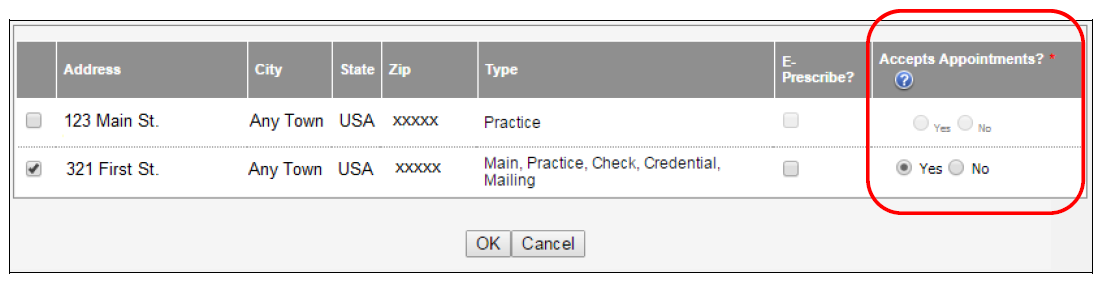
Practices must also confirm the “Accepts Appointments?” answers are accurate when submitting any of these location-related changes. The changes cannot be saved until this statement is confirmed.
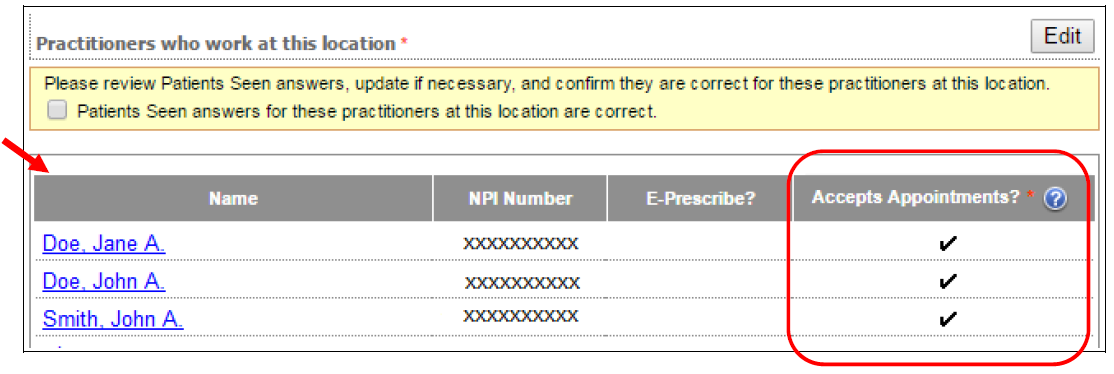
Written Notification Required for Mergers and Acquisitions
The provider agreement between Highmark and network practitioners is not assignable. In cases of practice mergers, acquisitions, etc., it is necessary to send written notification, on practice letterhead, to Highmark.
For additional information, please see the next section of this unit on Mergers and Acquisitions.
Immediate Notification of Certain Actions
Providers of all types must provide immediate written notification to Highmark in the event of any of the following:
- Termination, suspension, or limitation of license or certification;
- Exclusion, withdrawal, sanctions, or other change in status regarding participation in federal health programs (Medicare, Medicaid, Federal Employee Health Benefit Plan, other programs);
- Change in accreditation status;
- Felony conviction;
- Labor strike or work stoppage; and
- Change in credentialing information.
Notification can be mailed to Provider Information Management at:
| Mail to: | Highmark Blue Shield |
Notification to Highmark
You must send written notification on your practice letterhead of anticipated mergers, acquisitions, etc., at least 45 days, if not sooner as required by your network participation agreement, before the change(s) occur. The managing partner of the practice must sign the written notification. Include the following information:
- Effective date of the change
- Highmark provider number, NPI, new tax identification number* (if applicable)
- Changes to physician staffing
- Changes to physician location
The written notification can be mailed to Highmark:
| Mail to: | Highmark Blue Shield |
New assignment account paperwork will need to be completed – please use the Request for Assignment Account form. The form can also be found on the Provider Resource Center under Resources and Education, then Forms, and then Provider Information Management Forms.
*When reporting a new tax identification number, include the Internal Revenue Service (IRS) Tax Notification as evidence.
Consequences to Not Giving Notice
Most changes will require Highmark to revise existing provider files. In most cases, membership or claims payment will be affected by major changes in your practice. Therefore, if you do not give advance notification, we cannot guarantee accurate membership information and/or claims payments.
Sample Change Notification
If sending written notification on your practice letterhead, please include information in your letter as shown below:
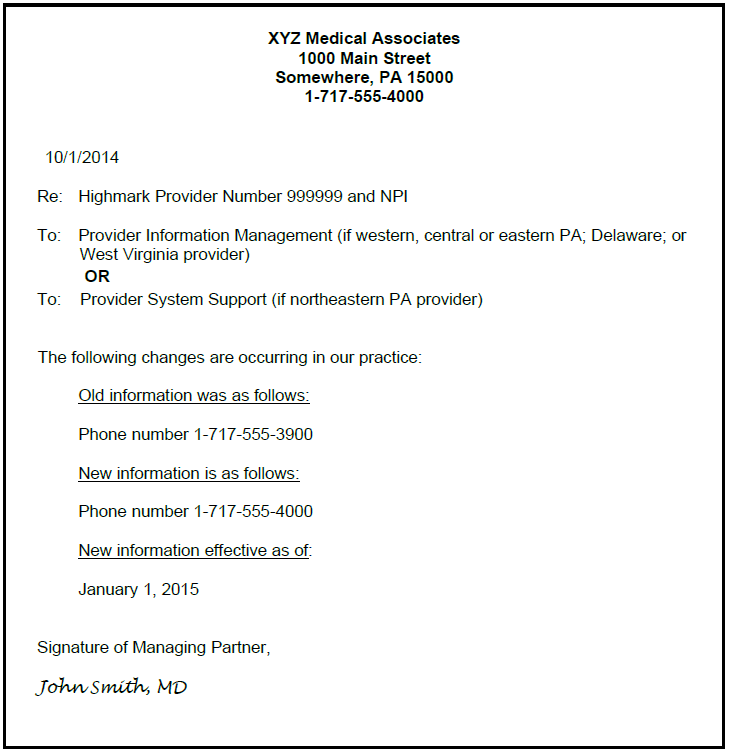
To resign from participation in Highmark’s credentialed network(s) in all service areas, fill out the electronic Request to Terminate a Contracted Network form. This form can also be accessed on the Provider Resource Center – select Resources and Education, then Forms, and then Provider Information Management Forms.
A resignation may be submitted at any time and is effective in accordance with the termination provision in the agreement the provider has executed. A letter will be sent to you advising of the effective date of your resignation.
IMPORTANT: If you decide to resign from the Highmark network(s) by submitting the form above, the resignation will trigger automatic letters to Highmark members, who are your patients, via U.S. Mail, notifying them you have terminated and are no longer in network. Please take this into account before completing the electronic form.
A network provider who engages in practices inconsistent with reasonable standards of care or professional conduct or who does not comply with Highmark contractual or administrative requirements may be subject to corrective action.
Determining Need for Corrective Action
Certain circumstances, acts, or omissions of a professional network provider may result in a requirement that the provider engage in a corrective action or a series of corrective actions to continue participation in the network.
Treatments, procedures, and services that are subject to corrective action include any treatments, procedures, or services that indicate a professional provider is practicing in a manner that is not consistent with reasonable standards of care (including, when applicable, accepted standards of medical care) and service, ethical expectations, contractual obligations, or the administrative requirements of the plan.
Examples of such circumstances, acts, or omissions which may be subject to corrective action include, but are not limited to, the following:
- Clinical quality of care
- Administrative non-compliance
- Unacceptable resource utilization
- Service-related issue
Providers identified with one of these issues will be reported to a Highmark Medical Director. The determination to take corrective action shall be made by a Medical Director.
Determining Need for Corrective Action
For New York providers, a corrective action plan can be initiated by any department or corporate committee. The Health Care Quality Improvement (HCQI) team is responsible to coordinate efforts amongst the Senior Medical Director and appropriate teams that will be integral in the review.
Once Provider Correspondence is reviewed and approved, it is sent out from the HCQI team with instructions, requested materials and a time frame when it is due back.
Forms of Corrective Action
Corrective action may vary according to the situation and may include, but is not limited to, one or more of the following actions as they relate to the circumstance, action, or omission that requires corrective action:
- Sending a written warning to the provider
- Engaging in a discussion or a series of discussions with the provider
- Monitoring the provider’s performance
- Expedited recredentialing
- Requiring that the provider complete a continuing medical education course regarding the treatment, procedure, or service in question
- Limiting the provider’s authority to perform certain procedures
- Requiring that the provider enter a preceptor relationship with another provider
- Monitoring and observing the provider subject to corrective action
- Termination or suspension
Highmark may immediately suspend the network participation status or restrict the clinical privileges of a provider who, in the opinion of the medical director, is engaged in conduct or is practicing in a manner that appears to pose a significant risk or imminent danger to the health, welfare, or safety of a patient or other individual. In such cases, Highmark will investigate the circumstances on an expedited basis.
If the suspension or restriction will last longer than 14 days, the provider will be notified that he/she can request a hearing. The request must be made in writing within 30 days of receipt of the notification.
Corrective Action on Clinical Quality of Care Issues
The determination to take corrective action on a clinical quality of care issue shall be based on an assessment of the severity level of the action based on the judgment of a Highmark Medical Director. The following are general guidelines used by the Medical Directors when assigning severity levels:
|
Severity Level |
Guideline |
|---|---|
|
Minor – low |
Deviation from the standard of care without harm to the member. |
|
Moderate – medium |
Deviation from the standard of care with temporary harm to the member. |
|
Severe – high |
Deviation from the standard of care with harm to the member resulting in permanent sequelae or death. |
Sanctioning
Sanctioning of a provider will occur whenever an assessment of the severity level of action is moderate or severe, and/or the corrective action was a result of an administrative non-compliance circumstance, act, or omission. Sanctioning may result in a provider’s practice not being eligible for participation in certain programs.
Corrective Action Appeals
An appeal shall be made available to a professional network provider before the Highmark Network Quality and Credentials Committee (NQCC), if the practitioner is placed under corrective action.
If an appeal is available, the procedure will be as follows:
|
Step |
Action |
|---|---|
|
1 |
The provider will be given written notice of the proposed action including: (a) the action that has been proposed to be taken against the provider; (b) the reason(s) for the action; (c) that the provider may request an appeal on the proposed action; (d) that the practitioner may participate via phone or in person; and (e) that the provider will waive any appeal rights if an appeal is not requested within 30 days of receipt of the notice of the action. |
|
2 |
If the provider requests an appeal on a timely basis, Highmark will notify the provider of the time and date of the NQCC meeting. |
|
3 |
The appeal shall be held before the NQCC, which is comprised of network practicing providers who will review the information presented and render a decision. The members of the NQCC shall not be in direct economic competition with the provider. |
|
4 |
After completion of the appeal, the provider has the right to receive the written decision of the Credentials Committee from the Medical Director, including a statement of the basis for the decision. The decision of the Credentials Committee is not subject to further appeal. |
Corrective Action Appeals
Corrective Action is discussed with the Senior Medical Director and team who were responsible for the review prior to notification to the provider.
Any Corporate Credential Committee initiated requests for Corrective Action would be determined by the Senior Medical Director and team prior to being discussed with the NY Corporate Committee team for re-credential consideration.
If the provider requests an appeal on a timely basis, Highmark will notify the provider of the time and date of the appeal meeting.
The following entities, which serve the noted regions, are independent licensees of the Blue Cross Blue Shield Association: Western and Northeastern PA: Highmark Inc. d/b/a Highmark Blue Cross Blue Shield, Highmark Choice Company, Highmark Health Insurance Company, Highmark Coverage Advantage Inc., Highmark Benefits Group Inc., First Priority Health, First Priority Life, Highmark Care Benefits Inc., or Highmark Senior Health Company. Central and Southeastern PA: Highmark Inc. d/b/a Highmark Blue Shield, Highmark Benefits Group Inc., Highmark Health Insurance Company, Highmark Choice Company or Highmark Senior Health Company. Delaware: Highmark BCBSD Inc. d/b/a Highmark Blue Cross Blue Shield. West Virginia: Highmark West Virginia Inc. d/b/a Highmark Blue Cross Blue Shield, Highmark Health Insurance Company or Highmark Senior Solutions Company. Western NY: Highmark Western and Northeastern New York Inc. d/b/a Highmark Blue Cross Blue Shield. Northeastern NY: Highmark Western and Northeastern New York Inc. d/b/a Highmark Blue Shield.
All references to “Highmark” in this document are references to the Highmark company that is providing the member’s health benefits or health benefit administration and/or to one or more of its affiliated Blue companies.
All revisions to this Highmark Provider Manual (the “manual” or “Highmark Provider Manual”) are controlled electronically. All paper copies and screen prints are considered uncontrolled and should not be relied upon for any purpose.
Unit 4: Organizational Provider Participation (Facility/Ancillary)
Highmark credentials organizational providers (facility and ancillary) in order to ensure they are in good standing with all regulatory and accrediting bodies. Highmark's participation and credentialing requirements derive from internal business decisions as well as the standards set by those agencies.
Requirements
All organizational providers are required to have a license, certificate, registration, or permit, as applicable, in the state where they do business. It must be maintained and in good standing with that particular state. Participation with Medicare/Medicaid may be required for providers. All organizational providers must submit their current certificate of liability insurance.
In addition, providers who are eligible for accreditation must also maintain an active accreditation status. Organizational providers who perform laboratory services must submit a current Clinical Laboratory Improvement Amendments (CLIA) certificate.
For requirements for specific organizational provider types, click on the link below:
Organizational Provider Participation, Credentialing, and Contracting Requirements
Facility Provider Types
Highmark defines “facilities” as those providers billing services in the UB-04/837I format. Highmark holds contracts with facility provider types including, but not limited to:
- Acute care hospitals
- Ambulatory surgical centers (ASCs)
- Comprehensive outpatient rehabilitation facilities (CORFs)
- Home health
- Hospice
- Long-term acute care facilities (LTACs)
- Psychiatric facilities
- Rehabilitation hospitals
- Renal dialysis facilities
- Skilled nursing facilities (SNFs)
- State-owned psychiatric hospitals
- Substance abuse treatment centers
Ancillary Provider Network
Ancillary providers are credentialed by Highmark as organizational providers; however, ancillary providers bill services in the 1500/837P format.
The ancillary provider network includes freestanding and facility-based providers in the specialties including, but not limited to:
- Ambulance
- Durable medical equipment
- Home infusion
- Independent laboratories
- Orthotics/prosthetics
Availability
Facility services must be available to members on a 24-hour-per-day, seven-day-per-week basis when medically necessary and in accordance with industry standards of care. Care should be provided in the most appropriate setting, in the most efficient manner, offering the most appropriate plan of treatment for the member.
Report Changes
Inform Highmark of any changes as required by your contract. Failure to keep this data current may lead to an incorrect listing in the provider directories, missed mailings or checks, and possibly incorrect payments.
The following list includes, but is not limited to, important informational changes that will require immediate written notification to Highmark:
- Change to hours of operation
- Address (physical location) change
- Mailing and/or billing address change
- Tax Identification Number (TIN) change
- Ownership/Corporation/Organizational changes
- Additions/deletions of Assignment Account members, if applicable
- Telephone number change, including area code (member access telephone number)
- Fax number change
See the section in this unit on Reporting Mergers, Acquisitions, and Changes for additional information.
For More Information
Refer to Highmark’s Provider Manual Chapter 3 Unit 1: Network Participation Overview for additional information on Highmark network participation.
Facilities and Ancillary Providers
To begin the process for credentialing and participation in Highmark’s networks, facilities and ancillary providers must complete and submit the following:
- Delaware: Initial Application for Facility and Ancillary Providers
- New York, Pennsylvania, and West Virginia: Certify Initial Application for Facility and Ancillary Providers
These applications are available on the Provider Resource Center within the Credentialing section, under Provider Network in the main menu.
Note: Certain ancillary provider networks, such as durable medical equipment and laboratories, may be closed to new applicants. Highmark most often performs outreach in the provider community when it is determined that such services are needed. If an application is received for a closed network, a response may not be provided. Closed network status will be noted on the Organizational Provider Participation, Credentialing, and Contracting Requirements document.
Urgent Care Centers/Medical Aid Units and Retail Clinics
To begin the process for participation in Highmark networks for Urgent Care Centers, Medical Aid Units (in Delaware), and Retail Clinics, providers must complete the following:
- Delaware: Initial Application for Facility and Ancillary Providers
- New York, Pennsylvania, and West Virginia: Certify Initial Application for Facility and Ancillary Providers
These applications are available on the Provider Resource Center within the Credentialing section, under Provider Network in the main menu.
For more information on participation requirements for Urgent Care Centers and Medical Aid Units, see 3.4 Urgent Care Centers/Medical Aid Units.
Behavioral Health
To begin the process for participation in Highmark networks for freestanding behavioral health facilities/centers, providers must complete the following:
- Delaware: Initial Application for Facility and Ancillary Providers
- New York, Pennsylvania, and West Virginia: Certify Initial Application for Facility and Ancillary Providers
These applications are available on the Provider Resource Center within the Credentialing section, under Provider Network in the main menu.
Highmark requires advance notification of the following events: mergers, acquisitions, changes of ownership, legal name changes, new or changed locations, or services or related events (individually or collectively, referred to as a "Facility Event").
Facilities are instructed to initiate the change notification process to notify Provider Contracting 30 days prior to the effective date of a Facility Event. A facility is also required to comply with any applicable notification requirements set forth in its facility agreement.
After determining all information and notices are complete, Provider Contracting will initiate internal processes as appropriate with respect to Highmark’s approval and file modifications.
Required Form
Highmark provides a standard form that is required for providing appropriate notification of significant changes as identified above. To view and print the form, click the link below:
The Change of Ownership Form is also available on the Provider Resource Center – select Resources and Education > Forms > Provider Information Management Forms.
This form should be used to report any changes in ownership which may include the Legal Name, Doing Business As name, NPI, or Tax ID information.
Highmark Approval Required
New facility locations cannot be billed under the Highmark facility agreement until Highmark has received proper contractual notice and given its prior approval, as set forth in the applicable facility agreement.
The approval requirement applies to all new facility locations, whether the location is brand new, the result of the movement of services or combination of services, or addition of services through a merger, acquisition, change of ownership or some other legal event of an existing health care entity or practice (e.g., acute care facility, ambulatory surgery center, or physician practice).
If a facility bills for services at a new location prior to notification and approval by Highmark, this may result in the following occurrences and/or as may be provided for in the facility agreement and related agreements and documents, a breach of contract:
- Denial of payment
- Denial of authorization
- Decreased payment
- Increased audit activity
Highmark's approval of a Facility Event is for the purpose of recognizing an event in terms of the provider's contract(s) with Highmark, and the rights and obligations of each party thereunder.
Address and Phone Number Changes
Providers should update their address, phone numbers, and/or contact information to existing locations for UB Facility Billers, Urgent Care Centers/Medical Aid Unit/Retail Clinics, or for Organizational Behavioral Health Billers, using the Highmark Facility/Ancillary Change Form.
This form is also available on the Provider Resource Center – select Resources and Education > Forms > Provider Information Management Forms.
In support of the Health Information Technology for Economic and Clinical Health (HITECH) Act of 2009, Highmark has taken steps to eliminate paper transactions with our contracted providers. As part of this initiative, all facilities are required to enroll in Availity and Electronic Funds Transfer (EFT) and will receive paperless Remittance Advices.
Due to their inherent speed and cost-effectiveness, electronic and online communications are integral in today’s business world and Highmark requires that all network providers participate in electronic programs sponsored or utilized by Highmark now or in the future.
Availity Essentials® and EFT Enrollment Required
All Highmark network participating providers are required to enroll in Availity and Electronic Funds Transfer (EFT).
Availity Essentials integrates all insurer-provider transactions into one system (e.g., eligibility and benefit inquiries, claim status inquiries, claim submission, authorization requests, etc.). This service is available at no cost to Highmark network participating providers.
Participating providers are also required to enroll to receive electronic funds transfers and paperless remittances.
- EFT is a secure process which directs Highmark claim payments to the provider’s checking or savings account as directed by your facility. Payments are typically in the designated bank account by Wednesday of each week. This information is also available for viewing within PNC’s Healthcare’s ECHO Health platform.
- Paperless Remittance Advices reduce the amount of paper flowing into the facility’s office. Remittance Advices are available for viewing via Availity, which is earlier than receiving them by mail. This information is also available for viewing within PNC’s Healthcare’s ECHO Health platform.
For More Information
For guidance on enrolling in Availity and EFT and paperless remittances, see the section on Electronic Transaction Requirements in Highmark’s Provider Manual Chapter 3 Unit 1: Network Participation Overview.
Urgent care is care for an illness, injury, or condition serious enough that it requires care right away, but not so severe as to require emergency room care.
When urgent care is needed, Urgent Care Centers and Medical Aid Units provide Highmark members with a convenient option for non-life-threatening injuries and illnesses when their personal physicians are unavailable.
Urgent Care Centers (UCCs)
An Urgent Care Center (UCC) generally provides immediate care for acute, non-life-threatening illnesses and injuries outside of a hospital emergency department. Services are provided on a walk-in basis without a scheduled appointment.
Urgent care medicine differs from emergency medicine in that its primary focus is on acute medical problems at the lower end of the severity spectrum. Individuals who present to an Urgent Care Center and are judged to need emergency care are transferred to a hospital emergency department.
Delaware Regulations for UCCs and MAUs
There is significant variation among states regarding regulation of urgent care facilities. Delaware law limits the use of the terms “emergency” or “urgent” by a facility if that facility is not able to handle life-threatening emergency care.
Delaware law defines “Free Standing Emergency Center” as a facility that is:
- Physically separate from a hospital
- Using the words “emergency,” “urgent care,” or parts of those words or other language or symbols which imply or indicate to the public that immediate medical treatment is available to individuals suffering from a life-threatening medical condition in its title or in its advertising
- Capable of treating all medical emergencies that have life-threatening potential
- Not a trauma center
- Open 24 hours a day, seven days a week
- Generally able to treat most emergencies
In Delaware, a facility is considered to be an “Urgent Care Center (UCC)” and credentialed as such only if they are licensed as a Freestanding Emergency Center. Facilities providing urgent care that are not licensed are called and credentialed as “Medical Aid Units (MAUs).”
New York Regulations for UCCs and UCPs
Effective May 19, 2025, New York facilities not licensed as an Urgent Care Center (UCC) are considered an Urgent Care Practice (UCP). The UCP will still be listed as a UCC in the directory. Affiliated providers will need to be credentialed as Emergency Medicine. See the Highmark Provider Manual's Chapter 3, Unit 2 for requirements.
Application Process for Highmark Network Participation
To begin the application process for participation in Highmark’s networks, providers must complete the following:
- Delaware: Initial Application for Facility and Ancillary Providers
- New York, Pennsylvania, and West Virginia: Certify Initial Application for Facility and Ancillary Providers
Each location will require a separate application. These applications are available on the Provider Resource Center within the Credentialing section, under Provider Network in the main menu.
You will be contacted by Highmark Provider Information Management if additional information is needed. Please allow up to 180 days for the application to be processed.
A GEO access analysis will be completed to determine the number of members and existing Urgent Care Centers within a reasonable radius of the provider’s ZIP Code. Highmark may approve or deny provider network participation based on the results of the GEO access analysis.
If Highmark approves network participation, a contract is sent to the provider to sign and return to Highmark. When Highmark receives the signed contract, a new provider number is assigned and a welcome letter and the executed contract, with the effective date indicated, is sent to the provider.
Credentialing Requirements
Highmark credentials Urgent Care Centers and Medical Aid Units at the facility level as part of the application and contracting process.
Although Highmark does not require in-network practitioners participating Urgent Care Centers and Medical Aid Units to credential, practitioners are still required to submit the Request to Add a New Practitioner to Existing Practice electronic form as they join or leave the group. The form is also available on the Provider Resource Center. Select Resources and Education > Forms > Provider Information Management Forms.
Accreditation Requirements
Highmark requires that Urgent Care Centers/Medical Aid Units have accreditation from one of the following organizations:
- Joint Commission (JC)
- National Urgent Care Center Accreditation (NUCCA)
- Accreditation Association for Ambulatory Health Care (AAAHC)
- Center for Improvement in Healthcare Quality (CIHQ)
- Urgent Care Association of America (UCAOA)
Initial applicants that are not accredited must pass a Highmark Health Services Site Visit and obtain accreditation by a Highmark recognized accrediting organization within 18 months after they are credentialed. If accreditation is not obtained within that time frame, the contract may be terminated.
License Requirements
Licensing is not required for Urgent Care Centers in Pennsylvania and West Virginia.
In Delaware, Urgent Care Centers are required to be licensed as a Freestanding Emergency Center. Medical Aid Units do not require licensing.
In New York, a license is required for Urgent Care Centers.
Additional Participation Requirements
Additional requirements for Urgent Care Center and Medical Aid Unit participation in Highmark networks includes, but is not limited to, the following:
- Medical Director who is a Highmark network participating physician with a valid license in the state(s) where the Urgent Care Center(s) is located. The Medical Director maintains responsibility for all medical personnel within the Urgent Care Center.
- Services provided on a walk-in basis with no appointment required.
- Hours of operation must be as follows:
- Monday-Friday: Minimum 12 hours per day
- Saturday and Sunday: Minimum eight hours per day
- Post-services coverage, which at a minimum shall include access to a physician by telephone, should be available 24 hours a day, seven days a week to all members who have received services.
- Claim submission via 1500/837P.
- Inspect, calibrate, service, and ensure equipment is in optimal working condition and meets all federal, state, and local safety standards.
- Compliance with federal and state requirements regarding the dispensing, recording, and controlling of medications.
- Store pharmaceuticals and medical supplies under proper and secure conditions.
- The provider should participate in, cooperate with, and abide by the decisions of Highmark’s peer review, utilization review, and quality improvement programs; medical record audits; and other activities deemed appropriate by Highmark for assuring quality care, cost-effectiveness of care, and patient satisfaction.
Urgent care does not replace the member’s PCP. Communication with the member’s PCP regarding the care rendered to the member is essential.
On-Site Services Required
The following services must be available during all hours of operation:
- X-ray (routine plain film) and phlebotomy services
- Licensed provider on-site with the appropriate state license and resources to obtain and read X-rays
- Administration of intramuscular, oral, and IV medication/fluids on-site
- Minor procedures such as suturing, cyst removal, incision and drainage, splinting, etc.
- Staff trained in equipment located on-site [i.e., automated external defibrillator (AED), oxygen]
- Working telephone to contact 911 if necessary
Verify Eligibility and Benefits for Urgent Care
Providers are advised to verify a member’s eligibility and benefits via Availity Eligibility and Benefits Inquiry or a 270/271 HIPAA electronic transaction. Member benefit plans vary and urgent care may not be a covered service for certain members.
Important: Verifying Highmark Delaware UCC Benefit
To verify a Highmark Delaware member’s benefits for services in an Urgent Care Center (a “Freestanding Emergency Center”), go to Availity’s Eligibility and Benefits Inquiry.
Note that member cost-sharing may be different for services at Urgent Care Centers and Medical Aid Units.
Billing Guidelines
Highmark will only accept claims from Urgent Care Centers and Medical Aid Units that are billed electronically via an 837P transaction or 1500 claim form. This applies to all services provided, including diagnostic services.
All claims should include the following:
- S9088 – services provided in an Urgent Care Center (list in addition to code for service)
- Evaluation and Management procedure code, as applicable
- All other eligible services provided during the visit (i.e., X-rays)
Note: Medicare Advantage and Federal Employee Program (FEP) members do not have coverage for code S9088. In addition, service(s) designated with S9088 are not eligible for payment when reported with place of service telemedicine (02) for Highmark commercial members. The code may be billed; however, claims will reject as non-billable to the member. In addition, self-funded groups may choose not to provide coverage for this code.
Supplies and oral medications are considered an integral part of the Evaluation and Management or procedure performed. No additional reimbursement is provided for supplies or oral medications.
If a member is referred/transferred to an emergency room, the Urgent Care Center/Medical Aid Unit may bill for services that were provided and collect any applicable member responsibilities, including copayments, coinsurance, and deductible. If the member was directed to an emergency room without treatment, a claim should not be submitted to Highmark.
The following entities, which serve the noted regions, are independent licensees of the Blue Cross Blue Shield Association: Western and Northeastern PA: Highmark Inc. d/b/a Highmark Blue Cross Blue Shield, Highmark Choice Company, Highmark Health Insurance Company, Highmark Coverage Advantage Inc., Highmark Benefits Group Inc., First Priority Health, First Priority Life, Highmark Care Benefits Inc., or Highmark Senior Health Company. Central and Southeastern PA: Highmark Inc. d/b/a Highmark Blue Shield, Highmark Benefits Group Inc., Highmark Health Insurance Company, Highmark Choice Company or Highmark Senior Health Company. Delaware: Highmark BCBSD Inc. d/b/a Highmark Blue Cross Blue Shield. West Virginia: Highmark West Virginia Inc. d/b/a Highmark Blue Cross Blue Shield, Highmark Health Insurance Company or Highmark Senior Solutions Company. Western NY: Highmark Western and Northeastern New York Inc. d/b/a Highmark Blue Cross Blue Shield. Northeastern NY: Highmark Western and Northeastern New York Inc. d/b/a Highmark Blue Shield.
All references to “Highmark” in this document are references to the Highmark company that is providing the member’s health benefits or health benefit administration and/or to one or more of its affiliated Blue companies.
All revisions to this Highmark Provider Manual (the “manual” or “Highmark Provider Manual”) are controlled electronically. All paper copies and screen prints are considered uncontrolled and should not be relied upon for any purpose.
Chapter 3 - All

This unit sets forth provisions of, and procedures and policies resulting from, the Ohio Healthcare Simplification Act (“OHSA”).
This unit applies exclusively to providers located in the State of Ohio and participating with Highmark Plans in West Virginia and/or Pennsylvania.
Applicability
This unit does not apply to self-funded Employee Retirement Income Security Act (ERISA) plans.
Who Should Read This Unit
This unit is intended to act as a reference point for Highmark’s network participating professional and facility providers located in the state of Ohio, excepting pharmacists.
In accordance with the Ohio Healthcare Simplification Act (OHSA), Highmark will not require network providers to provide services for all current or future products offered.
However, if all existing products are not accepted, the OHSA permits a plan to refuse to contract and allows for contract termination if a future product is refused.
Networks
Except as permitted by OHSA, Highmark will not rent or sell networks involving Ohio providers.
Termination for Cause Contract Provisions
Termination “for cause” contract provisions are permitted only for:
- Any lawful reason;
- If a party objects to a material amendment for which there is no resolution, either party may terminate not later than 60 days prior to the effective date of the amendment; or
- Any reasonable provision agreed to by both parties.
For More Information
Please see the termination provisions of your provider contract for additional information.
Notification of Material Changes to Terms of Agreement
Highmark shall furnish providers with 90 days’ notice if it intends to make a material change to the terms of the agreement.
Material changes, as defined by the Ohio Healthcare Simplification Act (OHSA), are amendments that decrease the provider’s payment, change the administrative procedures in a way that may reasonably be expected to significantly increase provider’s administrative expenses, or add a new product.
This section on credentialing applies to all providers subject to the Ohio Healthcare Simplification Act (OHSA).
Forms
Highmark accepts the Council for Affordable Quality Healthcare (CAQH) credentialing application form.
In addition, Highmark West Virginia will accept the State of West Virginia Uniform Credentialing Form and the State of Ohio Uniform Credentialing Form.
Incomplete Information
Highmark will notify providers of missing or incomplete information within 21 days of receipt of application.
Time Frames
All providers who participate with Highmark and whose primary site of service is located in Ohio are required to be credentialed and notified of their credentialing status within 90 days of Highmark receiving a complete or incomplete credentialing application.
State Medical Board
Highmark may accept information from the State Medical Board’s website to the extent that the Board has verified medical education, graduate medical education, and examination history of a physician (or the physician’s status with the educational commission for foreign medical graduates).
For More Information
Please see Units, 1, 2, and 4 in Chapter 3 of this Highmark Provider Manual for additional credentialing information.
Highmark may not include most favored nation clauses in professional provider and non-hospital facility provider contracts.
Most Favored Nation Clause as Defined by OHSA
As defined by the Ohio Healthcare Simplification Act (OHSA), a “most favored nation clause” is one that:
- Prohibits the provider from contracting with another contracting entity to provide health care services at a lower price; or
- Requires the provider to accept a lower payment if the provider agrees to provide health care services to any other contracting entity at a lower price; or
- Requires termination or renegotiation of the existing contract if the provider agrees to provide services to another contracting entity at a lower price; or
- Requires the provider to disclose the provider’s contractual reimbursement rates with other contracting entities.
3.5 Arbitration
Arbitration Available For Certain Contract Disputes
Arbitration for contract disputes for the enforcement of certain rights conferred by the Ohio Healthcare Simplification Act (OHSA) is available for:
- Termination for “for clause” provisions;
- Information required by the OHSA to be included in the contract;
- Material amendments; and
- Sections that:
- Prohibit renting or selling networks;
- Require the provider to provide services for all products offered;
- Require the provider to accept any future product offering;
- Waive the provider’s rights under state or federal law; and
- Prohibit the provider from entering into a contract with any other contracting entity.
3.5 Disclaimers
The following entities, which serve the noted regions, are independent licensees of the Blue Cross Blue Shield Association: Western and Northeastern PA: Highmark Inc. d/b/a Highmark Blue Cross Blue Shield, Highmark Choice Company, Highmark Health Insurance Company, Highmark Coverage Advantage Inc., Highmark Benefits Group Inc., First Priority Health, First Priority Life, Highmark Care Benefits Inc., or Highmark Senior Health Company. Central and Southeastern PA: Highmark Inc. d/b/a Highmark Blue Shield, Highmark Benefits Group Inc., Highmark Health Insurance Company, Highmark Choice Company or Highmark Senior Health Company. Delaware: Highmark BCBSD Inc. d/b/a Highmark Blue Cross Blue Shield. West Virginia: Highmark West Virginia Inc. d/b/a Highmark Blue Cross Blue Shield, Highmark Health Insurance Company or Highmark Senior Solutions Company. Western NY: Highmark Western and Northeastern New York Inc. d/b/a Highmark Blue Cross Blue Shield. Northeastern NY: Highmark Western and Northeastern New York Inc. d/b/a Highmark Blue Shield.
All references to “Highmark” in this document are references to the Highmark company that is providing the member’s health benefits or health benefit administration and/or to one or more of its affiliated Blue companies.
All revisions to this Highmark Provider Manual (the “manual” or “Highmark Provider Manual”) are controlled electronically. All paper copies and screen prints are considered uncontrolled and should not be relied upon for any purpose.