Unit 5: 1500 Claim Form Guidelines
Highmark accepts only the 02/12 version of the 1500 Claim Form. Photocopies, discontinued, or outdated versions of the 1500 Claim Form, including the 08/05 version, will not be accepted and will be returned to providers. Please remember that only original red claim forms will be accepted.
Photocopies of the 1500 Claim Form will not be accepted and will be returned to providers.
This tip sheet is designed to highlight the fields of the CMS-1500 (02/12) claim form that are required when submitting to Highmark.
Electronic Claims Submission
Highmark encourages providers who are submitting paper claims to consider electronic claims submission.
Electronic claims submission is a valuable method of streamlining claim submission and processing, resulting in faster payment. Highmark supports a variety of HIPAA-compliant electronic claims and inquiry transactions. Refer to the Highmark Provider Manual's Chapter 1, Unit 3: Electronic Solutions – EDI and Availity for information on how to take advantage of the electronic solutions available to you.
You may also want to consider Availity Essentials® for submitting claims to Highmark. Availity is provided to Highmark network participating providers at no cost. This Internet-based service seamlessly integrates all insurer-provider transactions into one system — HIPAA-compliant claims submission, claim status inquiry, claim investigation, eligibility, benefits, and much more. Availity even provides access to Highmark’s tools for real-time claim estimation and adjudication. Additional information about Availity is also available in Chapter 1, Unit 3: Electronic Solutions – EDI and Availity.
OCR Scanner Improves Paper Claims Processing Time
Highmark uses an OCR (Optical Character Recognition) scanner for direct entry of paper claims into its claims processing system, OSCAR (Optimum System for Claims Adjudication and Reporting). OCR technology is an automated alternative to manually entering claims data. The OCR equipment scans the claim form, recognizes and “reads” the printed data, and then translates it into a format for direct entry into OSCAR. The scanner can “read” both computer-prepared and typewritten claim forms but only if the data is within the borders of each box.
Direct entry of claims by the OCR scanner is an advantage to you because it requires less human intervention in preparing and entering your claims. The scanner reads, numbers, and images your paper claims in one step. OCR scanning reduces claim entry time as well as entry errors. However, OCR claims do not receive the same priority processing as do electronically submitted claims.
For the most efficient processing, use only original red 1500 Health Insurance Claim Forms. The OCR scanner is programmed to read this form. Highmark will not accept photocopies or discontinued versions of the 1500 Claim Form and will return claims received on these invalid forms. Providers will need to resubmit returned claims on valid, original forms for the claims to be entered into Highmark’s claims processing system.
If you use computer billing software to complete the 1500 paper claim forms, remember to use original, current versions of the form and not photocopies or older versions of the claim form.
How to Obtain Claim Forms
To obtain a supply of the current version of the 1500 Health Insurance Claim Form, contact:
- Your current forms supplier
- TFP Data Systems
- Email: 1500form@tfpdata.com
- Phone: 800-482-9367, ext. 1770
- The Government Printing Office
- Online: Health Insurance Claim Forms | U.S. Government Bookstore
- Phone: 866-512-1800
In today’s business world, there are no requirements to submit claims on paper. In fact, Highmark’s claim system places higher priority on processing and payment of claims filed electronically. However, if you are submitting paper claims, the guidelines provided below must be followed when completing the 1500 Health Insurance Claim Form. By following these guidelines, you can be assured that your claims will be scanned as quickly as possible, processed accurately, and paid without delay.
Note: Reference the Highmark Provider Manual's Chapter 6, Unit 1: General Claim Submission Guidelines for general guidelines and reporting tips that apply to claims submissions in both paper and electronic formats.
Be Sure to Use the Correct Forms
Highmark will accept only the Version 02/12 1500 Health Insurance Claim Form. Always provide Highmark with the original red 1500 form. Do not send copies or forms printed in black ink on a laser printer – they cannot be scanned. Photocopies, discontinued, or outdated versions of the 1500 Claim Form will not be accepted and will be returned to providers. Resubmission on a valid form will be required.
Appropriate Printing of Forms
Always print or type all information on the claim form. Clear, concise reporting on the form helps us to interpret the information correctly.
- Use computer-printed forms or type the data within the boundaries of the boxes provided. Do not handwrite.
- Use black ink. Do not use red ink. The OCR image scanner cannot read red ink.
- Printing Specifications:
- Use 10-pitch PICA type.
- Submit all claims on 20-pound paper.
- Do not use highlighters to emphasize information on the claim form or attachments. Highlighted information becomes blackened out when imaged and is not legible.
If Multiple Forms are Necessary
In cases where you must use several claim forms to report multiple services for the same patient, total the charges on each form separately. Treat each form as a separate and complete request for payment. Do not carry balances forward. It also is important that you report all other essential information on each claim form.
Complete the claim form in its entirety. Our claims examiners review each claim individually. If you submit several claim forms for the same member but fill in only essential details on one form, Highmark will reject the claim forms.
We must have complete information before we can process the claim. If details are missing, Highmark will reject the claim.
Use the Appropriate Mailing Address
Mail the claim forms to the appropriate P.O. Box address. A complete listing of addresses can be found in the Highmark Provider Manual's Chapter 1, Unit 2: Online Resources and Contact Information.
ICD-10 Compliance
Highmark only accepts ICD-10-CM diagnosis codes on claims.
Diagnosis Code Reporting Guidelines for the 1500 Claim Form (02/12)
The following diagnosis code reporting guidelines are for all lines of business:
- Report diagnosis codes to the highest level of specificity available.
- The “ICD Indicator” identifies the version of the ICD code set being reported. Enter the applicable ICD indicator: 0 (zero) for ICD-10-CM. Enter the indicator between the vertical, dotted lines in the upper right-hand portion of the field.
- Enter the codes to identify the patient’s diagnosis and/or condition.
- Claims must be submitted with ICD-10-CM diagnosis codes.
- The lines allow for diagnosis codes at a maximum of seven characters.
- You may report a maximum of 12 diagnosis codes.
- Report only one diagnosis code on each line (labeled A-L) in Box 21 of the 02/12 1500 Claim Form.
- Enter the diagnosis codes left-justified on each line.
- Do not include the decimal point within the diagnosis code.
- Do not provide narrative description in this field.
- Relate lines A – L to the lines of service in 24E by the letter of the line.
- Substantiate all member diagnoses in the medical record.
For Medicare Advantage members:
In addition to above, include all diagnosis codes that impact the patient’s evaluation, care, and treatment for the current problems.
1500 Claim Form (02/12) Reporting Example
This is an example of reporting ICD-10-CM diagnosis codes on the 02/12 version of the 1500 Claim Form.
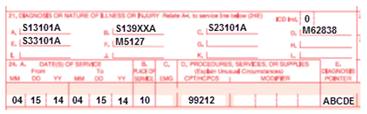
Always verify the patient’s information via Availity Essentials® or the HIPAA 270/271 Health Care Eligibility Benefit Inquiry and Response transaction before completing the claim form. Availity’s Eligibility and Benefits Inquiry function and the HIPAA 270/271 allow you to quickly confirm the member’s coverage and the member information needed on the claim form.
General Tips for Completing the Claim Form
- Do not staple over the Quick Response (QR) code symbol at the top of the Version 02/12 1500 Claim Form. Highmark’s scanners read the symbol to identify that the 1500 Claim Form is the 02/12 version.
- Be certain to enter information within the correct fields on the form.
- Make sure that the member’s identification number is correctly reported on the claim form (including the alphabetical prefix).
- Use an 8-digit format for reporting date of birth (MMDDYYYY).
- Submit a separate claim for each patient even when they are members of the same family. When a patient has had multiple hospital admissions, submit separate claim forms for each hospital admission.
- Include coordination of benefits or Medicare information on the claim form when the patient qualifies.
- Always report your 10-digit NPI in Item Number 33a.
- Regularly change your printer’s ink cartridge or typewriter ribbon to ensure print readability. Light print cannot be read by the scanner.
- Avoid using special characters such as dollar signs, hyphens, slashes, or periods.
- Avoid extra labeling in fields on claim form.
- Use X’s for marking Yes or No blocks. Do not use other alphabetical indicators such as Y for Yes, N for No, F for Female, or M for Male.
- Do not use correction fluid on the claims.
- Leave the upper right-hand corner of the claim form blank for internal purposes. If you need to print information at the top of the form, use the open space in the center.
- If using a rubber stamp, do not stamp information in or over fields one through 33 or in the upper right corner of the claim form. Any stamps used should be in black ink only.
- Claims and other documents (inquiries, referrals, etc.) should never be taped or glued in any way. Staples should be avoided unless absolutely necessary.
When Completing Service Lines …
- Include the date each service was provided in 6-digit format (MM|DD|YY).
- Be certain the total charge equals the service line charges.
- Do not fill in blank fields or space with unnecessary data. For example, if hospitalization dates are not required, leave the field blank rather than entering 00/00/00 or XX/XX/XX.
- Include HCPCS codes to identify the service or services rendered. Other coding manuals may use the same code number to describe a different service.
- The claim form can only accommodate six lines of service. The top area of the six service lines is shaded and is the location for reporting supplemental information. Supplemental information can only be entered with a corresponding, completed service line. It is not intended to allow the billing of 12 lines of service.
- Report all information about a service on one line. If the service dates, diagnosis code, charge, etc., are reported on separate lines, the scanner “creates” an extra line. This may cause the claim to be returned to you for correction and re-submission.
- Use the procedure code that most closely describes the service. Written descriptions are only necessary if using Non-Specific Codes or Not Otherwise Classified (NOC) codes or when no procedure code is available. Unnecessary descriptions are problematic for OCR scanned claims.
- Non-Specific Codes, including NOC, Not Otherwise Specified (NOS), not specific, and not specified codes: When reporting non-specific procedure codes, provide a written description of the item or service above the code in the shaded area of the service line on the claim form. When more than one non-specific code is submitted, provide an individual description and charge for each item. If a non-specific code is reported when a more appropriate code is available, the claim will be rejected and requested to be resubmitted with correct information. The member should not be billed.
Tips for Specific Reporting Needs
- Surgical procedures do not require operative notes unless:
- An “individual consideration” (IC) or “unlisted procedure” code is reported.
- The service performed is a new procedure.
- The service performed is potentially cosmetic.
- Multiple primary surgeons participated in a surgical procedure.
- The terminology for the reported code indicates “by report” (BR).
- A pre-authorization letter advised you to submit specific reports.
- The service involves unusual circumstances. Remember to also report modifier 22. If this modifier is not reported, the special circumstances will not be considered.
- When reporting circumcision for a baby boy, report the service on the baby’s claim, not the mother’s.
- In the case of a multiple birth, report the services under the babies’ names, not as Baby A, Baby B, etc.
Avoid Including Unnecessary Attachments
- Do not submit a photocopy of the member’s identification card.
- Do not routinely send “Release of Information” forms signed by the patient. Our member agreements give us the right to receive information without additional release forms.
- Avoid the use of Post-it Notes on claims or inquiries. (Full sheets of paper are preferable.)
- Avoid routinely attaching hospital notes (progress notes and order sheets) to claims. We will request this information if it is necessary to process the claim.
- Avoid routinely submitting copies of your payment records or ledgers. They often omit vital information, and it may be difficult to determine what services are to be considered for payment.
- The OCR scanner is designed to read computer-prepared or typewritten claim forms. Claims with superbill attachments cannot process through the OCR scanner. Type data from the superbill directly onto the claim form. Do not attach superbills for the same services you have reported on the claim form.
Mailing Tips
- Use flat envelopes for mailing claims.
- Do not fold claim forms. Folded or wrinkled claim forms cannot be effectively read by the scanner.
Examples of How to Submit Information Correctly
|
Insured’s ID Number |
|---|
|
Correct: YYZ123456789001 |
|
Incorrect: YYZ-123-456-789001; ID # YYZ123456789001 |
|
Charges |
|---|
|
Correct: 20.00 |
|
Incorrect: $20.00 |
|
Date of Birth: 8-Digit Format |
All Other Dates: 6-Digit Format |
|---|---|
|
Correct: 12271949 |
Correct: 122713; 021414 |
|
Incorrect: 12/27/49; 12-27-1949 |
Incorrect: 12/27/13; 2-14-14 |
|
Insured’s Policy Group Number |
|---|
|
Correct: 123456; NAS123 |
|
Incorrect: GRP # 123456; GRP # NAS123 |
For More Information
For instructions on how to begin to submit claims electronically, visit the EDI Trading Partner website by clicking the applicable link below:
Or, you may call EDI Operations at 800-992-0246.
Highmark will accept only the 02/12 version of the 1500 Claim Form. Also, remember that only original red claim forms will be accepted (except in New York where both red and photocopies are acceptable). Photocopies, discontinued, or outdated versions of the 1500 Claim Form will not be accepted and will be returned.
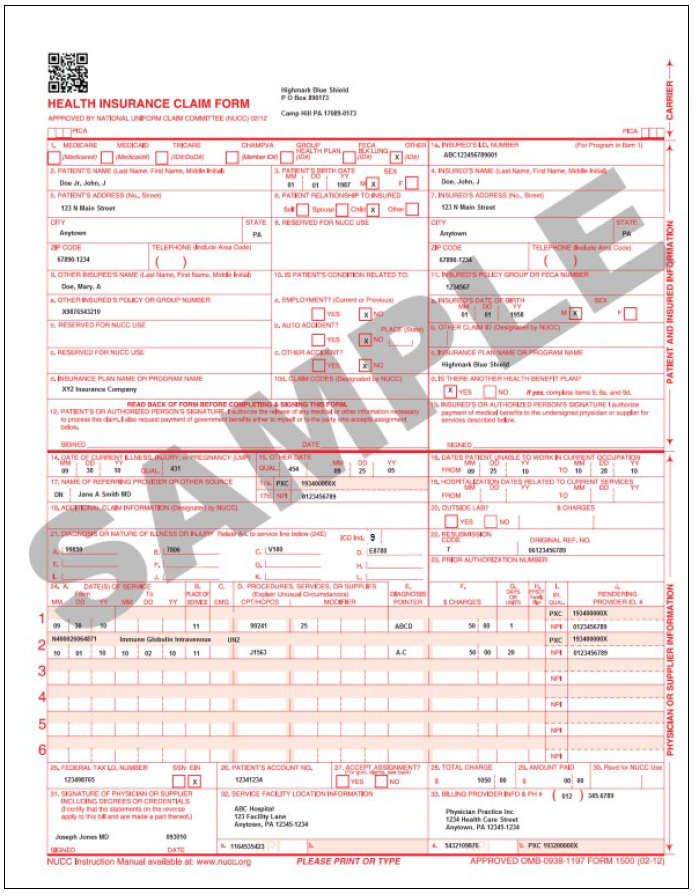
Instructions for Completing the 1500 Claim Form Version (02/12)
Any data (e.g., diagnosis codes, charges, NPIs, etc.) used in the instructions and sample claim form is demonstrating how to enter data in the field and is not providing instruction on how to bill for certain services.
Note: Refer to the Highmark Provider Manual's Chapter 6, Unit 4: Professional (1500/837P) Reporting Tips for additional information about specific claim reporting situations.
This tip sheet is designed to highlight the fields of the CMS-1500(02/12) claim form that are required when submitting to Highmark.
|
Item # |
Field Title /Description |
Instructions |
|
|---|---|---|---|
|
Top of Form |
Carrier Block |
Report name and address in the center of the open space. Do not report above Item #1a (this is where Highmark prints the claim number). Do not staple over the Quick Response (QR) code symbol. Highmark’s scanners read the symbol to identify that the 1500 Claim Form is the 02/12 version. |
|
|
1 |
Type of Health Insurance |
For Highmark products, place an X in the "Other" box. |
|
|
1a |
Insured’s ID Number |
Enter insured's identification number exactly as shown on the insured's identification card. Be sure to include any alpha prefixes. |
|
|
2 |
Patient’s Name |
Enter the patient's full last name, first name, and middle initial. Use commas to separate the last name, first name, and middle initial. A hyphen can be used for hyphenated names. Do not use periods within the name. If the patient uses a last name suffix (e.g., Jr, Sr), enter it after the last name and before the first name. Titles (e.g., Sister, Capt, Dr) and professional suffixes (e.g., PhD, MD, Esq) should not be included with the name. |
|
|
3 |
Patient’s Birth Date, |
Enter the patient's 8-digit birth date (MM|DD|YYYY). Enter an X in the correct box to indicate sex of the patient. Only one box can be marked. If gender is unknown, leave blank. |
|
|
4 |
Insured’s Name |
Enter the insured's full last name, first name, and middle initial. Use commas to separate the last name, first name, and middle initial. A hyphen can be used for hyphenated names. Do not use periods within the name. Do not use terms such as “Self” or “Same” if the patient is also the Insured. If the insured uses a last name suffix (e.g., Jr, Sr), enter it after the last name and before the first name. Titles (e.g., Sister, Capt, Dr) and professional suffixes (e.g., PhD, MD, Esq) should not be included with the name. |
|
|
5 |
Patient’s Address |
Enter the patient's mailing address. This field has 3 lines — the first line is for the street address; the second line, the city and state; and the third line, the ZIP Code. “Patient’s Telephone” is not used in processing and is not required by Highmark. Do not use punctuation (i.e., commas, periods) or other symbols in the address (e.g., 123 N Main Street 101 instead of 123 N. Main Street, #101). Report a 5 or 9-digit ZIP Code. Enter the 9-digit ZIP Code without the hyphen. |
|
|
6 |
Patient Relationship to Insured |
Enter an X in the correct box to indicate the patient's relationship to insured. Only one box can be marked. |
|
|
7 |
Insured’s Address |
Enter the insured's address. If Item #4 is completed, then this field should also be completed. This field has 3 lines — the first line is for the street address; the second line, the city and state; and the third line, the ZIP Code. “Insured’s Telephone” is not used in processing and is not required by Highmark. Do not use punctuation (i.e., commas, periods) or other symbols in the address (e.g., 123 N Main Street 101 instead of 123 N. Main Street, #101). Report a 5 or 9-digit ZIP Code. Enter the 9-digit ZIP Code without the hyphen. |
|
|
8 |
Reserved for NUCC |
Highmark does not need this information to adjudicate the claim. Leave blank. |
|
|
9 |
Other Insured’s Name |
If Item #11d is marked, complete fields 9 and 9a-d; otherwise leave blank. When additional group health coverage exists, enter other insured’s full last name, first name, and middle initial of the enrollee in another health plan if it is different from that shown in Item #2. Use commas to separate the last name, first name, and middle initial. A hyphen can be used for hyphenated names. Do not use periods within the name. If the insured uses a last name suffix (e.g., Jr., Sr.), enter it after the last name and before the first name. Titles (e.g., Sister, Capt., Dr.) and professional suffixes (e.g., PhD, MD, Esq) should not be included with the name. |
|
|
9a |
Other Insured’s Policy or Group Number |
Enter the policy or group number of the other insured. |
|
|
9b |
Reserved for NUCC |
Highmark does not need this information to adjudicate the claim. Leave blank. |
|
|
9c |
Reserved for NUCC |
Highmark does not need this information to adjudicate the claim. Leave blank. |
|
|
9d |
Insurance Plan Name or Program Name |
Enter the other insured's insurance plan or program name. |
|
|
10a,b,c |
Is Patient’s Condition Related to: |
When appropriate, enter an X in the correct box to indicate whether one or more of the services described in Item #24 are for a condition or injury that occurred on the job or as a result of an automobile or other accident. Only one box on each line can be marked. The 2-letter state code (e.g., PA, DE) must be shown if "YES" is marked in Item #10b for "Auto Accident." Any item marked "YES" indicates there may be other applicable insurance coverage that would be primary, such as automobile liability insurance. |
|
|
10d |
Claim Codes (Designated by |
Highmark requires the sub-set of Condition Codes approved by the NUCC in this field, when applicable. When reporting more than one code, enter three blank spaces and then the next code. The Condition Codes approved for use on the 1500 Claim Form are available at http://www.nucc.org under Code Sets. |
|
|
11 |
Insured’s Policy, Group, or FECA Number |
Enter the insured's policy or group number as it appears on the insured's health care identification card. Do not use a hyphen or space as a separator within the policy or group number. If Item #4 is completed, then this box should also be completed. |
|
|
11a |
Insured’s Date of Birth, Sex |
Enter the 8-digit date of birth (MM|DD|YYYY) of the insured and an X to indicate the sex of the insured. Only one box can be marked. If gender is unknown, leave blank. |
|
|
11b |
Other Claim ID |
Highmark does not need this information to adjudicate the claim. Leave blank. |
|
|
11c |
Insurance Plan Name or Program Name |
Enter the insurance plan or program name of the insured. |
|
|
11d |
Is There Another Health Benefit Plan? |
When appropriate, enter an X in the correct box. If marked “YES”, complete 9, 9a, and 9d. Only one box can be marked. |
|
|
12 |
Patient’s or Authorized Person’s Signature |
Highmark does not need this information to adjudicate the claim. The “Patient’s or Authorized Person’s Signature” indicates there is an authorization on file for the release of any medical or other information necessary to process and/or adjudicate the claim. You may report "Signature on File," "SOF," or a legal signature in this box. If you obtain a legal signature, (1) be sure the name is contained inside this box so it does not interfere with data you report in other boxes, and (2) enter the date signed in 6-digit format (MM|DD|YY). If there is no signature on file, leave blank or enter "No Signature on File." |
|
|
13 |
Insured’s or Authorized Person’s Signature |
Highmark does not need this information to adjudicate the claim. The “Insured’s or Authorized Person’s Signature” indicates that there is a signature on file authorizing payment of medical benefits. You may report "Signature on File," "SOF," or a legal signature in this box. If you obtain a legal signature, (1) be sure the name is contained inside this box so it does not interfere with data you report in other boxes, and (2) enter the date signed in 6-digit format (MM|DD|YY). If there is no signature on file, leave blank or enter "No Signature on File." |
|
|
14 |
Date of Current Illness, Injury, or Pregnancy (LMP) |
Enter the 6-digit (MM|DD|YY) date of the first date of the present illness, injury, or pregnancy. For pregnancy, use the date of the last menstrual period (LMP) as the first date. Be sure to complete this field when services were performed as a result of accident or injury. Enter the applicable qualifier to identify which date is being reported:
Be sure to enter the date and qualifier in the correct fields. The qualifier is entered to the right of the vertical, dotted line. |
|
|
DE Only: For physical, occupational, and speech therapy services: This box must be completed if the Highmark Delaware member has a per condition benefit. |
|||
|
15 |
Other Date |
Enter another date related to the patient’s condition or treatment. Enter the date in the 6-digit format (MM|DD|YY). (Previous pregnancies are not a similar illness.) Leave blank if unknown.
Be sure to enter the date and qualifier in the correct fields. The qualifier is entered between the left-hand set of vertical, dotted lines. |
|
|
DE Only: For physical, occupational, and speech therapy services: Provide date, if applicable. |
|||
|
16 |
Dates Patient Unable to Work in Current Occupation |
If the patient is employed and is unable to work in current occupation, a 6-digit (MM|DD|YY) date must be shown for the "from-to" dates that the patient is unable to work. An entry in this field may indicate employment-related insurance coverage. |
|
|
17 |
Name of Referring |
Enter the name (first name, middle initial, last name) and credentials of the professional who referred or ordered the service(s) or supply(s) on the claim. Do not use periods or commas. A hyphen can be used for hyphenated names. If multiple providers are involved, enter one provider only using the following priority order:
Enter the applicable qualifier to identify which provider is being reported.
Enter the qualifier to the left of the vertical, dotted line. |
|
|
17a |
Other ID# |
When the Referring Provider’s National Provider Identifier (NPI) is associated with more than one Highmark-assigned provider number, the Provider Taxonomy Code correlating to the contracted specialty must be submitted in addition to the NPI. This enables the accurate application of the provider’s contractual business arrangements with Highmark. The PXC Provider Taxonomy qualifier is reported in the qualifier field to the immediate right of the box containing “17a,” followed by the referring Provider’s taxonomy code. |
|
|
17b |
NPI# |
Enter the NPI number of the referring provider, ordering provider, or other source in Item #17b. |
|
|
18 |
Hospitalization Dates |
Enter the inpatient 6-digit (MM|DD|YY) hospital admission date followed by the discharge date (if discharge has occurred). If not discharged, leave discharge date blank. This date is when a medical service is furnished as a result of, or subsequent to, a related hospitalization (inpatient services only). |
|
|
19 |
Additional Claim |
Highmark does not need this information to adjudicate the claim. Leave blank. |
|
|
20 |
Outside Lab Charges |
Highmark does not need this information to adjudicate the claim. Leave blank. |
|
|
21 |
Diagnosis or Nature of Illness or Injury |
The “ICD Indicator” identifies the version of the ICD code set being reported. Enter 0 (zero) for ICD-10-CM. Enter the indicator between the vertical, dotted lines in the upper right-hand area of the field. *************** In A – L, enter the codes to identify the patient’s diagnosis and/or condition. List no more than 12 diagnosis codes. Use the highest level of specificity. Enter the codes left-justified on each line. Do not include the decimal point within the diagnosis code. Relate lines A – L to the lines of service in 24E by the letter of the line. ** Do not provide narrative description in this field. ** *************** See instructions regarding Federal Employee Program (FEP) claims and anesthesia reporting in the Highmark Provider Manual's Chapter 6, Unit 4: Professional (1500/837P) Reporting Tips. |
|
|
22 |
Resubmission |
When resubmitting a claim, enter the appropriate bill frequency code left justified in the left-hand side of the field.
List the original reference number for resubmitted claims. |
|
|
23 |
Prior Authorization |
For ambulance services, use this block to report the ZIP Code of the Point of Origin. (The 9-digit ZIP+4 Code is not required for the Point of Origin but will be accepted if reported.) Ambulance providers who submit paper claims for non-emergent ambulance transports must attach a PMNC (Physician’s Medical Necessity Certification) form to the claim. |
|
|
24 |
Supplemental information can only be entered with a corresponding, completed service line. The six service lines in section 24 have been divided horizontally to accommodate submission of both the NPI and another/proprietary identifier and to accommodate the submission of supplemental information to support the billed service. The top area of the six service lines is shaded and is the location for reporting supplemental information. It is not intended to allow the billing of 12 lines of service. The following types of supplemental information and their qualifiers can be entered in the shaded lines of Boxes 24A through 24H: |
||
|
Qualifier |
Type of Information |
||
|
7 Anesthesia information |
Report the surgical HCPC procedure code when a non-specific code, including ‘Not Otherwise Specified’ or ‘Not Otherwise Classified’ anesthesia service is reported. A complete description of the surgical service performed can be used in lieu of a surgical HCPC code or if the only applicable surgical procedure code is a non-specific code. |
||
|
ZZ Narrative description of unspecified code |
Narrative description of unspecified code. |
||
|
N4 National Drug Codes (NDC) |
National Drug Codes (NDC) for drugs: Report the qualifier, N4, prior to the 11-digit* NDC, e.g., N499999999999. |
||
|
To enter supplemental information in the shaded area, begin at Box 24A by entering the qualifier and then the information. Do not enter a space between the qualifier and the number/code/information. Do not enter hyphens or spaces within the number/code. *Many NDCs are displayed on drug packaging in a 10-digit format. Proper billing of an NDC requires an 11-digit number in a 5-4-2 format. Converting NDCs from a 10-digit to 11-digit format requires a strategically placed zero, dependent on the 10-digit format. For more information, refer to the section titled Reporting National Drug Codes in the Highmark Provider Manual's Chapter 6, Unit 2: General Claim Submission Guidelines. |
|||
|
24A |
Date(s) of Service |
Enter date(s) of service, from and to, in 6-digit format (MM|DD|YY). If one date of service only, enter that date under "From." Leave "To" blank. If grouping services, you may range date if the place of service, procedure code, charges, and individual provider for each line is identical for that service line. Grouping is allowed only for services on consecutive days. The number of days must correspond to the number of units in Item #24G. An exception to this is prolonged detention care. Do not range date these services even when performed on consecutive days. |
|
|
24B |
Place of Service |
Enter the appropriate 2-digit code from the Place of Service Code list for each item used or service performed. The Place of Service Codes are available at: |
|
|
24C |
EMG |
Highmark does not need this information to adjudicate the claim. Leave blank. |
|
|
24D |
Procedures, Services, or Supplies |
Enter the CPT or HCPCS code(s) and modifier(s) (if applicable) from the appropriate code set in effect on the date of service. This field accommodates the entry of one procedure code and up to four 2-character modifiers. The specific procedure code(s) must be shown without a narrative description. |
|
|
24E |
Diagnosis Pointer |
In 24E, enter the diagnosis code reference letter (pointer) as shown in Item Number 21 to relate the date of service and the procedures performed to the primary diagnosis. When multiple services are performed, the primary reference letter for each service should be listed first, other applicable services should follow. The reference letter(s) should be A – L or multiple letters as applicable. Enter letters left justified in the field. Do not use commas between the letters; hyphens can be used for ranges of multiple letters. This field allows for the entry of 4 characters in the unshaded area. Diagnosis codes must be entered in Item Number 21 only. Do not enter them in 24E. |
|
|
24F |
Charges |
Enter the charge for each listed service. Enter the number right-justified in the left-hand area of the field. Do not use commas or dollar signs when reporting the dollar amount. Do not report negative dollar amounts. Enter 00 in the right-hand area of the field if the amount is a whole number. |
|
|
24G |
Days or Units |
Enter the number of days, units, or minutes. This field is most commonly used for multiple visits, units of supplies, anesthesia minutes, or oxygen volume. If only one service is performed, the numeral 1 must be entered. When required by payers to provide the NDC units in addition to the HCPCS units, enter the applicable NDC units' qualifier and related units in the shaded line following the NDC qualifier and code. The following qualifiers are to be used when reporting an NDC quantity. Report the qualifier prior to the quantity, e.g., UN2. |
|
|
F2 International Unit |
ML Milliliter |
||
|
GR Gram |
UN Unit |
||
|
24H |
EPSDT/Family Plan |
Highmark does not need this information to adjudicate the claim. Leave blank. |
|
|
24I |
ID Qualifier |
The ‘NPI’ ID qualifier is pre-populated in the non-shaded area of Item #24I. (The Rendering Provider’s NPI is reported in the non-shaded area of Item #24J.) When the Rendering Provider’s National Provider Identifier (NPI) is associated with more than one Highmark-assigned provider number, the Provider Taxonomy Code correlating to the contracted specialty must be submitted in addition to the NPI. This enables the accurate application of the provider’s contractual business arrangements with Highmark. When required to report the Rendering Provider’s Taxonomy Code, enter the PXC Provider Taxonomy qualifier in the shaded area of Item #24I. Note: In most instances, the 3-character PXC qualifier can be printed within Item #24I. If the PXC qualifier runs into Item #24J, our Optical Character Recognition (OCR) scanner will still capture the qualifier and provider taxonomy correctly since 24I and 24J are read as one field. |
|
|
24J |
Rendering Provider ID# |
The Rendering Provider is the person or company (laboratory or other facility) who rendered or supervised the care. Report the provider’s information in Item Numbers 24I and 24J only when different from data recorded in Item Numbers 33a and 33b. In other words, when you report a billing provider (e.g., assignment account) in Item #33, you must report the rendering/performing provider information in Item #24I and Item #24J. Enter the Rendering Provider’s NPI number in the non-shaded area of Item #24J. Note: In the case where a substitute provider (locum tenens) was used, the regular physician on whose behalf the services were furnished by a substitute is reported as the rendering provider. The HCPCS modifier Q6 is entered after the procedure code(s) in Item 24D to indicate that the services were provided by a substitute provider. When the Rendering Provider’s National Provider Identifier (NPI) is associated with more than one Highmark-assigned provider number, the Provider Taxonomy Code correlating to the contracted specialty must be submitted in addition to the NPI. This enables the accurate application of the provider’s contractual business arrangements with Highmark. In the shaded area of Item #24J, enter the Rendering Provider’s Taxonomy Code when required. |
|
|
25 |
Federal Tax ID Number |
Enter the federal tax ID (employer identification number) or Social Security number. Enter an X in the appropriate box to indicate which number is being reported. Only one box can be marked. This must be the tax ID which correlates to the billing provider reported in Item #33. |
|
|
26 |
Patient’s Account No. |
Optional. Highmark does not require this number for processing; however, we can reference this number when contacting your office for additional information. |
|
|
27 |
Accept Assignment? |
Enter an X in the correct box. Only one box can be marked. |
|
|
28 |
Total Charge |
Enter total charges for the services (i.e., total of all charges in column 24F). Enter amount right justified in the left-hand area of the field. Do not use commas or dollar signs when reporting dollar amounts. Do not report negative dollar amounts. |
|
|
29 |
Amount Paid |
Enter total amount the patient or other payers paid on the covered services only. Enter number right justified in the dollar area of the field. Do not use commas or dollar signs when reporting dollar amounts. Do not report negative dollar amounts. Enter 00 in the cents area if the amount is a whole number. |
|
|
30 |
Reserved For NUCC Use |
Highmark does not need this information to adjudicate the claim. Leave blank. |
|
|
31 |
Signature of Physician or |
This field must be completed on all claims to affirm that the reported services were performed by the provider, or performed under the provider's personal supervision. The name of the individual performing the service on the claim must be entered. The name may be computer printed or typed. Simply reporting the name of the group is insufficient. |
|
|
32 |
Service Facility |
Enter the name, address, city, state, and ZIP Code of the location where the services were rendered. The full nine digits of the ZIP+4 Code must be reported. Enter the 9-digit ZIP Code without the hyphen. The use of zeros (0000) or spaces for the last four digits of the ZIP+4 Code is not valid. Enter the name and address information in the following format: 1st Line – Name Note: A physical street address must be reported for the Service Facility Location — a P.O. Box or lock box will not be accepted. Highmark requires the Service Facility Location when the service was performed at a secondary location and the provider’s primary location was reported in Item #33. Highmark always requires the Service Facility Location when the Place of Service reported in Item #24B is one of the following: 21 – Inpatient Hospital |
|
|
32a |
Service Facility – NPI# |
Enter the NPI number of the service facility location. |
|
|
32b |
Service Facility – Other ID# |
When the National Provider Identifier (NPI) is associated with more than one Highmark-assigned provider number, the Provider Taxonomy Code correlating to the contracted specialty must be submitted in addition to the NPI. This enables the accurate application of the provider’s contractual business arrangements with Highmark. |
|
|
33 |
Billing Provider Info and PH# |
Item #33 identifies the provider that is requesting to be paid for the services rendered and should always be completed. Enter the billing provider's name, address, ZIP Code, and telephone number. The full nine digits of the ZIP+4 Code must be reported. Enter the 9-digit ZIP Code without the hyphen. The use of zeros (0000) or spaces for the last four digits of the ZIP+4 code is not valid. The telephone number is to be entered in the area to the right of the box title. Enter the name and address information in the following format: 1st Line – Name Note: A physical street address must be reported for the Billing Provider — a P.O. Box or lock box will not be accepted. |
|
|
33a |
Billing Provider - NPI# |
Enter the NPI number of the billing provider reported in Item #33. |
|
|
33b |
Billing Provider - Other ID# |
When the Billing Provider’s National Provider Identifier (NPI) is associated with more than one Highmark-assigned provider number, the Provider Taxonomy Code correlating to the contracted specialty must be submitted in addition to the NPI. This enables the accurate application of the provider’s contractual business arrangements with Highmark. Enter the PXC qualifier followed by the Provider’s Taxonomy Code when required. |
Additional Edit Checks for Paper Billers
Highmark does not attempt to correct or retrieve missing information for the situations listed below. Instead, these situations will result in a rejection of the claim, and you will be required to resubmit a new claim with the corrected data.
When a claim rejects, it is important for your billing staff and/or vendor to understand exactly what was wrong and what is needed to correct it.
If you submit paper claims, you may encounter the following denial codes and descriptions on your explanation of benefits notices:
|
Rejection Code |
Description |
|---|---|
|
B5606 |
In order to process the claim, additional information is required. Please resubmit the claim with a prescription for this service. Electronically enabled providers should resubmit electronically. |
|
P5039 |
In order to process this claim, additional information is required. The claim should be resubmitted with a valid modifier and associated number of services rendered. Electronically enabled providers should resubmit electronically. |
|
P5040 |
The patient’s coverage does not provide for this service in the place of treatment reported. Therefore, no payment can be made. |
|
P5010 |
The procedure code reported is not appropriate for the patient’s age. Please resubmit claim with verification of the patient’s age and/or a corrected procedure code. Electronically enabled providers should resubmit electronically. |
|
P5011 |
The procedure code reported is not appropriate for the patient’s age. Please resubmit claim with verification of the patient’s age and/or a corrected procedure code. Electronically enabled providers should resubmit electronically. |
|
P5012 |
The patient’s sex is invalid for the reported procedure. Please resubmit the claim with verification of the patient’s sex and/or a corrected procedure code or a complete description of service. Electronically enabled providers should resubmit electronically. |
The following entities, which serve the noted regions, are independent licensees of the Blue Cross Blue Shield Association: Western and Northeastern PA: Highmark Inc. d/b/a Highmark Blue Cross Blue Shield, Highmark Choice Company, Highmark Health Insurance Company, Highmark Coverage Advantage Inc., Highmark Benefits Group Inc., First Priority Health, First Priority Life, Highmark Care Benefits Inc., or Highmark Senior Health Company. Central and Southeastern PA: Highmark Inc. d/b/a Highmark Blue Shield, Highmark Benefits Group Inc., Highmark Health Insurance Company, Highmark Choice Company or Highmark Senior Health Company. Delaware: Highmark BCBSD Inc. d/b/a Highmark Blue Cross Blue Shield. West Virginia: Highmark West Virginia Inc. d/b/a Highmark Blue Cross Blue Shield, Highmark Health Insurance Company or Highmark Senior Solutions Company. Western NY: Highmark Western and Northeastern New York Inc. d/b/a Highmark Blue Cross Blue Shield. Northeastern NY: Highmark Western and Northeastern New York Inc. d/b/a Highmark Blue Shield.
All references to “Highmark” in this document are references to the Highmark company that is providing the member’s health benefits or health benefit administration and/or to one or more of its affiliated Blue companies.
All revisions to this Highmark Provider Manual (the “manual” or “Highmark Provider Manual”) are controlled electronically. All paper copies and screen prints are considered uncontrolled and should not be relied upon for any purpose.
Chapter 6 All Units 5-End
Coordination of benefits (COB) applies when a patient is covered by two or more health insurance policies. Highmark employs several processes to ensure the services provided to our members are paid by the proper insurer and the reimbursement for these services does not exceed the actual charge.
Coordination of Benefits Defined
Coordination of benefits (COB) is the process of determining which of a member’s benefit plans should assume primary, secondary, and tertiary (first, second, and third) financial responsibility for health care services.
COB allows patients to receive up to 100% of the cost of covered services while ensuring that no one collects more than the actual cost of the covered health expenses. When a member is covered by more than one health plan, one plan is determined to be primary and its benefits are applied to the claim first; reimbursement of the remaining balance is considered through the secondary policy, subject to benefit provisions.
Payment sources include Highmark plans as well as other commercial health care plans, automobile/liability insurers, and government programs such as Workers’ Compensation and Medicare.
Workers' Compensation Insurance
Workers' compensation insurance covers medical treatment for work-related injuries or illnesses.
- Federal and state laws require employers to provide this coverage to their employees.
- Employees are entitled to full coverage for all employment-related health care expenses through their workers' compensation insurance.
- Highmark is not liable to pay claims under these circumstances, unless workers’ compensation benefits have been exhausted.
Automobile Insurance
The following apply to coverage for medical treatment related to automobile accidents:
- Highmark may pay for covered services after the automobile insurance benefits are exhausted.
- The Pennsylvania Motor Vehicle Financial Responsibility Law requires anyone who registers a motor vehicle in the state to provide for specific levels of medical insurance coverage. The law mandates a minimum of $5,000 in medical benefit coverage must be available for each accident victim. The victim’s motor vehicle accident insurance is always the primary payer for the treatment of injuries sustained in an automobile accident.
- The law in Delaware mandates a minimum of $15,000 in Personal Injury Protection (PIP) coverage be available for each accident. PIP coverage is always primary in Delaware.
- Medical benefit coverage on motor vehicle insurance is not mandatory in West Virginia. However, if a member has medical benefits on their automobile policy, that coverage will be primary.
- New York law requires all vehicles to carry a minimum amount of $50,000 for Personal Injury Protection (PIP), also known as No-Fault. The victim’s motor vehicle accident insurance is always the primary payer for the treatment of injuries sustained in an automobile accident.
Note: Be aware that automobile insurance laws can vary by state.
When Highmark is Secondary
Highmark coverage is considered secondary in the situations listed below:
|
If … |
Then … |
|---|---|
|
Injuries are received in an automobile accident |
Automobile insurance is primary |
|
Injuries are received in a work-related illness or injury |
Workers’ Compensation Program is primary |
|
Injury or illness occurs when another party is judged to be responsible |
Liability insurance is primary |
Subrogation
Subrogation is the contractual and equitable right of Highmark to recover any payments paid for health care expenses which were the result of injuries caused by another person or entity.
- Subrogation helps by crediting the member’s benefit plan with the recovered monies and controls the cost the customer and his/her employer pay for health care.
- Examples of other party liability include product liability, property negligence, auto accident caused by another party, or accidental injury on someone else’s property.
Network providers must assist in our subrogation efforts by indicating an accident, the accident date, and the diagnosis on the claim.
Authorization Requirements Still Apply
Be advised that the authorization requirements for any Highmark benefit plan would still apply even if that benefit plan is secondary or tertiary for the services being reported.
Right of Recovery
If Highmark pays more for covered services than the applicable COB provision or that any other provision the member’s contract requires, then we have the right to recover the excess from any person or entity to whom or for whom the payment was made. Recovery may be made through deductions and offsets from any pending and subsequent claims. Highmark’s right of recovery includes, among other things, periods where a member’s premiums were delinquent or the individual was otherwise ineligible for coverage.
Reporting Other Insurance
Highmark primarily obtains other insurance information from employer groups for the employer’s group members. However, Highmark also allows providers to collect this information at the time of service and then report it to us to help reduce the number of claims suspended or rejected as a result of coordination of benefits (COB) situations.
Electronic COB Questionnaire
Highmark offers a feature in Availity Essentials that allows you to quickly and easily report a member’s other insurance by completing an electronic form.
Once you log into Availity, you can access the questionnaire directly from Payer Spaces under Applications. Click on COB Questionnaire.
Note: This questionnaire cannot be used for Medicare Advantage members, Law Enforcement Members (Plan Area 327), Federal Employees, Highmark West Virginia members (Plan Area 943), or members in Plan Area 362.
These members should be advised to contact Customer Service to report any changes in regard to other insurance.
When coordination of benefits is applied, the order of the member’s benefit plans must first be determined:
- If the coverage is primary, it bears the majority of the financial responsibility for claim costs.
- If the coverage is secondary, it may contribute toward any remaining amounts after the primary benefit plan has paid.
- If the coverage is tertiary, it may contribute toward any remaining amounts after both the primary and secondary benefit plans have paid what they are liable to pay.
Determining the order of benefit payment requires applying certain standard rules to the member’s situation. Most health insurance carriers, including Highmark, use the following rules to decide who is primary.
Member’s Own Benefit Plan
Typically, when a member has more than one benefit plan, the plan where the member is enrolled as the employee, or “subscriber,” will be primary. A plan on which the individual is covered as a spouse or dependent is not primary, unless it is the only plan available.
- Two Active Coverages
- When a person is enrolled in two different plans as the subscriber, the plan that has provided coverage for the longer period of time will be primary.
- Active Over Retiree/Laid-Off Coverage
- If a member is subscribed as an active employee of one company and is also subscribed as a retiree or laid-off worker of another company, the benefit plan from his or her active employment is considered primary in most cases, while the benefit plan of the other company is considered secondary.
- In some cases, however, one of the group contracts may not include this provision. Under these circumstances, the coverage that has been in force the longest is considered primary.
- If a member is subscribed as an active employee of one company and is also subscribed as a retiree or laid-off worker of another company, the benefit plan from his or her active employment is considered primary in most cases, while the benefit plan of the other company is considered secondary.
Dependent Child
When both parents provide coverage for a dependent child, the plan of the parent whose date of birth (month and day) arrives earlier in the calendar year is the plan that pays first. The year of birth is not relevant. For example, if the mother’s birthday is March 10 and the father’s birthday is March 20, the mother’s plan would pay first. This is known as the” birthday rule.”
The birthday rule applies only under the following conditions:
- The parents are married; or
- The parents are living together, they are not married to each other or anyone else, and they are not separated from each other; or
- There is a court order for joint custody with no assigned financial responsibility.
If the parents are separated or divorced, then:
- The plan of the parent with whom the child lives pays first.
- The plan of the stepparent with whom the child lives pays second.
- The plan of the parent without custody pays third.
- A court order can establish a different order*
*When such a decree exists, it is documented in the parent’s membership file. This information is not available in Availity Essentials® Eligibility and Benefits. Providers must open a claim inquiry using Message this Payer in Availity.
When Highmark is Primary
When Highmark is the primary coverage, the services are considered as though no other coverage is available. A health care professional who participates in our networks agrees to accept the program allowance as payment in full. The only amounts billable to the secondary insurance are for coinsurances, deductibles, amounts exceeding a maximum, and those charges denied as non-covered.
When Highmark is not Primary
When not the primary payer, Highmark uses several methodologies when processing claims. These COB payment methodologies include:
- National Association of Insurance Commissioners (NAIC) Model
- Regular COB
- Hard non-duplication
- Soft non-duplication I
- Soft non-duplication II
- Regular Medicare COB
- Customized COB
NAIC Model COB Regulation
Highmark has adopted the National Association of Insurance Commissioners (NAIC) Model COB Regulation. This regulation is the most common methodology used for calculating a secondary payment in COB situations. This model applies to all commercial group products. While the majority of commercial business has been moved to the NAIC model, certain national accounts and larger regional accounts have the option to not participate in this methodology.
The NAIC model COB regulation applies to institutional claims, professional claims, and ancillary claims. It applies to all health care professionals and providers regardless of their participating status with Highmark. The Blue Cross Blue Shield Association supports the NAIC model COB regulation. This is a common industry standard and is consistent with most insurers.
Note: Highmark’s senior products, Medicare Advantage products, direct pay products, and the Federal Employee Program (FEP) do not use the NAIC Model.
Delaware and West Virginia NAIC Model

With the Delaware and West Virginia NAIC model, Highmark first determines the amount it would have paid as primary. As a secondary payer, Highmark will never pay more than it would have paid as primary.
Highmark compares their primary benefit to the “Other Insurance” member liability. Highmark will pay the member liability up to, but not more than, what the Highmark primary payment would have been.
Highmark will follow Delaware and West Virginia State regulations, unless an ASO groups requests something different.
New York NAIC Model**

With the New York NAIC model, Highmark first determines the amount it would have paid as primary. As a secondary payer, Highmark will never pay more than it would have paid as primary. If the primary other insurance carrier has paid more than or equal to the original Highmark payment, no additional payment will be made.
The Other Insurance primary payment is deducted from the original Highmark payment. This amount is then compared to the Other Insurance member liability. The lesser of the two amounts is paid.
**This does not apply when traditional Medicare is primary.
Pennsylvania NAIC Model

With the Pennsylvania NAIC model, Highmark first determines the amount it would have paid as primary. As a secondary payer, Highmark will never pay more than it would have paid as primary. If the primary “Other Insurance” carrier has paid more than or equal to the original Highmark payment, no additional payment will be made.
The Other Insurance primary payment is deducted from the original Highmark payment. This amount is then compared to the Other Insurance member liability. The lesser of the two amounts is paid at 100 percent reimbursement. The member always receives credit for the original Highmark deductible and coinsurance expenses.
With this method, when Medicare is primary, regular Medicare coordination of benefits would be applied.
Regular COB Model Defined
With the Regular COB model, Highmark first determines the amount it would have paid as primary. As a secondary payer, Highmark will never pay more than it would have paid as primary.
Highmark compares their original allowance to the primary “Other Insurance” member liability. The lesser of the two amounts is considered for payment. Highmark will apply the member’s group benefits, such as co-payments, coinsurance and deductibles, to any balances after the coordination of benefit methodology is applied.
With this method, when Medicare is primary, regular Medicare coordination of benefits would be applied.
Nonstandard COB Model (NY Only)**
With the New York Nonstandard COB model, Highmark first determines the amount it would have paid as the primary carrier for the member’s benefit. As a secondary payer, Highmark will never pay more than it would have paid as primary.
This amount is then compared to the Other Insurance member liability. The lessor of the member liability from the primary insurance or Highmark’s benefit (allowed amount minus patient responsibility) is paid.
**This does not apply when traditional Medicare is primary.
Hard Non-Duplication COB Model
With the Hard Non-Duplication COB model, Highmark first determines the amount it would have paid as primary. As a secondary payer, Highmark will never pay more than it would have paid as primary. If the primary “Other Insurance” carrier has paid more than or equal to the original Highmark payment, or there is no primary Other Insurance member liability, no additional payment will be made.
The Other Insurance primary payment is deducted from the original Highmark payment. This amount is then compared to the Other Insurance member liability. The lesser of the two amounts is paid at 100% reimbursement. The member always receives credit for the original Highmark deductible and coinsurance expenses.
With this method, when Medicare is primary, Medicare Hard Non-Duplication coordination of benefits would be applied. Highmark first determines the amount it would have paid as primary using the Medicare allowance. From here, the calculations remain the same as in the Hard Non-Duplication definition.
Note: This pertains to Blue on Blue or Blue on Commercial Only.
Soft Non-Duplication I COB Model
With the Soft Non-Duplication I COB model, Highmark first determines the amount it would have paid as primary. As a secondary payer, Highmark will never pay more than it would have paid as primary. If the primary “Other Insurance” carrier has paid more than the original Highmark allowance, no additional payment will be made.
The Other Insurance primary payment is deducted from the original Highmark allowance. This amount is then compared to the Other Insurance member liability. The lesser of the two amounts is considered for payment. Highmark will apply their group benefits, such as co-payments, coinsurance and deductibles, to any balances after the coordination of benefit methodology is applied.
With this method, when Medicare is primary, regular Medicare coordination of benefits would be applied.
Note: This pertains to Blue on Blue or Blue on Commercial ONLY.
Soft Non-Duplication II COB Model
With the Soft Non-duplication II model, Highmark first determines the amount it would have paid as primary. As a secondary payer, Highmark will never pay more than it would have paid as primary. If the primary “Other Insurance” carrier has paid more than the original Highmark allowance, no additional payment will be made.
The Other Insurance primary payment is deducted from the original Highmark allowance. This amount is then compared to the original Highmark payment. The lesser of the two amounts is paid at 100% reimbursement, not to exceed the primary Other Insurance member liability. If the lesser of the two amounts is greater than the Other Insurance member liability, Highmark will pay the Other Insurance member liability at 100% reimbursement after any copayments are applied. The member always receives credit for the original Highmark deductible and coinsurance expenses. With this method, when Medicare is primary, regular Medicare coordination of benefits would be applied.
Note: This pertains to Blue on Blue or Blue on Commercial ONLY.
Regular Medicare COB Model
For Medicare participating providers or providers who are obligated to accept Medicare Assignment (MOM Legislation), when Medicare is primary, Highmark will coordinate benefits up to the Medicare allowance. Highmark will apply their group benefits, such as co-payments, coinsurance and deductibles, to any balances after the coordination of benefit methodology is applied.
Customized COB Model
Self-funded (“ASO”) accounts may choose from any COB method option. Certain ASO Accounts may also be permitted to customize calculation methodologies. Custom COBs are methods considered to be outside of Highmark's regular COB method option.
COB Calculation Tip Sheet
To understand the different COB models outlined in this unit, click on this Tip Sheet document for examples of the following types of COB calculations:
- COB Calculation Example #1: An example COB calculation that illustrates an insurance payment that is greater than what Highmark would have paid if Highmark were primary.
- COB Calculation Example #2: An example COB calculation that illustrates an insurance payment that is less than what Highmark would have paid if Highmark were primary.
Blue on Blue
In many cases, duplicate coverage occurs when both the primary coverage and the secondary coverage are provided through Highmark. In most “Blue on Blue” cases, the paid-in-full regulations do apply for health care professionals who participate with Highmark networks.
When submitting COB claims to Highmark when it is the secondary payer, include all relative information from the primary insurer, including member liability (e.g., copayment, coinsurance, and deductible).
When Highmark processes a COB claim as the secondary payer, your Explanation of Benefits (EOB) may or may not show the amount the primary insurer paid. The EOB will also show the member’s liability. A network provider cannot balance bill the member when Highmark made payment as secondary payer except for any copayment, coinsurance, deductible, or non-covered service under the secondary policy.
How can Providers Assist with the Process?
Health care providers can assist in the COB process by following these guidelines:
- When you file a COB claim, submit it to the primary carrier first.
- When Highmark is the secondary coverage, you must submit information about the primary insurer’s claim payment and/or the denial of the claim to Highmark.
- When filing claims electronically, the nationally accepted electronic submission formats accommodate secondary claims submission.
- If you submit paper claim forms, you must also send us a copy of the other plan’s Explanation of Benefits payment information.
- If both insurance companies make payments on a claim and the combined payments exceed your charge, contact Highmark via Message this Payer in Availity. Provider Service will investigate and advise if a refund is required.
When a Duplicate Payment is Received
If you received a duplicate payment for a service, follow these guidelines:
- An offset request is the preferred method to return a duplicate payment. This allows for the quickest turnaround and eliminates the administrative cost of mailing and handling a check. Utilize Message this Payer in Availity Essentials to initiate the offset.
- If a refund check needs to be submitted, use the chart below.
|
Delaware: |
|
|---|---|
|
Send refund checks for overpayments to: |
Highmark Blue Cross Blue Shield Delaware |
|
To request a formal refund request for an offset… |
Open a claim inquiry using Message this Payer in Availity. |
|
New York: |
|
|---|---|
|
Send refund checks for overpayments to: |
Highmark New York |
|
Pennsylvania: |
|
|---|---|
|
Send refund checks for overpayments to: |
Highmark |
|
To request a formal refund request for an offset… |
Open a claim inquiry using Message this Payer in Availity to initiate an offset. |
|
West Virginia: |
|
|---|---|
|
If you receive duplicate payment in a subrogation case, open a claim inquiry: |
Using Message this Payer in Availity |
Member Inquiries
If a member seeks advice on a duplicate payment, advise members to call the Highmark member service telephone number on the back of their identification cards regarding their specific situation.
When a member has Medicare and other insurance, there are certain rules that decide whether Medicare or the other insurance pays first.
Retiree Coverage
Medicare is typically primary for retirees and their spouses since their coverage is not on the basis of current active employment. An employer group retiree health plan with Highmark would be the secondary coverage for the retiree and spouse.
Medicare is Secondary Payer for the Working Aged
The Tax Equity and Fiscal Responsibility Act (TEFRA) requires that employers of 20 or more people offer their working-aged employees and their spouses aged 65 and over the same employee group health plan offered to other employees.
Under the TEFRA law and subsequent legislation, the employee group health plan is the primary payer and Medicare is the secondary payer of claims for working- aged employees in employer group health plans with 20 or more full-time and/or part-time employees. This applies when a single employer with 20 or more employees (as determined by the IRS) sponsors or contributes to the employee group health plan; or multiple employers sponsor or contribute to the employee group health plan and at least one of them has 20 or more employees.
Please open a claim inquiry using Message this Payer in Availity Essentials to determine whether TEFRA applies.
Active, Retiree/Laid-Off, and Medicare Coverage
If a member has coverage as an active employee of one company, coverage as a retiree or laid-off worker of another company, and Medicare coverage, either of the following scenarios could occur:
- If TEFRA applies, the active coverage is primary; Medicare is secondary; and the retiree coverage is tertiary.
- If TEFRA does not apply, Medicare is primary; the active coverage is secondary; and the retiree coverage is tertiary.
In the case of a husband and wife, it is possible that one may be actively employed while the other is retired, and one or both may also have Medicare coverage, in such a case, either of these scenarios could occur:
- If TEFRA applies, the active coverage is primary for both the husband and wife; Medicare is secondary; and the retiree/laid-off coverage is tertiary.
- If TEFRA does not apply, Medicare is primary for both the husband and the wife; the active coverage is secondary; and the retiree/laid-off coverage is tertiary.
If Medicare is not involved in this scenario, the husband and wife would each be primary under his or her own insurance.
Medicare and Persons with Disabilities
The Omnibus Budget Reconciliation Act of 1993 (OBRA-93) is a federal law that enabled the government to raise additional revenues to help reduce the deficit and balance the federal budget. One of the provisions of OBRA-93 made Medicare the secondary payer for people who meet all the following criteria:
- Are under age 65;
- Have Medicare coverage because of a disability other than permanent kidney failure; and
- Are covered by a large group health plan (100 or more employees).
Those who can receive secondary Medicare coverage due to disability include:
- Disabled members who are covered by a large group health plan
- Disabled members who are the spouse of a person covered by a large group health plan
- Disabled child members with at least one parent covered by a large group health plan
End-Stage Renal Disease (ESRD)
Under certain circumstances, Medicare benefits are available to persons under the age of 65 who have end-stage renal disease (ESRD). For members who have coverage under an employee group health plan, Medicare and the group plan have specific, time-dependent roles in paying for care related to ESRD. The table below outlines this coverage process:
|
If … |
Then … |
|---|---|
|
It is within the first three months after the Medicare application has been made … |
Only the employee group health plan coverage will be available. |
|
The application for Medicare has been finalized, and the coordination period begins … |
The employee group health plan is primary; Medicare is secondary. |
|
The coordination period ends … |
Medicare is primary; the employee group health plan is secondary. |
|
Member is no longer ESRD for 12 consecutive months; or, the member is 36 months after a successful kidney transplant … |
Medicare benefits end; only the employee group health plan will be available. |
The waiting period is waived for ESRD members who undergo a kidney transplant within the first three months after applying for Medicare benefits. The same waiver is provided for members who participate in a course of self-dialysis training during the initial three-month period.
When a member’s entitlement has ended and another course of dialysis and/or kidney transplant is needed, a new waiting period is not required. Medicare will be the secondary payer for persons with ESRD who fall into one of the following categories:
- Members who are also covered under an employee group health plan
- Members who are the spouse of a person covered by a group health plan
- Child members with at least one parent covered by an employee group health plan
Who is Primary?
The following table describes who is considered primary when a Medicare beneficiary also has group health coverage:
|
If … |
Then … |
|---|---|
|
The beneficiary has retiree insurance… |
Medicare pays first. |
|
The beneficiary is 65 or older, has group health plan coverage based on their own or their spouse’s current employer, and the employer has 20 or more employees… |
The group health plan pays first. |
|
The beneficiary is 65 or older, has group health plan coverage based on their own or their spouse’s current employer, and the employer has less than 20 employees… |
Medicare pays first. |
|
The beneficiary is under 65 and disabled, has group health plan coverage based on their own or a family member’s current employer, and the employer has 100 or more employees… |
The group health plan pays first. |
|
The beneficiary is under 65 and disabled, has group health plan coverage based on their own or a family member’s current employer, and the employer has less than 100 employees… |
Medicare pays first. |
|
The beneficiary has Medicare because of end-stage renal disease (ESRD)… |
The group health plan will pay first for the first 30-month period after the beneficiary becomes eligible to enroll in Medicare. Medicare will then pay first after the initial 30-month period. |
Note: In some cases, the employer may join with other employers or unions to form a multiple employer plan. If this happens only one of the employers or unions in the multiple employer plan is required to have the number of employees for a group health plan to pay first.
Group Coverage Doesn’t Exist
If the employer group does not provide coverage for particular services deemed to be medically appropriate (e.g., kidney transplant), then Medicare may pay for those services as the primary payer. This assumes that the medically appropriate service is covered under the Medicare program.
The Centers for Medicare and Medicaid Services (CMS) consolidated its claim crossover process under a special Coordination of Benefits Contractor (COBC) by means of the Coordination of Benefits Agreement. Under this program, the COBC automatically forwards Medicare claims to the secondary payer, eliminating the need to separately bill the secondary payer.
Crossover Process
Blue Plans implemented the Medicare crossover consolidation process system-wide. This process provides an increased level of one-step billing for your Medicare primary claims, streamlines your claim submissions, and reduces your administrative costs.
The claims you submit to the Medicare carrier cross over to the Blue Plan only after the Medicare carrier or intermediary has processed them. The Medicare carrier or intermediary automatically advises the Blue Plan of Medicare’s approved amount and payment for the billed services. Then, the Blue Plan determines its liability and makes payment to the provider. This one-step process means that you do not need to submit a separate claim and copy of the Explanation of Medicare Benefits (EOMB) statement to the Blue Plan after you receive the Medicare carrier’s or intermediary’s payment.
Some providers submit paper claims and EOMB statements for secondary payment unnecessarily. Sending a paper claim and EOMB statement for secondary payment, or having your billing agency resubmit automatically, does not speed up the reimbursement of secondary payments. Instead, this costs you money and creates confusion for members. It also increases the volume of claims handled by the secondary payer and can slow down all claims processing and delay payments.
Whether you submit electronic or paper claims, it is no longer necessary to send a separate claim and EOMB statement for the purpose of obtaining payment on a secondary claim.
If You Have Not Yet Received Secondary Payment from Highmark
Please allow at least 30 days for the secondary claim to process. If you have not received notification of the processing of the secondary payment, do not automatically submit another claim. Rather, you should check the claim status before resubmitting. To further streamline the claim submission process to save your practice time and money, consider revising the time frame for the automated resubmission cycle of your system to accommodate the processing times of these secondary claims.
The following entities, which serve the noted regions, are independent licensees of the Blue Cross Blue Shield Association: Western and Northeastern PA: Highmark Inc. d/b/a Highmark Blue Cross Blue Shield, Highmark Choice Company, Highmark Health Insurance Company, Highmark Coverage Advantage Inc., Highmark Benefits Group Inc., First Priority Health, First Priority Life, Highmark Care Benefits Inc., or Highmark Senior Health Company. Central and Southeastern PA: Highmark Inc. d/b/a Highmark Blue Shield, Highmark Benefits Group Inc., Highmark Health Insurance Company, Highmark Choice Company or Highmark Senior Health Company. Delaware: Highmark BCBSD Inc. d/b/a Highmark Blue Cross Blue Shield. West Virginia: Highmark West Virginia Inc. d/b/a Highmark Blue Cross Blue Shield, Highmark Health Insurance Company or Highmark Senior Solutions Company. Western NY: Highmark Western and Northeastern New York Inc. d/b/a Highmark Blue Cross Blue Shield. Northeastern NY: Highmark Western and Northeastern New York Inc. d/b/a Highmark Blue Shield.
All references to “Highmark” in this document are references to the Highmark company that is providing the member’s health benefits or health benefit administration and/or to one or more of its affiliated Blue companies.
All revisions to this Highmark Provider Manual (the “manual” or “Highmark Provider Manual”) are controlled electronically. All paper copies and screen prints are considered uncontrolled and should not be relied upon for any purpose.
Chapter 6 All Units 5-End
6.7 Payment Methodology for Professional Services
6.7 Explanation of Benefits for Medical-Surgical Contracts
6.7 Facility Payment Methodology
6.7 Facility Remittance Advice
6.7 ANSI Claim Adjustment Group and Reason Codes
6.7 Electronic Manual Payments
6.7 Payment for FEP Members Over 65
6.7 Payment for the Highmark Healthy Kids Program (CHIP)
This unit addresses payment methodology for both professional and facility provider types, Explanation of Benefits (EOBs), the Facility Remittance Advice, guidance for overpayments and refunds, and special circumstances, such as payment for Federal Employee Program (FEP) members over 65 years of age.
Highmark Reimbursement Policies
Highmark’s reimbursement policies contain general coding and reimbursement guidelines to help you avoid claim denials and receive timely payment. The policies are reviewed regularly and updated as necessary, with new policies added when a need is identified. When a policy is updated, past versions are stored within the Reimbursement Policy Bulletin and accessed by selecting the Click Here for History Versions link that will appear on the top right of the first page of the bulletin.
To access Highmark’s reimbursement policies on the Provider Resource Center, select Claims and then Reimbursement Policies.
Compliance with the Mental Health Parity and Addiction Equity Act
In compliance with the Mental Health Parity and Addiction Equity Act of 2008 (“MHPAEA”), Highmark utilizes the same processes, standards, factors, and strategies to develop provider reimbursement rates for providers that render medical services, behavioral health services, and substance abuse treatment services.
Medicare Advantage Sequestration Payment Reductions

As part of federal budget cuts mandated by the Sequestration Transparency Act, the Centers for Medicare and Medicaid Services (CMS) initiated a 2% cut in Medicare spending in the form of payment cuts to health care providers for Medicare claims.
Highmark applies sequestration payment reductions similar to those applied by original Medicare. The reductions are applied to all Highmark Medicare Advantage HMO and PPO claim payments after determining any applicable member deductible, member coinsurance, and any applicable Medicare secondary payment adjustments. There is no impact to member cost sharing.
Value-Based Reimbursement
Highmark’s network management methodology also utilizes value-based reimbursement models, performance, and high-value networks and products. This strategy emphasizes efficiency and appropriateness, encourages provider/payer collaboration, and increases quality and cost improvement potential.
Highmark’s value-based reimbursement strategy evaluates providers' ability to deliver the right care at the right time and in the most appropriate setting. Our value-based reimbursement programs place intense focus on care coordination and population health management principles. For more information, please see Highmark’s Provider Manual Chapter 5 Unit 7: Value-Based Reimbursement Programs.
For More Information
Additional information, such as Medical Policy and HCPCS Information, is available under Policies and Programs on the Provider Resource Center to assist you in billing services for reimbursement from Highmark.
Highmark uses several mechanisms to reimburse professional providers for services rendered to its members. These mechanisms vary depending on the program in which the member is enrolled. The most common payment methodology for professionals is the Highmark Professional Fee Schedule. Highmark's Professional Fee Schedule contains fees for various regions and lines of business (for example, Affordable Care Act products, Highmark CHIP, and Medicare Advantage).
Fee Schedule Inquiries
Fee Schedule Inquiries in Availity can be used to determine allowances for specific codes or to generate a list of frequently reported procedures for a given specialty. Go to Claims and then Fee Schedule Information.
Requests for fee schedules for most frequently reported procedures can also be submitted in writing to the address below. Please include your provider name, address, and NPI (National Provider Identifier) on your request.
Fee Based Pricing and Analysis
Highmark Blue Shield
P.O. Box 890089
Camp Hill, PA 17089-0089
The fee information will provide the fee-for-service dollar amount allowable for each CPT code. Highmark will not require the participating physician to provide Highmark with billing rates as a precondition to providing fee information.
Plan Allowance
The Plan Allowance is based on the reimbursement terms contained in the Member’s Plan Documents as well as their reimbursement amount contained in the fee schedule applicable to the product and provider. If the provider's charges are less than the plan allowance for a particular service, the fee paid to the provider for such service will not exceed the provider's charges. Plan Allowance amounts are updated periodically to respond to changing economic and market conditions.
Fee-for-Service Method
Fee-for-service claims are paid using the network fee schedule specific to the service area. For each service, the payment calculation selects the lower of the provider’s billed amount or the Plan Allowance.
Fee-for-service payments may be subject to member program copayments, coinsurance, and deductibles. If the provider's charge is less than the Highmark Plan Allowance, including any incentive payments if applicable, the provider's charge will be paid.
Premier Blue Shield Fee Structure
Premier Blue Shield is Highmark’s statewide selectively contracted network of preferred providers in Pennsylvania. It is not tied to a specific benefits program but supports a variety of Highmark programs.
Premier Blue Shield allowances are based on a fee schedule that emphasizes evaluation and management services. Adjustments to the Premier Blue Shield fee schedule are made, as needed, to ensure providers are receiving fair reimbursement — and to ensure that members have adequate access to primary care and specialty services.
Premier Blue Shield providers agree to accept Highmark’s allowances as payment-in-full for covered services. Members are responsible for any applicable copayments, deductibles, or coinsurances.
The Premier Blue Shield Network Fee Schedule is available on the Provider Resource Center under Claims then Fee Schedule Information.
First Priority Health PCP Payment Methodologies
The First Priority Health (FPH) managed care provider network supports the health maintenance organization (HMO) products in the 13-county Northeastern Region of Pennsylvania, including the Highmark Healthy Kids/Children’s Health Insurance Program (CHIP).
There are several reimbursement methodologies available to primary care physicians (PCPs) participating in the FPH network, including capitation, billables, copayments, and fee-for-service reimbursement as more specifically set forth in your FPH participating provider agreement. For more details, see the Highmark Provider Manual's Chapter 4, Unit 1: PCPs and Specialists.
Medicare Advantage Claims are Paid Differently
Providers with a Medicare Advantage contract with Highmark are reimbursed for Medicare Advantage claims in accordance with their contracted rate, which is based on the Medicare fee schedule; however, it may not match the Medicare fee schedule exactly.
At a minimum, Medicare Advantage programs are required to provide coverage for the services covered by Traditional Medicare. They may also provide additional services and benefits. While a person is a member of Medicare Advantage, services are not paid by Traditional Medicare except for services incurred during a hospice election period and routine costs associated with clinical trials paid by Medicare.
An Explanation of Benefits (EOB) statement is sent to network professional providers and to members via postal mail or electronically based on preference. Along with the claim payments, network providers receive an EOB listing all claims processed each week. This EOB lists each patient’s claim separately. Each individual member on the provider’s EOB will also receive an EOB listing the services processed. (See example of a provider EOB later in this unit.)
Regardless of your practice location, all Highmark EOBs are available electronically on Availity® by choosing Claims and Payments and then click on Remittance Viewer.
Availity, Electronic EOBS, and EFT
After becoming Availity-enabled, providers must also enroll in electronic funds transfer and paperless Electronic Remittance Advices. For more information on electronic transaction requirements, see Highmark’s Provider Manual Chapter 1 Unit 3: Electronic Solutions – EDI and Availity.
Non-Network Providers
Non-network providers do not receive an EOB. Instead, the member receives the EOB and a check, if applicable. The member is responsible for reimbursing the non-network provider for services performed.
Highmark develops and maintains reimbursement methodologies for facility-type providers (UB-04/837I billers) that allow claims to pay at industry standards while taking into account the specific needs of the network participating facilities in our service areas. Reimbursement is in accordance with the payment and reimbursement terms contained in the provider’s agreement.
Facility Inpatient
Highmark’s general reimbursement methodology for commercial inpatient claims is designed to establish, on a prospective basis, fixed rates for inpatient services. Payment for medical/surgical inpatient services will be made on a per case basis, using the DRG (diagnosis related group) patient classification system.
Highmark develops their own DRG weights. However, the Centers for Medicare and Medicaid Services (CMS) reimbursement methods are reviewed regularly to determine what the impacts are to Highmark’s reimbursement methods. These updates can occur annually or quarterly depending on the provider type.
Facility Outpatient: Highmark OPPS-Based Payment Method
Highmark has adopted the Medicare Outpatient Prospective Payment System (OPPS) that is based on the Ambulatory Payment Classification (APC) system and the use of the OPPS components in Highmark APC-based payment methods. OPPS was designed to pay acute care hospitals for most outpatient services.
The Highmark OPPS-based payment method is designed to use all the features, values, and workings of the Medicare OPPS, with the exception of select customized features. The payment method includes the APC grouper and pricer, relative weights, applicable edits, and quarterly updates.
Since its inception, CMS has made, and continues to make, changes and refinements to APCs and the entire OPPS. These changes are made every calendar quarter, with the most significant changes occurring at the start of each calendar year.
Highmark evaluates the appropriateness of CMS’ new or revised components for potential modification. Highmark’s implementation of each quarterly update is based on the time frame in which CMS releases the quarterly change notices and Highmark’s receipt of such changes via the vendor software. The date of implementation will be posted in advance via the Highmark OPPS calendar on the Provider Resource Center when accessed via Availity®.
For More Information
For more details, you can find the Highmark Outpatient Prospective Payment System (OPPS) Based Payment Method Provider Training Manual and the APC Pricing Component Update Calendar on the Provider Resource Center. Look under Claims and then Reimbursement Resources.
SNF RUG-Based Payment Methodology
Highmark currently uses a Resource Utilization Group (RUG) based payment methodology for all participating skilled nursing facility providers for both commercial and Medicare Advantage products. RUG-based reimbursement more closely approximates the relative resource intensity associated with treating individual skilled patients. Each RUG category translates into a per diem payment that is specific to each patient’s condition.
The Highmark methodology is designed to use all the features, values, and workings of the Medicare per diem payment methodology with only a few exceptions.
The Provider Remittance Advice is provided by Highmark’s claim processing system and accounts for all claims adjudicated in the payment cycle, including those which have been denied. The Remittance Advice displays how the claim processes, including contractual adjustments, payments, and member liabilities.
Remittance Types and Availability
The facility Provider Remittance Advice is available in an online version via Availity by going to Claims and Payments and then clicking on Remittance Viewer.
Providers can also choose to receive their claim payment information via an electronic remittance advice (Version 5010 – 835). Receipt of the 835 can be set up through contacting your electronic vendor or clearinghouse or directly by:
- Delaware, Pennsylvania, and West Virginia: Receipt of the 835 is generated from PNC-ECHO Health Trust using the ECHO Payer ID 58379. To sign-up to receive ERAs visit ECHO Health’s EFT/ERA enrollment page.
- New York: Receipt of the 835 is generated from either PNC-ECHO Health Trust (using the ECHO Payer ID 55204) or Administrative Services of Kansas (ASK).
For all Friday evening payment cycles, the 835 is available for viewing by Monday morning. The actual availability of the 835 files may also depend on your vendor.
Electronic Funds Transfer (EFT) payments associated with both the facility Remittance Advice and the Version 5010-835 are available on Wednesday.
EDI Support
For information on electronic remittance advice (Version 5010-835), please visit the Highmark EDI Services website by clicking on the applicable link below for your service area:
An EDI support analyst may also be contacted by phone at 800-992-0246.
American National Standard Institute (ANSI) codes are used to explain the adjudication of a claim and are the CMS-approved ANSI messages. Group codes must be entered with all reason code(s) to establish financial liability for the amount of the adjustment or to identify a post-initial-adjudication adjustment.
ANSI Group Codes (AGC)
The table below defines the ANSI Claim Adjustment Group Codes that appear in the field represented as AGC (column 2, line 4) on the Highmark Remittance Advice Detail Report:
|
Group Code |
Description |
|---|---|
|
Patient Responsibility (PR) |
This code is used when the amount rejected is billable to the insured or the patient. Examples would include: amounts applied to deductibles, coinsurance, copayments, subscriber penalties, and patient assumed financial responsibility for a service considered not medically necessary. The amount adjusted is the responsibility of the patient. |
|
Contractual Obligation (CO) |
This code is used when the amount rejected is non-billable to the insured or the patient. The amount adjusted is not the patient’s responsibility under any circumstance because of the obligation that exists between the provider and the payer, or because a regulatory requirement is in existence. |
|
Payer Initiated Reductions (PI) |
This code is used when the amount rejected is non-billable to the insured or the patient. In the opinion of the payer, the adjustment is not the responsibility of the patient, but there is no supporting contract between the provider and the payer (i.e., medical review or professional review organization adjustments). |
|
Other Adjustment (OA) |
This is used when the amount rejected is non-billable to the insured or the patient. Additionally, this is used when there are miscellaneous adjustments being made to the rejected claim (for example, if the service is being processed on another claim that has not been paid). If no other category is appropriate, this one will be used. |
|
Correction and Reversal (CR) |
This code is used when the amount rejected is non-billable to the insured or the patient. For example, if the provider withdraws a claim, the claim will be rejected on reconciliation as a rejected claim. The claim is a reversal of a previously reported claim or claim payment. |
ANSI Reason Codes (ARC)
ANSI Claim Adjustment Reason Codes (CARCs) appear on the remittance, designated as ARC (column 2, line 4), to communicate an adjustment. These codes explain why a claim or service line was paid differently than it was billed. If there is no adjustment to a claim/line, then there is no adjustment reason code on the remittance.
Below is a list of commonly used Claim Adjustment Reason Codes:
1 Deductible Amount
2 Coinsurance Amount
3 Copayment Amount
18 Duplicate claim/service
29 The time limit for filing has expired.
35 Lifetime benefit maximums have been reached.
49 Non-covered services – Routine
78 Non-covered days/Room charge adjustment
96 Non-covered charge(s)
119 Benefit maximum has been reached for this time period.
For a complete current listing of Claim Adjustment Reason Codes, click here.
Highmark offers streamlined, electronic processes that simplify how you notify Highmark of claim overpayment and how Highmark will notify you when we identify overpayments.
Provider Identifies Overpayment
If a provider identifies an overpayment:
- All providers must use Message this Payer within Claim Status in Availity to notify Highmark of an overpayment.
- If Highmark agrees that an overpayment exists, it will adjust the payment so that the next Explanation of Benefits (EOB) statement and Electronic Remittance Advice (835) transaction (if used) will include details of the changes in the payment. It will also reduce the total payment for that EOB/835 by the amount of the overpayment. The EOB/835 detail, on a line-item basis, is clear and easy to post in your accounts receivable software. If you take advantage of the Electronic Remittance Advice (835) transaction, your office/facility can automatically post the refund.
- While less desirable, if you prefer to refund the amount of overpayment by sending a check. Send a check and a copy of the EOB with the overpaid claim circled to:
|
Pennsylvania |
Delaware |
West Virginia |
New York |
|---|---|---|---|
|
Highmark |
Highmark Blue Cross Blue Shield Delaware |
Highmark |
Highmark Blue Cross Blue Shield of Western New York P.O. Box 4208 |
CHIP Provider Self Audit Protocol
Per the Highmark Healthy Kids/Pennsylvania Children’s Health Insurance Program (CHIP) Provider Self Audit Protocol, providers are to mandatorily disclose overpayments or improper payments of CHIP funds within 60 days of identification and provide written description of the reason for the overpayment or improper payment.
Highmark Identifies an Overpayment
If Highmark identifies an overpayment:
- Highmark will notify your practice of all overpayments on a separate section of the EOB and Electronic Remittance Advice (835) transaction, if used. Highmark will not send notification of overpayment letters to you. The overpayment details in the new section of the EOB (future offset summary) and 835 reference an overpayment that will be withheld from a future check.
- The EOB/835 provides detail as to the reason for the refund request. It serves as notice that unless appealed or paid by check, the overpayment will be deducted from an EOB/835 approximately 60 days following the notification.
- If you agree with the refund request, you should take no action. Highmark will automatically deduct the overpayment from a future check. The deduction will be indicated on your EOB/835. If you do not want the overpayment withheld from a future check but prefer to write a check for the overpayment, send the check and a copy of the EOB with the overpaid claim circled to:
|
Pennsylvania |
Delaware |
West Virginia |
New York |
|---|---|---|---|
|
Highmark |
Highmark Blue Cross Blue Shield Delaware |
Highmark |
Highmark Blue Cross Blue Shield of Western New York P.O. Box 4208 |
When a manual payment is requested for a provider and the provider is both EFT and Availity®-enabled, Highmark will send the provider an electronic payment instead of a paper check. Electronic manual payments will have a unique check number that will begin with “77” (e.g., 7700000001). An electronic remittance advice/EOB will not be issued for electronic manual payments.
How to Obtain Electronic Manual Payment Information
You can use Availity’s Cash Management function to see payment details for an electronic manual payment. The Cash Management transaction provides a weekly payment accumulation and a summary of payments received for the current year. In addition, you may retrieve individual check details.
To access check details, select Payer Spaces and then select Cash Management. Click on the applicable check number from the list on the Provider Payment and History Inquiry page. You can view additional information about the payment in the Comments field on the check’s Detail Information screen.
Federal Employee Program (FEP)
For certain Federal Employee Program (FEP) members aged 65 or older who do not have Medicare, the Federal Employee Health Benefit (FEHB) law limits payments for inpatient hospital care and physician care to what Medicare would pay. Outpatient hospital care and non-physician-based care are not covered by this law.
The following chart provides information about the limits:
|
If the FEP Member is… |
Then, for Inpatient Hospital Care… |
And for Physician Care… |
|---|---|---|
|
|
The law requires the payment and the member’s applicable coinsurance or copayment be based on:
|
The following table explains member responsibility under each plan option:
|
If the Physician… |
Then the FEP Member is Responsible for… |
|
|---|---|---|
|
Participates with Medicare or accepts Medicare assignment for the claim and is in our Preferred network… |
Standard Option: |
Deductibles, coinsurance, and copayments. |
|
Basic Option: |
Copayments and coinsurance. |
|
|
Participates with Medicare or accepts Medicare assignment for the claim and is in our PPO network… |
Blue Focus: |
Deductibles, coinsurance, and copayments. |
|
Participates with Medicare or accepts Medicare assignment and is not in the Preferred network… |
Standard Option: |
Deductibles, coinsurance, copayments, and any balance up to the Medicare approved amount. |
|
Basic Option: |
All charges. |
|
|
Participates with Medicare and is not in the Preferred network… |
Blue Focus: |
All charges. |
|
Does not participate with Medicare and is in our Preferred network… |
Standard Option: |
Deductibles, coinsurance, and copayments, and any balance up to 115% of the Medicare approved amount. |
|
Basic Option: |
Copayments and coinsurance, and any balance up to 115% of the Medicare approved amount |
|
|
Blue Focus: |
Deductibles, coinsurance, and copayments, and any balance up to 115% of the Medicare approved amount. |
|
|
Does not participate with Medicare and is not in our Preferred network… |
Standard Option: |
Deductibles, coinsurance, copayments, and any balance up to 115% of the Medicare approved amount. |
|
Basic Option: |
All charges. |
|
|
Blue Focus: |
All charges. |
Promise™ ID Enrollment Required for Highmark Healthy Kids (CHIP) Payment
The Pennsylvania Department of Human Services (DHS) implemented the Affordable Care Act (ACA) Provider Enrollment and Screening provisions that require all providers who render, order, refer, or prescribe items or services to Highmark Healthy Kids (CHIP) members to have a valid PROMISe ID. A valid PROMISe ID is required to receive payment for CHIP member claims. Failure to have a valid PROMISe ID may result in denial of reimbursement.
For more information about PROMISe ID enrollment, see the Highmark Provider Manual's Chapter 3, Unit 1: Network Participation Overview.
Reimbursement
Participating providers accept Highmark’s reimbursement for services as payment in full without balance billing the members. There is no additional discount applied to provider reimbursement rates due to income level (providers receive the full Highmark CHIP reimbursement rate).
For the CHIP HMO plan, if covered services are not available from a network provider, preauthorization must be obtained to receive services from a provider outside the network.
Highmark Healthy Kids (CHIP) Provider Self Audit Protocol
Per the Pennsylvania Children’s Health Insurance Program (CHIP) Provider Self Audit Protocol, providers are to mandatorily disclose overpayments or improper payments of Highmark Healthy Kids (CHIP) funds within 60 days of identification and provide written description of the reason for the overpayment or improper payment.
For more information on reporting overpayments to Highmark, see the Overpayments and Refunds section of this unit.
FQHC/RHC Payment and Claim Submission
Section 503 of the Children’s Health Insurance Program Reauthorization Act of 2009 (CHIPRA) requires payment for services provided by Federally Qualified Health Centers (FQHCs) and Rural Health Clinics (RHCs) to be at least equivalent to Medicaid Prospective Payment System (PPS) rates for all CHIP encounters. The PPS rates are all-inclusive rates for encounter services provided, except for vaccine services.
All FQHCs and RHCs must bill for services using the T1015 procedure code. The T1015 code is the required code to be able to pay the all-inclusive PPS rate and is defined as “clinic visit/encounter, all-inclusive.”
When the FQHCs are using the 1500 Claim Form, they must list T1015 in the first section of Item #24d. All pertinent services furnished during the encounter should be listed in the claim. FQHC PPS specific payment codes are listed here: Centers for Medicare and Medicaid Services (CMS) website.
General Guidelines for CHIP FQHC/RHC Claim Submissions:
- Providers should include the T1015 HCPCS code indicating an encounter/service meeting the guidelines for CHIP has occurred.
- Providers can either bill the T1015 HCPCS with a charge amount or a zero charge.
- T1015 code must be billed on the same claim as the office visit and not separately.
- Reimbursement at the PPS encounter rate may be split across lines on the claim. Base Pricing will prorate the claim allowance on eligible lines to apply the entire encounter/claim allowance to the claim.
- All other procedures performed during the encounter on the claim (e.g. office visit, screening, behavioral assessment, etc.) must be billed with a charge amount and the procedure CPT code (as they would normally submit). Zero charge lines reported for CHIP members will reject.
- All vaccines should be billed with charge amounts and associated CPT code and do not need to be billed with the T1015 code.
- Vaccine administrations should be billed with the charge amounts and associated CPT code and do not need to be billed with the T1015 code.
- CHIP does not reimburse more than charge. Each claim is capped at charge before any member liability and approved amounts are calculated.
- CHIP members may be liable for copays based on services.
Questions on FQHC PPS can be emailed to FQHC-PPS@cms.hhs.gov
For More Information
To learn more about Pennsylvania’s CHIP program, see the Highmark Provider Manual's Chapter 2, Unit 3: Other Government Programs.
Non-network providers do not sign an agreement with Highmark. Therefore, they have no contractual obligation to accept Highmark’s allowance as payment-in-full. However, non-network providers are required to accurately report services performed and fees charged, and comply with laws related to balance billing members for their services.
The following entities, which serve the noted regions, are independent licensees of the Blue Cross Blue Shield Association: Western and Northeastern PA: Highmark Inc. d/b/a Highmark Blue Cross Blue Shield, Highmark Choice Company, Highmark Health Insurance Company, Highmark Coverage Advantage Inc., Highmark Benefits Group Inc., First Priority Health, First Priority Life, Highmark Care Benefits Inc., or Highmark Senior Health Company. Central and Southeastern PA: Highmark Inc. d/b/a Highmark Blue Shield, Highmark Benefits Group Inc., Highmark Health Insurance Company, Highmark Choice Company or Highmark Senior Health Company. Delaware: Highmark BCBSD Inc. d/b/a Highmark Blue Cross Blue Shield. West Virginia: Highmark West Virginia Inc. d/b/a Highmark Blue Cross Blue Shield, Highmark Health Insurance Company or Highmark Senior Solutions Company. Western NY: Highmark Western and Northeastern New York Inc. d/b/a Highmark Blue Cross Blue Shield. Northeastern NY: Highmark Western and Northeastern New York Inc. d/b/a Highmark Blue Shield.
All references to “Highmark” in this document are references to the Highmark company that is providing the member’s health benefits or health benefit administration and/or to one or more of its affiliated Blue companies.
All revisions to this Highmark Provider Manual (the “manual” or “Highmark Provider Manual”) are controlled electronically. All paper copies and screen prints are considered uncontrolled and should not be relied upon for any purpose.
Unit 8: Payment Review
6.8 Financial Investigations and Provider Review (FIPR)
6.8 Defining the Issues: Fraud, Waste, Abuse, and Material Misrepresentation (FWAM)
6.8 Techniques Used for Investigation
6.8 Retroactive Denials and Overpayments
6.8 Post-Payment Dispute Resolution Process – Appeals and External Reviews
6.8 Independent Review Organization (IRO)
6.8 Highmark Medical Review Committee (PA Only)
FIPR Overview
The mission of Highmark’s Financial Investigations and Provider Review (FIPR) department is twofold:
- Support Highmark’s vision of providing affordable, quality health care by ensuring that provider reimbursements are appropriate.
- Protect Highmark’s assets by investigating and resolving suspected incidents of health care insurance fraud, waste, abuse, or material misrepresentation (FWAM).
In addition to conducting post-payment practice pattern reviews, FIPR also investigates potential member and provider FWAM. Highmark’s FIPR unit takes a proactive approach to detecting and investigating potential health care FWAM. When necessary, FIPR carries out internal and/or external corrective action regarding fraudulent activity that impacts Highmark, its customers, or members.
For more information on FIPR, visit myhighmark.com. Click on Fraud Prevention in the blue area at the bottom of the page.
Highmark’s Fraud Hotline
Highmark established a fraud hotline so that members and providers can notify FIPR of potential fraud. The fraud hotline is automated and allows anyone to leave a message.
If you suspect fraud, contact your local FIPR department within Highmark:
- Delaware and Pennsylvania: 800-438-2478; 800-352-9100
- New York: 800-333-8451; 800-314-0025
- West Virginia: 800-788-5661
Fraud, Waste, and Abuse are defined in various federal and state laws and regulations and are generally consistent, however, may have slight variations. Your provider agreement may also provide definitions of these terms. In all instances, the definitions given by the applicable laws and regulations will control.
Fraud
Fraud occurs when a provider or consumer intentionally submits, or causes someone else to submit, false or misleading information to a health insurance company for the purpose of receiving payments that an individual or entity is not eligible to receive.
Example: Billing for services not rendered.
Waste
Waste is defined as the overutilization of professional medical services or the misuse of resources by a health care provider.
Example: A provider’s belief is that all patients should receive an X-ray every time they have an appointment.
Abuse
Abuse is defined as incidents or practices of providers, physicians, or suppliers of services and equipment that are inconsistent with accepted sound medical, business, or fiscal practices.
Example: Billing separate services that should be bundled under one service code.
Material Misrepresentation
When a provider submits claims to Highmark for reimbursement, the provider is contractually obligated to ensure that the information in the claim accurately reflects the services performed as documented in the provider’s records. Claims that do not accurately reflect the services performed are misrepresentations; when a misrepresentation results in an overpayment to the provider, it is a material misrepresentation.
Because the provider is contractually obligated to submit claims that accurately reflect the services performed, Highmark may retroactively adjust payments to reflect the services actually performed following a review of the provider’s records or receipt of other information that indicates a claim materially misrepresents the services performed. Highmark may retroactively adjust payments in these circumstances and seek recoupment even where there is no evidence that the provider or entity intentionally submitted claims containing misrepresentations.
Example: Coding claims to reflect that a more complicated, higher level office visit was performed when a lower office visit code was more appropriate.
Note: These four definitions are not mutually exclusive and may overlap. For example, billing unbundled services that should be bundled under one service code may be both abuse and a misrepresentation or even fraud.
Payment review1 is a key element of the screening process Highmark uses to assure that members receive health care services that are medically necessary and that the claims for these services are submitted properly. This process also ensures that claims are being paid in accordance with provider agreements, while at the same time addressing the integrity of the payment calculated by Highmark.
History of Payment Review
Highmark initiated payment review in 1962 in cooperation with the Pennsylvania Insurance Department. Since that time, it has increased in importance not only at Highmark but in the entire health care industry.
Payment reviews are now conducted in all Highmark service areas due to regulations established by Federal and State regulatory agencies, such as the Centers for Medicare and Medicaid Services (CMS), Federal Employee Program, and the respective State insurance departments. In addition, the national Blue Cross and Blue Shield Association (BCBSA) and the contracts we have with our group clients also require Highmark to monitor provider claims billing.
Ultimate Goals of Payment Review
The ultimate goals of payment review are to:
- Be a deterrent to fraud, waste, abuse, and material misrepresentation (“FWAM”) by performing advanced analytical and investigational payment reviews.
- Educate our provider community on appropriate reporting of services in accordance with industry standard and “Best Practice” guidelines.
- Ensure that payments are being made in accordance with contracted provider agreements.
- Ensure that payments are made consistent with medical policy and other Highmark guidelines.
- Identify, control, and eliminate aberrant and inappropriate claim coding.
In rare instances of suspected fraud, Highmark’s Financial Investigations and Provider Review (FIPR) tracks claim reporting to collect information that may become evidence for law enforcement officials or the courts. Professional physician consultants support and advise Highmark personnel in pre- and post-payment review activities.
1Unless otherwise specifically noted, when used in this Manual the term “payment review” is meant to also refer to the following processes, including but not limited to provider audit/review, audit, claim(s) audit/review, post-payment audit/review, retroactive post-payment audit/review, coding audit/review, E/M audit/review, pre- payment audit review, post-payment practice pattern review, and pre-payment practice pattern review.
Three Phases of Payment Review
- Initial claims review: Highmark staff screens each claim received for easily identifiable errors and services claimed for payment that are not covered in a customer’s benefit package. Frequently, Highmark pays for eligible services even though a more extensive review of a provider’s practice pattern may take place at a later time.
- Pre-payment practice pattern review: Staff looks closely at selected claims before the claims are paid in order to determine appropriateness of services billed and/or the medical necessity of the services reported.
- Post-payment practice pattern review: Staff looks closely at selected claims after the claims have paid in order to determine appropriateness of claim coding, services billed, and medical necessity, if applicable. This involves long-term tracking and monitoring of many services rendered by providers.
Which Providers are Reviewed?
Highmark is required to monitor all providers in our participating, preferred, and managed care networks throughout Delaware, New York, Pennsylvania, and West Virginia. The claims being reviewed are for Highmark members and also for when Highmark is acting as the intermediary for contracted pricing for other Blue Cross and Blue Shield Plan members.
Who is Conducting Payment Reviews?
Highmark’s FIPR team is comprised of experienced health care professionals with expertise in clinical, financial, revenue cycle, health information management, and coding specializations. These individuals include nurses, financial and IT analysts, investigators, medical coders, consultants, and auditors.
Due to the complexity of facility billing and payment methodologies, Highmark also uses external firms to assist in payment reviews of paid claims. These reviews are conducted to ensure that providers are complying with industry standards on appropriate billing and that payments are monitored for accuracy.
Professional consultants are also engaged to support and advise Highmark personnel in the identification of problematic billing and coding issues.
For purposes of this Chapter and unless otherwise noted, if a section refers to “FIPR,” it is also referring to external firms and professional consultants that may assist or support Highmark’s payment review processes.
When Problems are Identified
When a potential FWAM problem is identified, what actions are taken to correct the provider’s reporting?
- FIPR performs an investigation of the potential FWAM.
- FIPR notifies the provider of the findings.
- FIPR educates the provider on proper coding and billing and expects the provider to adhere to such education on any future billing.
- FIPR collects identified overpayments.
- If potential fraud is detected, FIPR refers the issue to the appropriate law enforcement agency.
In the payment review process, Highmark employs various techniques to investigate potential issues of fraud, waste, abuse, and material misrepresentation (“FWAM”).
Routine Surveys of Paid Claims
Financial Investigations and Provider Review (FIPR) staff routinely surveys a percentage of all claims Highmark receives. FIPR staff verifies the accuracy of claims by gathering information from hospital medical records departments, professional provider offices, or members.
Statistical Review of Cumulative Claims Payment Data
FIPR utilizes an internal system to investigate unusual utilization. Highmark developed this web-based application to gain faster access to claims data and also to enhance reporting capabilities. The system is able to generate both summary and detailed reports from seven years of available data.
The reporting capabilities of the system allow for comparison of a provider’s utilization to the utilization of other providers within the same geographic region and specialty. This type of comparison allows FIPR to analyze utilization quickly and effectively, and it is these analyses that identify overutilization and potential fraudulent behavior.
Pre-Payment Review
FIPR employs predictive analytic software to search for and screen potentially aberrant claims. This software works by identifying patterns of suspicious behavior and provides a score based on that claim’s degree of risk; the higher the score, the higher the fraud risk. Claims identified by this process are then reviewed for accuracy and appropriateness of payment and, if necessary, FIPR will open an investigation of the specific claim or the provider.
Highmark continually updates the FWAM detection tools based on improvements in technology and data analysis techniques.
Special Research Studies
FIPR frequently conducts special studies to identify new areas for review and to assess the adequacy of our present claims systems to ensure cost-effective quality health care for our members.
Ongoing Investigations
FIPR continues to closely monitor claims after the claims have been paid in order to determine the appropriateness of the services reported. This involves long-term trending and monitoring of many services.
Federal Deficit Reduction Act (DRA) of 2015 and Fraud, Waste, and Abuse
Health care organizations subject to Section 6032 of the federal Deficit Reduction Act of 2005 (the "DRA") are required to educate their providers and contractors about the False Claims Act as well as the organization's policies and programs for detecting and preventing fraud, waste, and abuse. The following documents are intended to satisfy Highmark Blue Cross Blue Shield of Western New York and Highmark Blue Shield of Northeastern New York's obligations under the DRA.
Highmark Blue Cross Blue Shield maintains a commitment to ensuring that all clinical and business activities are conducted in full compliance with applicable laws and government program requirements. Cooperation in the application of Highmark Blue Cross Blue Shield's fraud prevention and detection policies and programs is expected in connection with services provided to members.
Inquiries regarding this information may be directed to Highmark Blue Cross Blue Shield's fraud prevention program at 716-887-8451 or 800-333-8451.
Fraud Waste and Abuse Laws in Health Care:
Process When a Potential Problem is Identified
When a potential problem is identified, a case investigation is initiated. Claims data is generated and reviewed.
Analysis of Claims Processed
A statistical analysis of the claims processed for a particular provider will be conducted. This analysis will compare all phases of a provider’s billing patterns to those of his or her peers.
Financial Investigations and Provider Review (FIPR) may select specific claims for a detailed review and also may select a statistical sample of claims. If a statistical sampling approach is used, FIPR would randomly select a population of claims and extrapolate the results over all the claims paid to a provider for a given period.
Note: Due to state laws, FIPR does not use statistical sampling when reviewing claims submitted by Delaware providers.
If irregularities are found during the investigation (for example, the provider is performing more of one particular service than his or her peers), FIPR will notify the provider of the potential irregularity and request a response.
On-Site Review
If warranted, an on-site review may be conducted. This usually includes obtaining copies of clinical records.
Patient Interviews
Patients may also be interviewed to verify that services were performed as reported. If the patient’s age or condition precludes an interview, the investigator(s) may interview the patient’s relatives, as appropriate. These interviews may be necessary in all types of investigations conducted by FIPR. FIPR investigators are trained to avoid making improper comments about the provider or the quality or appropriateness of treatment the member received.
Discrepancies between information reported on the claim form and the member’s recollection of the services performed are pursued carefully. FIPR investigators make every effort to assess the reliability of persons interviewed and the accuracy of their statements. Whenever possible, all interviews are recorded to memorialize the details of any statements made. The recording will protect the member as well as the investigator(s) from misinterpreted information, avoiding the change of specific details at a later time, and potentially provide evidence for use in all proceedings. (Warnings of audio recording are given to the interviewees to avoid potential wiretap violations.)
FIPR informs the provider of the final results of the case investigation if a change in behavior or a refund appears to be appropriate.
Review by FIPR Investigators
It is the responsibility of FIPR investigators to examine and summarize hospital and office records and reports of on-site reviews. They also review statistical information on payments made and compare claim coding to Highmark medical and payment policies.
Review by Professional Consultants
Although not required in every case, a professional consultant may be used to review documentation and provide a written opinion. The professional consultant program involves over 250 independent health care professionals who provide their perspective on issues of medical policy, clinical guidelines, and unusual claims.
A professional consultant is contracted as a Business Associate of Highmark. The consultants are typically actively practicing health care professionals, representing major professional specialties and disciplines. The consultants are required to provide:
- Written medical opinions regarding medical claims;
- Written medical opinions regarding medical policy;
- Written input for use in the development of reimbursement amounts for medical service; and
- Written medical opinions regarding provider practice patterns and utilization.
Referrals to consultants involve two separate and distinct types of reviews: pre-payment and post-payment. Pre-payment investigations are performed on the medical necessity or appropriateness of a service(s) or procedure code(s) prior to claims payment. Post-payment investigations involve utilizing professional consultants to review overall practice patterns and specific claims as necessary.
In these situations, the consultants are generally providing their opinion as to whether the documentation in the medical records supported the services billed and the level of care. If there is a lack of supportive documentation, the consultants advise what services, or level of care, should have been reported.
In order to assure the credibility of these reviews, every effort is made to use a consultant of the same specialty or subspecialty and similar practice. A consultant from a different geographic location is typically used in an attempt to ensure that the provider being reviewed receives a completely unbiased review. In addition, the consultants are currently in active practice to ensure they are aware of the latest developments in their specialties.
Provider Contact and Education
Following review, the provider may be contacted by a FIPR representative to discuss several items, such as the statistical data; the individual treatment patterns; the professional consultant’s opinion; education on future reporting; and, if necessary, obtain a refund of overpaid monies.
This section summarizes how Financial Investigations and Provider Review (FIPR) staff conducts post-payment reviews of claim submissions and processing for potential fraud, waste, abuse, and material misrepresentation (FWAM).
Post-Payment Review
FIPR staff periodically performs post-payment reviews of providers who have been selected based on their utilization and billing patterns, relative to their peers. Providers and members may also be selected for review based on various other criteria including, but not limited to, potential allegations of wrongdoing, systemic billing errors, and Fraud Hotline tips.
A statistically random sample of records for the questioned services is reviewed. Typically, a certified professional coder and/or registered nurse perform the reviews. However, qualified external consultants may on occasion be contracted to perform such reviews on behalf of Highmark.
Similarly, FIPR staff may on occasion pend and review a provider or member’s claim on a pre-payment basis.
Criteria Used in E/M Reviews
In the performance of E/M (evaluation and management) reviews (whether pre- or post-payment), the reviewer will use the following criteria to assess adequacy of documentation to support the level of service billed:
- Applicable E/M guidelines published by the American Medical Association (AMA) in the Current Procedural Terminology (“CPT”) book and Documentation Guidelines for E/M Services published by the Centers for Medicare and Medicaid Services (CMS).
- The representations in each record must support the service billed and the level of care provided on each unique date. Records that contain cloned documentation, conflicting information, or other such irregularities may be disallowed for reimbursement. Reimbursement for any record containing such questioned documentation will be represented in overpayment calculations with zero reimbursement allowed.
- Each entry in the record must be made such that the documenter is obvious (name and credentials) and must include the date and specific time performed, including accurate start and stop time for the time-based procedures. Hard copy records must be signed on each page by the person providing the services (e.g., a physician assistant providing the services must sign their name and credentials in the medical records).
- Electronic medical records (EMR) must be recorded in order to specifically substantiate who performed each unique service, along with the date and specific time performed.
Treatment of Under Coding
FIPR reviewers document determinations of both over coding and under coding. In the event a FIPR reviewer determines that documentation supports a higher level code than billed, the reviewer gives credit for the underpayment.
Review of Results
At the conclusion of a payment review, the results are submitted in writing to the provider via certified mail, and facsimile if applicable. The provider is afforded the opportunity to rebut review findings by providing clarification and/or supporting documentation within 30 calendar days.
For providers in West Virginia responding to the receipt of a retroactive denial, refer to the Prompt Pay Act “provider recovery process” located below.
Copies of review worksheets may be made available to the provider upon written request. Additionally, the provider may request a meeting with FIPR staff to:
- Ensure the provider understands the review process and results.
- Answer questions regarding correct billing and documentation.
- Afford the provider an opportunity to furnish additional supporting documentation and/or clarification.
- Discuss repayment arrangements, if applicable.
If Highmark’s Financial Investigations and Provider Review (FIPR) identifies an overpayment, recovery of the overpayment may be subject to each service region’s respective retroactive denial or overpayment collection laws as applicable.
The Prompt Pay Act

Under the Ethics and Fairness in Insurance Business Practices Act, W.Va. Code § 33-45-1 et seq. (the “Prompt Pay Act”), Highmark West Virginia may retroactively deny an entire previously paid claim insured by Highmark West Virginia for a period of one year from the date the claim was originally paid. See also Chapter 6.1: General Claim Submission Guidelines for additional information about the Prompt Pay Act.
The Prompt Pay Act does not apply:
- To services furnished by providers not contracted with Highmark West Virginia;
- To contracted providers outside of West Virginia;
- To claims paid under an Employee Retirement Income Security Act of 1974 (ERISA) self-funded plan;
- To government programs such as the Federal Employee Health Benefit Program, Medicare Advantage, and Public Employees Insurance Agency (PEIA);
- To claims submitted fraudulently or which contain material misrepresentations;
- When a good faith dispute about the legitimacy of the amount of the claim is involved (e.g., disputed review findings during the resolution process);
- Where Highmark West Virginia’s failure to comply with the time limit is caused in material part by the person submitting the claim or Highmark West Virginia’s compliance is rendered impossible due to matters beyond its reasonable control (e.g., fire, pandemic flu);
- Where the provider is obligated by law or other reason to return payment to Highmark West Virginia or a Highmark West Virginia member (e.g., Unclaimed Property Act);
- To BlueCard claims;
- To claims that are not covered under the terms of the applicable health plan (e.g., Workers’ Compensation exclusions); or
- A partial adjustment to an amount paid that is not a denial of an entire previously paid claim.
Provider Recovery Process
Under the Prompt Pay Act, upon receipt of a retroactive denial, the provider has 40 days to either: (1) notify Highmark West Virginia of the provider’s intent to reimburse the plan; or (2) request a written explanation of the reason for the denial.
Upon receipt of an explanation, a provider must: (1) reimburse Highmark West Virginia within 30 days; or (2) provide written notice that the provider disputes the denial. The provider should state reasons for disputing the denial and include any supporting information or documentation. Highmark West Virginia will review as an appeal and notify the provider of its final decision within 30 days after receipt of the provider’s notice of dispute. See the section titled Post-Payment Dispute Resolution Process – Appeals and External Review.
If the retroactive denial is upheld, the provider must pay the amount due within 30 days or the amount will be offset against future payments unless the provider notifies Highmark West Virginia in writing that the provider is disputing the review findings. The dispute resolution process shall be in accordance with the procedures outlined in this unit for West Virginia providers or, if there is a conflict, in accordance with the terms of the applicable provider agreement.
For overpayments and refunds not initiated by FIPR, see the section on “Overpayments and Refunds” in the Highmark Provider Manual’s Chapter 6, Unit 7: Payment/EOBs/Remittances.
The Retroactive Denial of Reimbursement Act
The Retroactive Denial of Reimbursement Act, 40 Pa. C.S. § 3801 et seq. (the “Retroactive Denial Act”), prohibits the retroactive denial of a reimbursement to a health care provider (hereinafter “provider”) as a result of an overpayment determination more than 24 months after the date the insurer initially paid the provider. The Retroactive Denial Act does not apply to:
- Claims in which the information submitted therein constitutes fraud, waste, or abuse as those terms are defined in the Retroactive Denial Act;
- Duplicate claims;
- Claims in which denial was required by a Federal or State government plan;
- Claims where the services were subject to coordination of benefits with another insurer, the medical assistance program, or the Medicare program; or
- Services furnished by providers that are not licensed, certified, or approved by the Commonwealth of Pennsylvania to provide health care or professional medical services.
Note: If Highmark submits a written request for medical or billing records to the provider, the due date for providing the requested records will be specified in the request, and the period of time for which it takes the provider to collect the requested records shall be added to the 24-month period.
Provider Recovery Process
Under the Retroactive Denial Act, if Highmark retroactively denies reimbursement to a provider, Highmark shall give the provider a written statement specifying the basis for the retroactive denial. If the provider disputes the retroactive denial, the provider shall notify Highmark in writing that the provider is disputing the findings. The dispute resolution process shall be in accordance with the procedures outlined in this unit for Pennsylvania providers or, if there is a conflict, in accordance with the terms of the applicable provider agreement.
For overpayments and refunds not initiated by FIPR, see the 6.7 Overpayments and Refunds section in the Highmark Provider Manual’s Chapter 6, Unit 7: Payment/EOBs/Remittances.
Collection Overpayment Act

Title 18, Chapter 27 of the Delaware Code, 18 Del. C. § 2730 (the “Collection Overpayment Act”), prohibits the initiation of collection of overpayments from a healthcare provider (hereinafter “provider”) by a health insurer or health plan more than 12 months after the original payment for the claim was made. Overpayment recovery efforts are “initiated” when a health insurer or health plan first identifies an error in the original payment for the claim through an initial audit report or similar communication delivered to the healthcare provider. A finding of overpayment must be based on the actual overpayment and not a projection based on the number of patients served having a similar diagnosis or on the number of similar orders or refills for similar drugs. The entity conducting the audit may not use extrapolation in calculating the recoupment or penalties for audits unless required by state or federal law or regulations.
The Collection Overpayment Act's limitations on recovery efforts do not apply:
- When the health insurer or health plan overpayment recovery efforts are based on fraud, abuse, or other intentional misconduct as indicated by a physical review of claims data or statements;
- When the recovery of the overpayment is required by, or initiated at the request of, a self-insured plan;
- When the recovery of the overpayment is required by a state or federal government plan; or
- To certain coverages excluded by the Collection Overpayment Act’s definition of health plan (e.g., accident-only, credit, Medicaid plans, long- term care or disability income insurance, coverage issued as a supplement to liability insurance, workers’ compensation or similar insurance, or automobile medical payment insurance).
Provider Recovery Process
Under the Collection Overpayment Act, if Highmark Delaware seeks to collect an overpayment, the provider shall be given written notice identifying the error and providing justification for the overpayment recovery. If the provider disputes the overpayment, the provider shall notify Highmark Delaware in writing that the provider is disputing the findings. The dispute resolution process shall be in accordance with the procedures outlined in this unit for Delaware providers or, if there is a conflict, in accordance with the terms of the applicable provider agreement. During the dispute resolution process, the provider will be entitled to any relevant claims information pursuant to the Collection Overpayment Act.
For overpayments and refunds not initiated by FIPR, see 6.7 Overpayments and Refunds in the Highmark Provider Manual’s Chapter 6, Unit 7: Payment/EOBs/Remittances.
New York State Insurance Law
New York State Insurance Law § 3224-b states a health plan shall not initiate overpayment recovery efforts more than 24 months after the original payment was received by a health care provider. However, no such time limit shall apply to overpayment recovery efforts that are:
- Based on a reasonable belief of fraud or other intentional misconduct;
- Required by, or initiated at the request of, a self-insured plan;
- Required or authorized by a state or federal government program or coverage that is provided by this state or a municipality thereof to its respective employees, retirees, or members.
Provider Recovery Process
For overpayment to healthcare providers — other than recovery for duplicate payments — Highmark New York shall provide 30 days written notice to health care providers before engaging in additional overpayment recovery efforts seeking recovery of the overpayment of claims to such health care providers.
Such notice shall state the patient’s name, service date, payment amount, proposed adjustment, and a reasonably specific explanation of the proposed adjustment. Highmark New York shall provide a health care provider with the opportunity to challenge an overpayment recovery, including the sharing of claims information, and shall establish written policies and procedures for health care providers to follow to challenge an overpayment recovery. Such a challenge shall set forth the specific grounds on which the provider is challenging the overpayment recovery.
For overpayments and refunds not initiated by FIPR, see the 6.7 Overpayments and Refunds section in the Highmark Provider Manual’s Chapter 6, Unit 7: Payment/EOBs/Remittances.
The post-payment review dispute resolution process is intended to address a multitude of disputes and provides a means whereby Highmark and the provider will resolve any disputes related to claims for services submitted to Highmark.
Any provider that treats a Highmark member has the right to dispute claims payment decisions made by Highmark. It is important to note that the dispute will be governed by the terms of the provider’s contract with Highmark and not under the plan through which a member receives benefits. A provider’s request for payment of services will be made directly to Highmark rather than the plan providing the member’s benefits. This includes plans governed by either the Employee Retirement Income Security Act of 1974 (ERISA) or the Patient Protection and Affordable Care Act of 2010 (PPACA). Therefore, any claim dispute between a provider and Highmark arising from a provider’s request for payment is solely a contract dispute between the provider and Highmark, and does not involve any other party.
In addition, benefit plans and plan sponsors are not parties to any contracts with providers. Providers are bound to the terms of their respective contracts with Highmark. Such provider contracts are not binding upon any benefit plan or plan sponsor.
What is a Post-Payment Review Dispute?
A post-payment review dispute is a dispute that arises as a result of one or more claims reviews conducted by Highmark and/or its designated agents. Post-payment review disputes include, but are not limited to, coding disputes.
A coding dispute shall mean a dispute that arises as a result of one or more claims coding reviews as conducted by Highmark and/or its designated agent and that: (a) result in a disagreement as to the appropriate code(s) assigned to a particular diagnosis and/or service rendered or supplied by Provider to a Member; and (b) has not been resolved by the parties through informal means.
Disputes regarding benefit coverage are not claim review disputes.
Anti-Assignment Provision
All Highmark insurance policies for members contain anti-assignment provisions. As a result, a provider cannot dispute a claim with benefit plans or plan sponsors in the event a member’s benefits are denied in whole or in part unless the provider follows the appropriate steps to be the member’s authorized representative for purposes of a member appeal. An assignment of benefits form is not enough, is not valid under member policies, and will not be recognized by Highmark. In addition, member appeals are separate and apart from the claim review dispute process outlined in this unit.
When a Provider Disagrees with the Review Findings
If providers disagree with the review findings, they have the opportunity to appeal the findings to Highmark and may also have external review options.
Refer to the region-specific sections below for additional information for consideration as well as the section titled Retroactive Denials and Overpayments.
Appeal Rights in Pennsylvania
Professional health service doctors, as defined in 40 Pa. C.S.A. § 6302, in Pennsylvania may have the right to appeal their case to the Medical Review Committee (MRC). Determinations made by the MRC are binding on both the health service doctor and Highmark. For additional information, refer to the Highmark Medical Review Committee (PA Only) section of this unit.
The appeal rights of facility providers in Pennsylvania vary based on the type of review that was conducted:
- Cases involving coding issues are referred to an independent review organization (IRO). For additional information, refer to the Independent Review Organization (IRO) section in this unit.
- Cases involving non-coding issues are handled through Mediation or Arbitration in accordance with the terms of the provider’s contract with Highmark.
Appeal Rights in Delaware
The appeal rights of professional providers in Delaware vary based on the type of review that was conducted:
- The denial, in whole or part, of claims based on medical necessity may be appealed to the Highmark Delaware Utilization Management Program Appeal Process.
- The denial, in whole or part, of claims based on reasons other than medical necessity may be appealed to the Highmark Delaware Provider Services Department.
If professional providers in Delaware are not satisfied with Highmark Delaware’s final appeal decision, they have a right to appeal their case to the Delaware Department of Insurance. Determinations made by the Delaware Department of Insurance are binding on both the provider and Highmark Delaware, except the losing party in such an arbitration shall have a right to trial de novo in the Delaware Superior Court so long as notice of appeal is filed with that Court in the manner set forth by Superior Court rules within 30 days of the date of the arbitration decision being rendered. For additional information, refer to the Delaware Department of Insurance (DE Only) section of this unit.
The appeal rights of facility providers in Delaware vary based on the type of review that was conducted:
- The denial, in whole or part, of claims based on medical necessity may be appealed to the Highmark Delaware Utilization Management Program Appeal Process.
- The denial, in whole or part, of claims based on reasons other than medical necessity may be appealed to Highmark Delaware Provider Services Department.
- Cases involving coding issues may be appealed to an independent review organization (IRO). For addition information, refer to the Independent Review Organization (IRO) section in this unit.
If facility providers in Delaware are not satisfied with the final appeal decision, they have a right to appeal their case to the Delaware Department of Insurance. Determinations made by the Delaware Department of Insurance are binding on both the facility provider and Highmark Delaware except the losing party in such an arbitration shall have a right to trial de novo in the Delaware Superior Court so long as notice of appeal is filed with that Court in the manner set forth by Superior Court rules within 30 days of the date of the arbitration decision being rendered. For additional information, refer to the Delaware Department of Insurance (DE Only) section of this unit.
Appeal Rights in West Virginia
Professional Providers
Professional providers who do not agree with FIPR review findings must request an appeal within the time frame stated in the Notice of Review Results Letter. Following review of the appeal, the provider will receive a determination letter explaining the findings.
If professional providers in West Virginia are not satisfied with the appeal determination, they may have the right to request review by an Independent Review Organization (IRO). Determinations made by the IRO are binding on both the provider and Highmark West Virginia. For additional information, refer to the Independent Review Organization (IRO) section of this unit. All available review options are subject to the terms of the Provider/Network Agreement.
Facility Providers
Facility providers that do not agree with the review findings must request an appeal within the time frame stated in the Review Findings Letter. Following review of the appeal, the provider will receive a determination letter explaining the findings.
If facility providers in West Virginia are not satisfied with the appeal determination, additional review options vary based the type of review that was conducted:
- Cases involving coding issues are referred to an IRO. For additional information, see the Independent Review Organization (IRO) section in this unit.
- Cases involving non-coding issues are handled through Mediation or Arbitration.
All available review options are subject to the terms of the Provider/Network Agreement.
Appeal Rights in New York
Professional Providers
If a professional provider in New York is not satisfied with the appeal determination, the practitioner may have the right to request review by an Independent Review Organization (IRO). Determinations made by the IRO are binding on both the provider and Highmark New York. For additional information, refer to the Independent Review Organization (IRO) section of this unit. All available review options are subject to the terms of the Provider/Network Agreement.
Once the parties have exhausted all attempts to resolve the dispute, including non-binding mediation, the parties can submit the dispute to binding arbitration with the American Health Lawyers Association (AHLA) for a final determination.
The arbitration shall be held at a location in Buffalo or Albany, New York, to be mutually agreed upon by the parties and conducted pursuant to the Rules of Procedure for Arbitration of the AHLA, Alternative Dispute Resolution Service.
Unless otherwise agreed upon by the parties in writing, the dispute shall be determined by a panel of three arbitrators who are members of the AHLA, are current members of the AHLA panel of Dispute Resolvers, and are attorneys who are familiar with issues relating to payment for hospital services by health care plans. Each party shall appoint one arbitrator and the third shall be mutually selected by the two arbitrators appointed by the parties.
Facility Providers
Facility providers who do not agree with the review findings must request an appeal within the time frame stated in the Review Findings Letter. Following review of the appeal, the provider will receive a determination letter explaining the findings.
If a facility provider in New York is not satisfied with the appeal determination, the facility provider may request Mediation or Arbitration in accordance with the terms of the provider’s contract with Highmark Blue Cross Blue Shield/Highmark Blue Shield.
Use of an Independent Review Organization
When a provider disputes a coding decision made by Highmark or its designated agent, the provider and Highmark shall make a good faith effort to resolve the dispute by first exhausting available appeal options and shall discuss the matter with the appropriate representative(s).
Subject to the applicable Provider/Network Agreement, following exhaustion of available appeal option(s), if the provider remains in disagreement with the findings, the provider may request review by an Independent Review Organization (IRO), which may be referred to as a certified review entity (“CRE”), to perform a review and conclusively resolve the dispute.
The provider must state its intention to either accept Highmark’s or its designee’s findings or request review by an IRO within the time period as set forth in written correspondence, i.e., the Appeal Determination Letter. The letter will also include a list of two IRO entities from which the provider must choose. All listed IROs shall be independent entities from Highmark (other than with respect to any contract with Highmark to provide IRO services).
If the provider fails to timely respond with its intention to appeal and its selection of an IRO from the list, then the parties agree that the provider shall be deemed to have accepted the decision made by Highmark or its designee, and Highmark will initiate repayment efforts up to and including performing automatic offset against future payments to recoup the stated overpayment.
The resolution process set forth herein is the sole means for resolving coding disputes.
Binding Decision
For providers in Pennsylvania, in instances where an agreement between the provider and Highmark states that the decision by the IRO shall be final and binding on, and non-appealable by, Highmark and the provider/business owner, each party waives its right to commence litigation as to the coding review dispute in a court of law as well as appeal the determination by the IRO of a coding review dispute to the Medical Review Committee (MRC) or a court of law.
For providers in other regions, unless the agreement between the provider and Highmark states otherwise, the decision of the IRO shall be final and binding on Highmark and the provider/business owner.
IRO Fees and Costs
Unless a provider’s contract with Highmark states otherwise, when the IRO’s decision is fully in favor of one party, the other party shall pay the entire fees and costs associated with the IRO’s review and decision. If the IRO’s decision is partly in favor of each party, the parties shall share equally the cost of the review. If required by the IRO, Highmark and the provider shall make escrow deposits to cover the costs of the review by the IRO.
Limitation Time Period
All disputes not resolved by negotiation as described in this section of this unit must be submitted to an IRO within the time period provided by the applicable limitation of time for bringing such action or proceeding as contained in the provider agreement, or, where applicable, federal or state law.
MRC Overview
In Pennsylvania, any claims review dispute involving claims submitted by a health service doctor that remains unresolved may be referred to the Medical Review Committee (MRC) for consideration as required by law or the health service doctor’s contract with Highmark.
The MRC is charged with hearing matters, disputes, or controversies relating to the professional health services rendered by health service doctors, or any questions involving professional ethics.
What is the MRC?
The Medical Review Committee (MRC) is made up predominantly of health care professionals and is established pursuant to the Bylaws of Highmark Inc. The Medical Review Committee investigates and resolves claim disputes arising out of the relationship between Highmark and professional health care providers in Pennsylvania who render health services to Highmark members; certain restrictions apply. The committee’s decisions are based on current medical practices and Highmark Medical Policy.
In addition, appeals of credentialing decisions are directed to the Medical Review Committee. In the event of an appeal, the Highmark Medical Review Committee is available, upon written request, to any professional network practitioner who has been notified of termination or a denial decision. The Medical Review Committee’s decision is final and not subject to further appeal.
Breakdown of Committee Members
The Medical Review Committee consists of a maximum of nine members, which shall be comprised of seven health service doctors and two subscribers who are not health service doctors and who have coverage under contracts issued or administered by Highmark.
All health service doctors who are members of the Medical Review Committee, or the employer of the health service doctor member, shall be parties to one or more professional provider agreements with Highmark.
No member of the Medical Review Committee shall be a director, officer, or employee of Highmark or of any affiliated entities.
The provider members of the Medical Review Committee are representative of the various health care professions and specialties whose services are covered by Highmark. At least three-fourths of the provider members of the Highmark Medical Review Committee must be medical doctors or doctors of osteopathy.
Conflict of Interest
No member of the Medical Review Committee who has any conflict of interest that would prevent him or her from rendering a fair and impartial decision or is in economic competition with a provider shall participate in the decision-making process with respect to such practitioner.
MRC Process
Determinations made by Highmark’s Medical Review Committee (MRC) are based on current medical practice, Highmark Medical Policy, and Highmark credentialing policy. If you choose the MRC, its decision is considered your final level of internal appeal. You will be notified of the MRC decision in writing.
The committee is made up of a variety of degree specialties and lay members. The Medical Review Committee Selection Committee is responsible for appointing MRC members. As per the Bylaws of Highmark Inc., the Medical Review Committee is charged with the following responsibilities:
- Consider unresolved matters, disputes, or controversies arising out of the relationship between Highmark and any provider, including any questions involving professional ethics;
- Review any matter affecting the status of a health care professional as a network provider of Highmark;
- Conduct hearings to resolve disputes involving the status of health care professionals as Participating Providers in accordance with Article IX of the Bylaws of Highmark;
- Consider appeals by providers who are rejected or terminated as network providers in any network provider panel.
- The MRC is empowered to take a wide range of actions to resolve disputes. A provider has the right to be present throughout the proceedings and may be represented by legal counsel. MRC consideration is the provider’s final level of internal appeal.
How to Submit a Matter to the MRC
After all other appeals with Highmark are exhausted, providers in Pennsylvania may submit a matter for review to the Medical Review Committee in writing to:
Secretary, Medical Review Committee (MRC)
Financial Investigations and Provider Review
Highmark Inc.
FAPHM-202D
120 Fifth Avenue
Pittsburgh, PA 15222
Review Committee Guidelines
The Highmark Blue Shield Review Committee Guidelines are available in the Appendix (Chapter 7) of the Highmark Provider Manual.
Appeals to Highmark Delaware
In Delaware, any provider review conducted by Financial Investigations and Provider Review (FIPR) staff that remains unresolved can be referred to the Delaware Department of Insurance (DOI) for consideration.
Arbitration
If a provider is not satisfied with a Highmark Delaware final appeal decision regarding reimbursement, the provider may have a right to arbitration.
If the provider is a provider as defined by 18 Del. C. §333(a)(1), the provider has the right to seek review of Highmark Delaware’s decision regarding the final disposition of a claim(s). The Delaware Department of Insurance provides claim arbitration services, which are in addition to, but do not replace, any other legal or equitable right the provider may have to review this decision or any right of review based on the provider’s contract with Highmark Delaware.
The provider may contact the Delaware Department of Insurance for information about arbitration by calling the Arbitration Secretary at 302-674-7322 or by sending an email to DOI-arbitration@delaware.gov.
All requests for arbitration must be filed within 60 days from the date the provider receives the adverse determination from Highmark Delaware; otherwise, the Highmark Delaware decision will be final.
The following entities, which serve the noted regions, are independent licensees of the Blue Cross Blue Shield Association: Western and Northeastern PA: Highmark Inc. d/b/a Highmark Blue Cross Blue Shield, Highmark Choice Company, Highmark Health Insurance Company, Highmark Coverage Advantage Inc., Highmark Benefits Group Inc., First Priority Health, First Priority Life, Highmark Care Benefits Inc., or Highmark Senior Health Company. Central and Southeastern PA: Highmark Inc. d/b/a Highmark Blue Shield, Highmark Benefits Group Inc., Highmark Health Insurance Company, Highmark Choice Company or Highmark Senior Health Company. Delaware: Highmark BCBSD Inc. d/b/a Highmark Blue Cross Blue Shield. West Virginia: Highmark West Virginia Inc. d/b/a Highmark Blue Cross Blue Shield, Highmark Health Insurance Company or Highmark Senior Solutions Company. Western NY: Highmark Western and Northeastern New York Inc. d/b/a Highmark Blue Cross Blue Shield. Northeastern NY: Highmark Western and Northeastern New York Inc. d/b/a Highmark Blue Shield.
All references to “Highmark” in this document are references to the Highmark company that is providing the member’s health benefits or health benefit administration and/or to one or more of its affiliated Blue companies.
All revisions to this Highmark Provider Manual (the “manual” or “Highmark Provider Manual”) are controlled electronically. All paper copies and screen prints are considered uncontrolled and should not be relied upon for any purpose.